
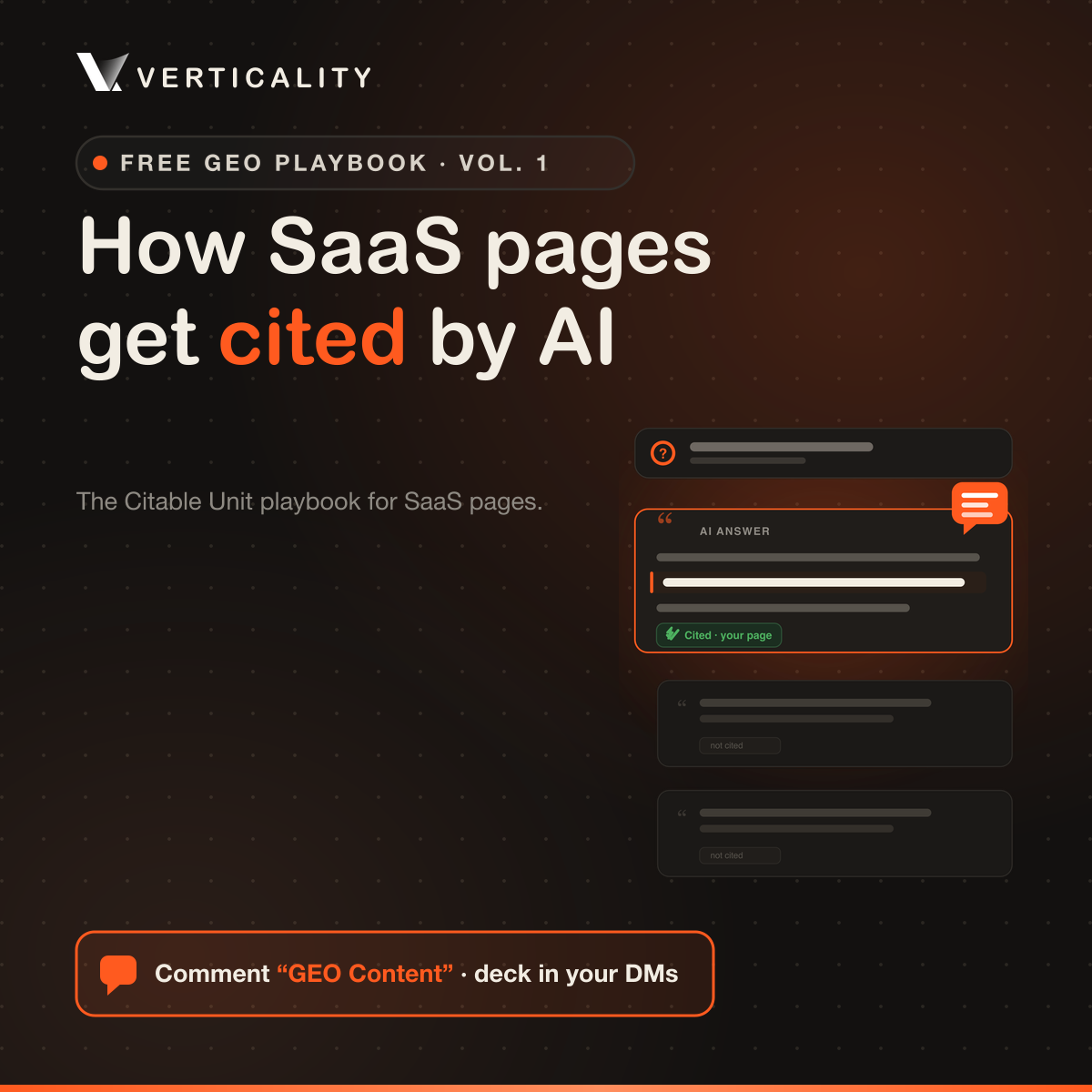
Ranking #1 on Google used to win the click. Now a Google AI Overview often answers the question before anyone reaches your site. For B2B SaaS, that shift hits your highest-intent pages first: product, pricing and integrations.
This is a guide to getting those pages cited by AI. Not ranked. Cited. The core technique is what we call the Citable Unit, and it changes how you write a single paragraph.
Ranking #1 no longer means getting the click
When a Google AI Overview appears, clicks to the #1 organic result drop by 58% (Ahrefs, December 2025). With an AI summary on the page, people click a result about 8% of the time, versus 15% when no summary is shown (Pew Research, 2025).
Your page can still rank first and lose the visit. The answer was delivered before the click.
AI search does not rank pages. It quotes paragraphs.
Classic Google reads your whole page and ranks it as one unit. AI search works differently. It cuts the page into paragraphs, scores each snippet on its own, and quotes the best few inside the answer.
So the question is no longer “is my page the best?” The question is “how many of my paragraphs are quotable on their own?” For most SaaS sites, the honest answer is close to none.
How AI actually retrieves a snippet
An AI engine fingerprints every snippet at indexing time, matches those fingerprints against the user’s question, pulls 20 to 50 candidate snippets, reranks them, and quotes the 3 to 5 winners. One strong paragraph is one shot at being cited. Five strong paragraphs are five shots.
The Citable Unit formula: Claim, Context, Proof, Takeaway
A Citable Unit is a paragraph an AI can lift word for word. It has four parts:
- Claim — answer the question in the first sentence. Always first.
- Context — for whom, when, which plan or use case.
- Proof — a real number or a named source.
- Takeaway — the next action the reader should take.
Lead with the answer. AI reads the start of a snippet to judge it, so if you bury the answer under a setup, the snippet gets skipped.
Same facts, one gets quoted
Here is the same information written two ways, for the query “How much does project management software cost?” (The product below, Northstar, is a fictional example used for illustration.)
A typical paragraph: “Pricing depends on your needs. Our platform delivers value at every stage of growth.” There is no number, so AI quotes the competitor who stated a price.
A Citable Unit: “B2B project management tools run $8 to $15 per user per month (G2 median, 2025). Northstar starts at $9 for teams up to 50, with SSO on every plan. Start with the 14-day trial.” That is a named price an AI can lift directly.
Structure pages as Entity, Property, Value
AI stores knowledge as triples: an entity, a property, and a value. Map that structure onto your page.
| Element | Role | Example |
|---|---|---|
| H1 | Entity | Northstar Analytics |
| H2 | Property | Data retention window |
| Paragraph | Value | 13 months, on every plan |
Every H2 should name a concrete property a buyer actually asks about. Never “Features” or “Why choose us.” Those headings carry no question for an AI to match.
Name the entity in every paragraph
AI lifts a snippet with zero surrounding context. Words like “it,” “this,” and “our platform” make the snippet useless on its own, so the model reaches for a competitor’s paragraph that named itself.
Write “Northstar syncs with Salesforce, HubSpot and Segment via native connectors,” not “it connects with all your favorite tools.” The named version works as a standalone fact.
A quick test: show one paragraph to a colleague with no page around it. If they understand it completely, ship it.
Give AI a reason to cite you, not a competitor
A thousand words carrying three unique facts beats five thousand words of common knowledge. Generic content is something the model already knows from ten other sites, so it has no reason to cite yours.
Five kinds of information are genuinely yours to give, strongest first:
- Your own product data
- Real customer outcomes
- Fresh data (your 2026 numbers against their 2023)
- A contrarian, defensible angle
- An original framework or method
The 3-fact uniqueness check
You can run this today on any page:
- Google the exact query you want to win.
- Open the top three results and list every fact they state.
- Check your page. Does it state at least three facts none of them have?
If it does not, add them. No unique facts, no citation.
Five principles to get cited by AI
- Self-contained — each paragraph works with no page context.
- Citable Unit — Claim, Context, Proof, Takeaway.
- Entity structure — entity, property, value across H1, H2, paragraph.
- Name everything — the product name, in every paragraph.
- Be unique — state facts the top results do not have.
Start with one page this week
Pick a single high-intent page. Rewrite three paragraphs as Citable Units. Add three facts your competitors do not state. Then watch where you land in AI answers over the next few weeks.
If you would rather we do it, our AI SEO service runs a Citable Unit audit on your highest-intent pages and rewrites them to be quotable. Ask for a free audit and we will check one of your pages first.