GEO vs SEO: What Generative Engine Optimization Changes
GEO gets a brand named and cited inside AI answers; SEO ranks its pages in a list of links. The two side by side, when each matters, and why teams run both.

Founder · Growth Lead
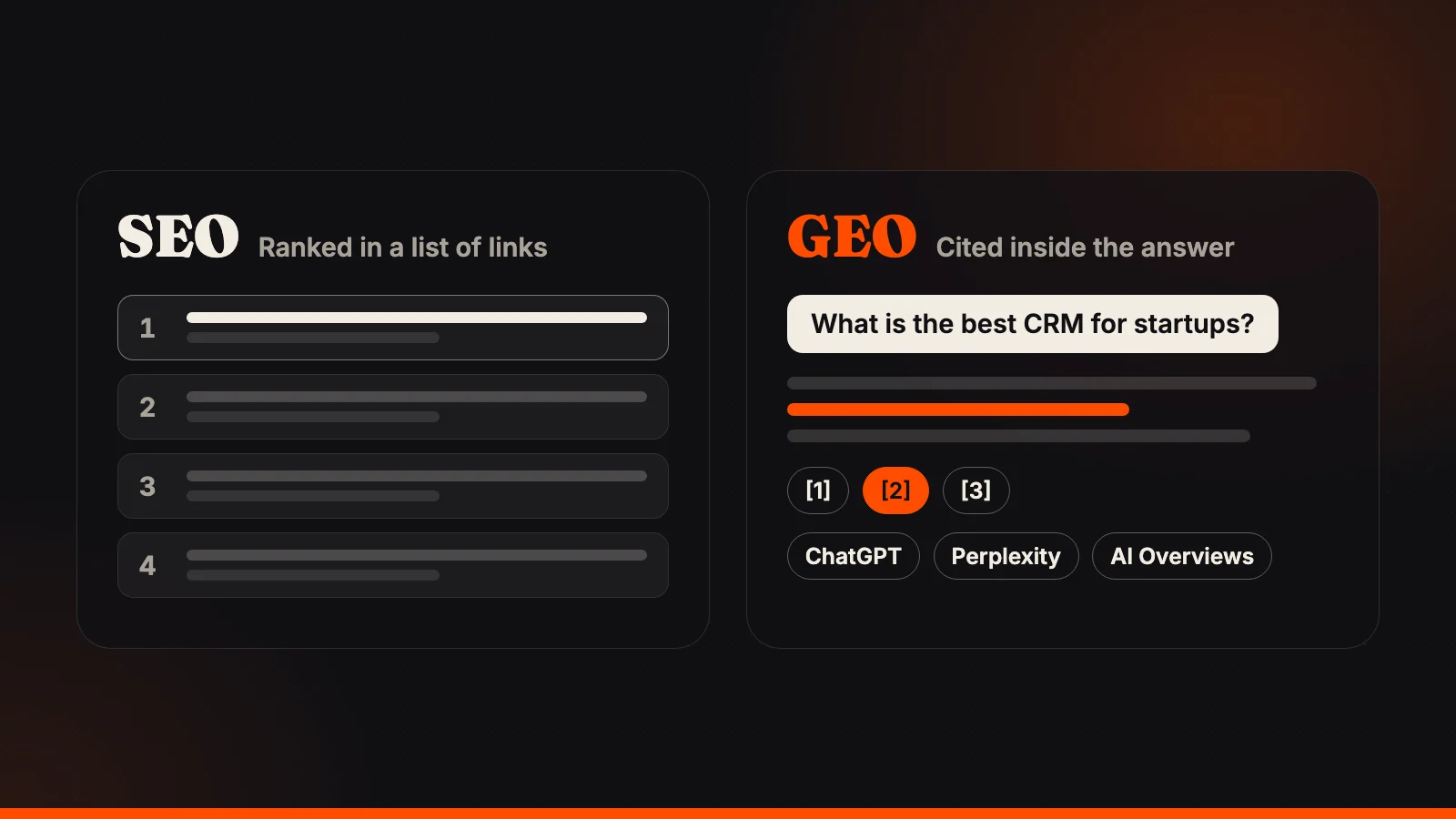
Generative engine optimization (GEO) is the work of getting a brand named and cited inside the answers that AI engines such as ChatGPT, Perplexity and Google AI Overviews write. Search engine optimization (SEO) is the work of getting a site’s pages ranked in the list of links that Google and Bing return. The “geo” in GEO has nothing to do with geography or geo-targeting, and GEO does not replace SEO: it is built on top of it.
What is generative engine optimization (GEO)?
Generative engine optimization makes a brand one of the sources an AI engine names or cites when it writes an answer to a buyer’s question. A GEO win is a mention or a citation inside that answer, and often the buyer never clicks through to any site.
The engines in scope are ChatGPT, Perplexity, Google AI Overviews and AI Mode, Gemini, Claude and Microsoft Copilot. The label comes from a 2023 research paper (arXiv:2311.09735), and the engines have adopted its acronym: across 11,635 answers that ChatGPT, Google AI Overviews and Perplexity gave to the 130 questions we track every day between 3 September and 3 October 2026, “GEO” appears 15,407 times and “generative engine optimization” spelled out 2,069 times. Our guide to generative engine optimization covers the paper and how each engine finds its sources.
What is SEO?
Search engine optimization makes a site’s pages crawlable and indexable, then earns them the highest possible position in the organic results of Google and Bing. An SEO win is a position on the results page and the visit that follows from it.
The work has three parts: technical health (crawling, indexing, rendering, speed), content that matches what people type into the search box, and authority, which still comes mostly from links. Every one of them stays in place when a team adds GEO.
GEO vs SEO: how do they compare side by side?
| SEO | GEO | |
|---|---|---|
| What the buyer sees | A page of ranked links with titles and snippets | One written answer that names a few brands and cites a few sources |
| Who picks the winner | Google’s and Bing’s ranking systems, one query at a time | A language model choosing passages from the pages its search step fetched, often several searches per question |
| How people ask | Short keyword queries | Full questions with context: budget, team size, the tools already in use |
| Main levers | Technical health, content matched to the query, internal links, backlinks | Facts stated plainly in the first lines of a section, one consistent description of the brand across the web, mentions on the third-party pages engines cite, access for each engine’s crawler |
| Unit of success | A position, and the click it earns | A mention or a citation, often with no click |
| Whose pages count | Mostly your own | Yours, plus the roundups, reviews, Reddit threads and directories in your category |
| What you report | Impressions, positions, organic sessions, conversions | Mention rate, share of voice per engine, citation sources, LLM referral sessions |
| Typical timeline | Months, page by page, as pages are recrawled and re-ranked | First signals in 4–8 weeks, compounding by month 3–6 |
The row that changes planning most is the second one. SEO work is largely shared between Google and Bing. GEO has a separate result for every engine, and the engines rarely agree: on the 56 AI-search buying questions we tracked from 4 to 23 September 2026, ChatGPT, Perplexity and Google AI Overviews cited at least one common URL on only 11.2% of question-days. So GEO is planned and reported engine by engine, not as one ranking.
Does ranking first on Google get you into AI answers?
Not reliably, and least of all in ChatGPT. Our tracker saves Google’s first page for each of the 130 buying questions we track every day. On the days that page was verified, ChatGPT linked to the page Google ranked first for the same question in 11.7% of its answers; Perplexity did in 42.4% and Google’s own AI Overviews in 43.0% (4 September to 4 October 2026, 6,724 question-days). Across the questions we track for other brands the figures were 10.1%, 53.9% and 51.8%.
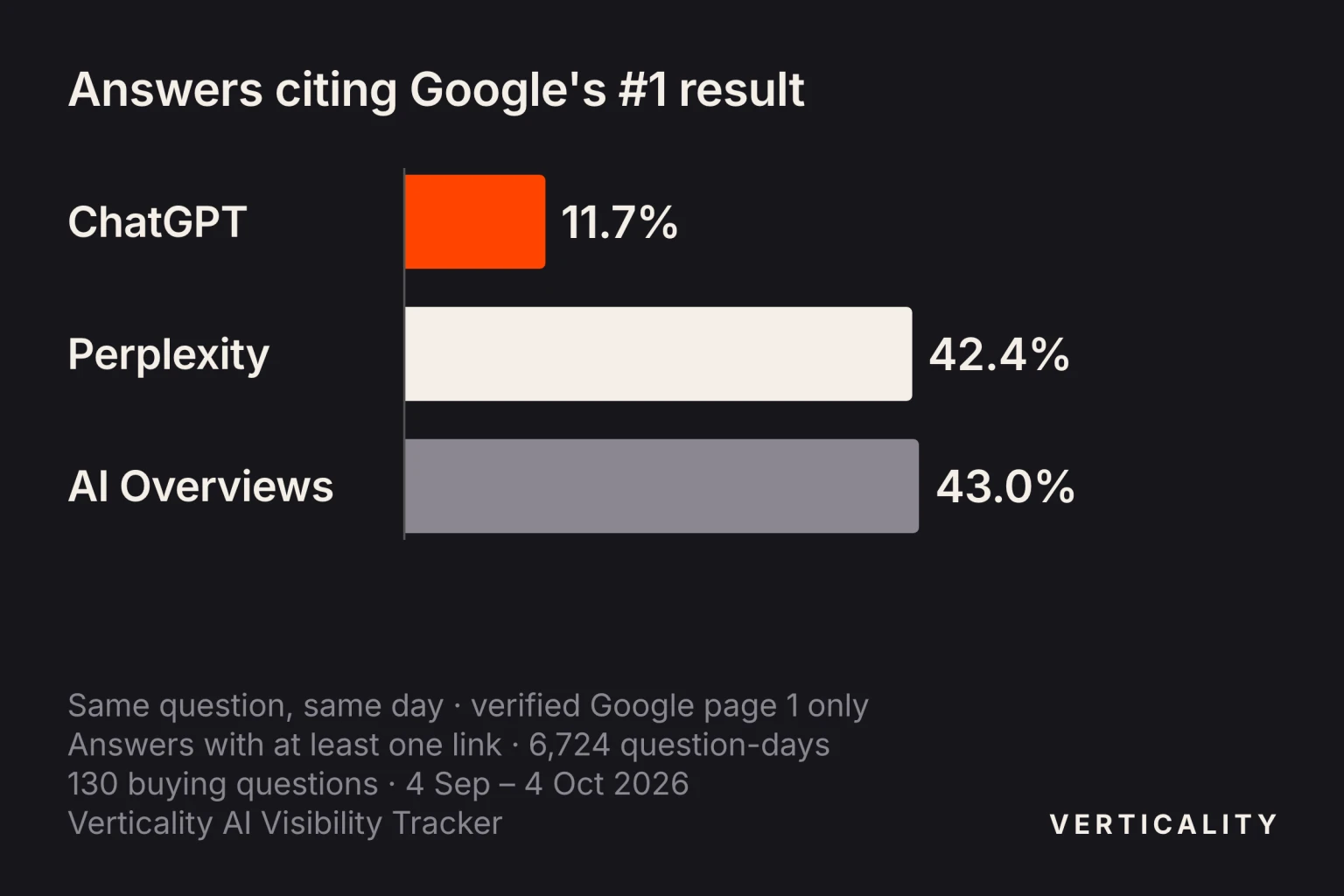
A first position on Google carries into Perplexity and AI Overviews about four times in ten, and into ChatGPT in fewer than one answer in eight.
A first position on Google is a good start for Perplexity and AI Overviews, which draw heavily on what already ranks. It says much less about ChatGPT, which rewrites the question into its own searches and usually cites other pages. Google’s results here are for the full question as typed, not for the shorter searches a buyer or an engine would run, and our guide on why AI recommends competitors instead of your brand measures the same gap from the other side: how many of the pages each engine cites rank in Google’s top 10 at all.
When should GEO be your priority?
- Your buyers ask AI before they search. Considered purchases such as B2B software, agencies and high-ticket DTC products start with “what are the best options for…” in a chat window, and the shortlist in that answer is the first filter.
- The answers in your category already name a shortlist, and you are not on it. Ask ChatGPT, Perplexity and Google the ten questions your sales team hears most often and write down who gets named. If competitors appear and you do not, that gap is a GEO problem, not a ranking problem.
- You rank well and AI still leaves you out. Ranking and being recommended are related but separate. In a one-day sample of 1,126 citations behind AI answers to GEO buying questions (3 September 2026), 63.6% went to articles and roundups and 21.0% to vendor and agency sites, so much of the work moves off your own site.
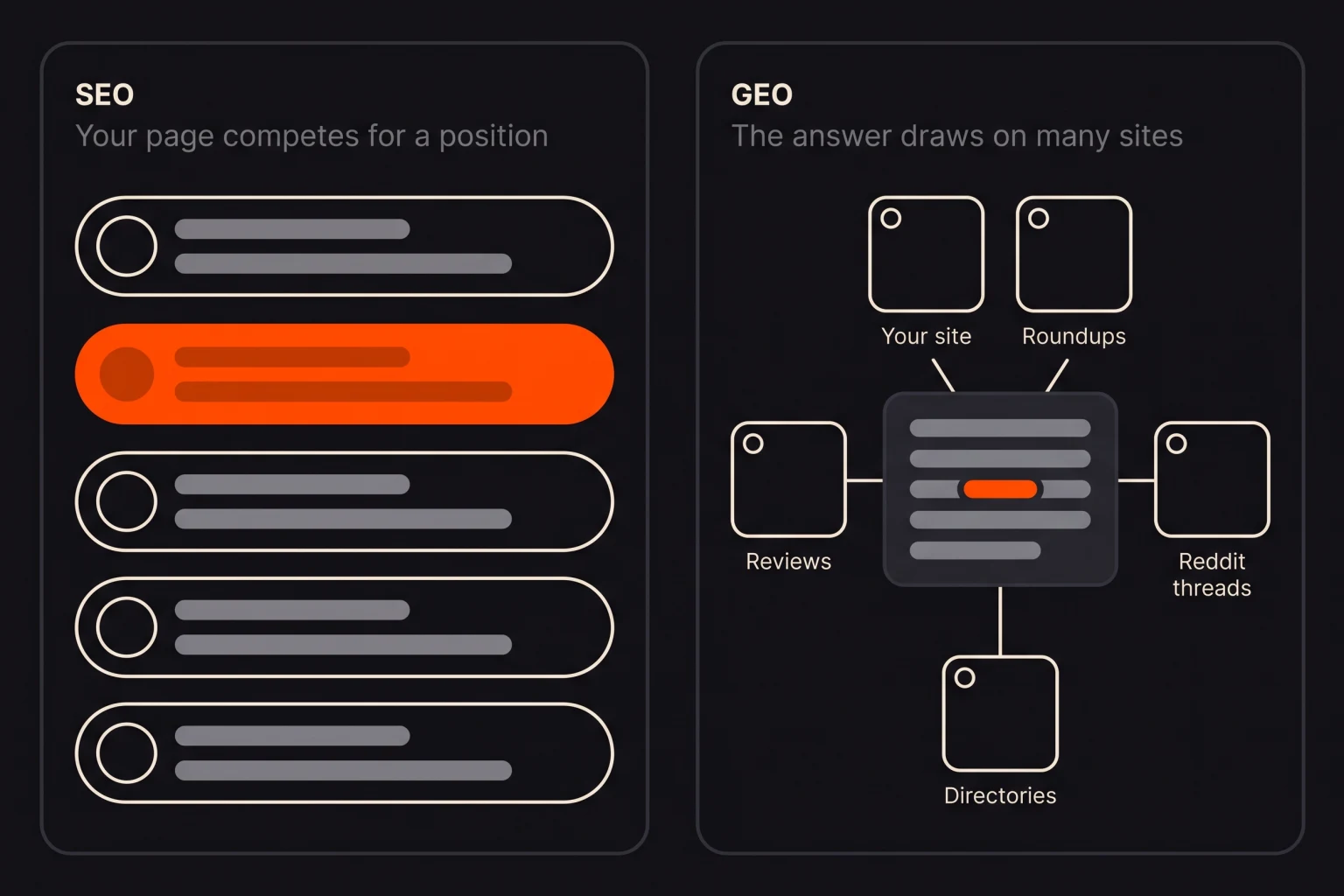
In SEO your page competes for a slot; in GEO the answer about you is assembled from other people’s pages as well as yours.
This is the scope of a GEO programme: a fixed set of buyer questions, the pages and third-party sources that decide each answer, and a report per engine.
When should SEO be your priority?
- Your pages are not indexed yet. Google’s rule for its AI features is explicit: “To be eligible to be shown in generative AI features on Google Search, a page must be indexed and eligible to be shown in Google Search with a snippet” (Google Search Central). Until that is true, no GEO work can put the page into an AI Overview.
- Demand is transactional and high-volume. People who search for a product name or “buy” plus a category want a product or category page and a checkout, and the ranked list is still where that click happens.
- You sell locally. A walk-in business wins on its Business Profile, reviews and city pages, which is local SEO.
- Google sends most of your traffic. Google says its generative AI features are “rooted in our core Search ranking and quality systems”, so on Google the SEO work is most of the GEO work.
How do GEO and SEO work together?
They share a foundation: pages that can be crawled and indexed, a brand described the same way on its own site and on its profiles, content specific enough to be worth quoting, and authority earned from other sites. Microsoft puts it in its own guidelines: “SEO best practices that support discovery, indexing accuracy, and content clarity also support eligibility for AI-generated experiences, grounding results, and citations” (Bing Webmaster Guidelines).
GEO adds four things SEO does not cover. Each AI engine’s crawler needs access: OAI-SearchBot for ChatGPT search, PerplexityBot for Perplexity. Bing’s index matters on its own: Microsoft says Copilot relies on the same crawling, indexing and ranking foundation as Bing search, and Bing is one of the inputs to ChatGPT search. The third-party pages the engines cite become targets. And reporting moves from rankings to a fixed question set measured per engine, as described in how to measure AI visibility.
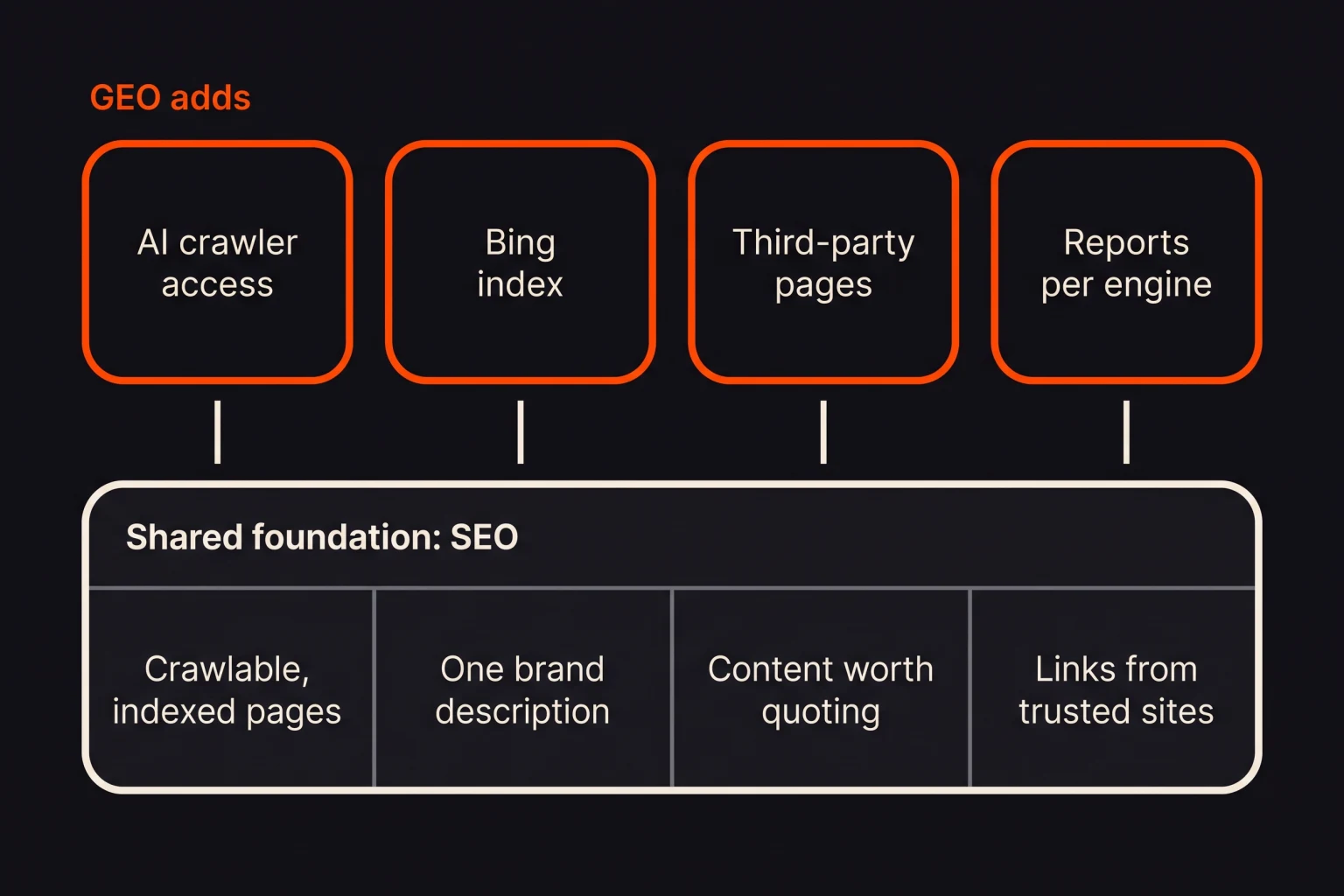
Everything in the bottom row is SEO work that GEO depends on; the top row is what a GEO programme adds.
The engines themselves describe the two as layers, not rivals. In 30 days of answers to our 130 tracked questions, neither ChatGPT nor Perplexity said that GEO or AEO replaces SEO, and 66 of their answers said explicitly that it does not; Google’s AI Overviews were the exception, telling the reader to shift from traditional SEO to GEO or AEO in 30 answers.
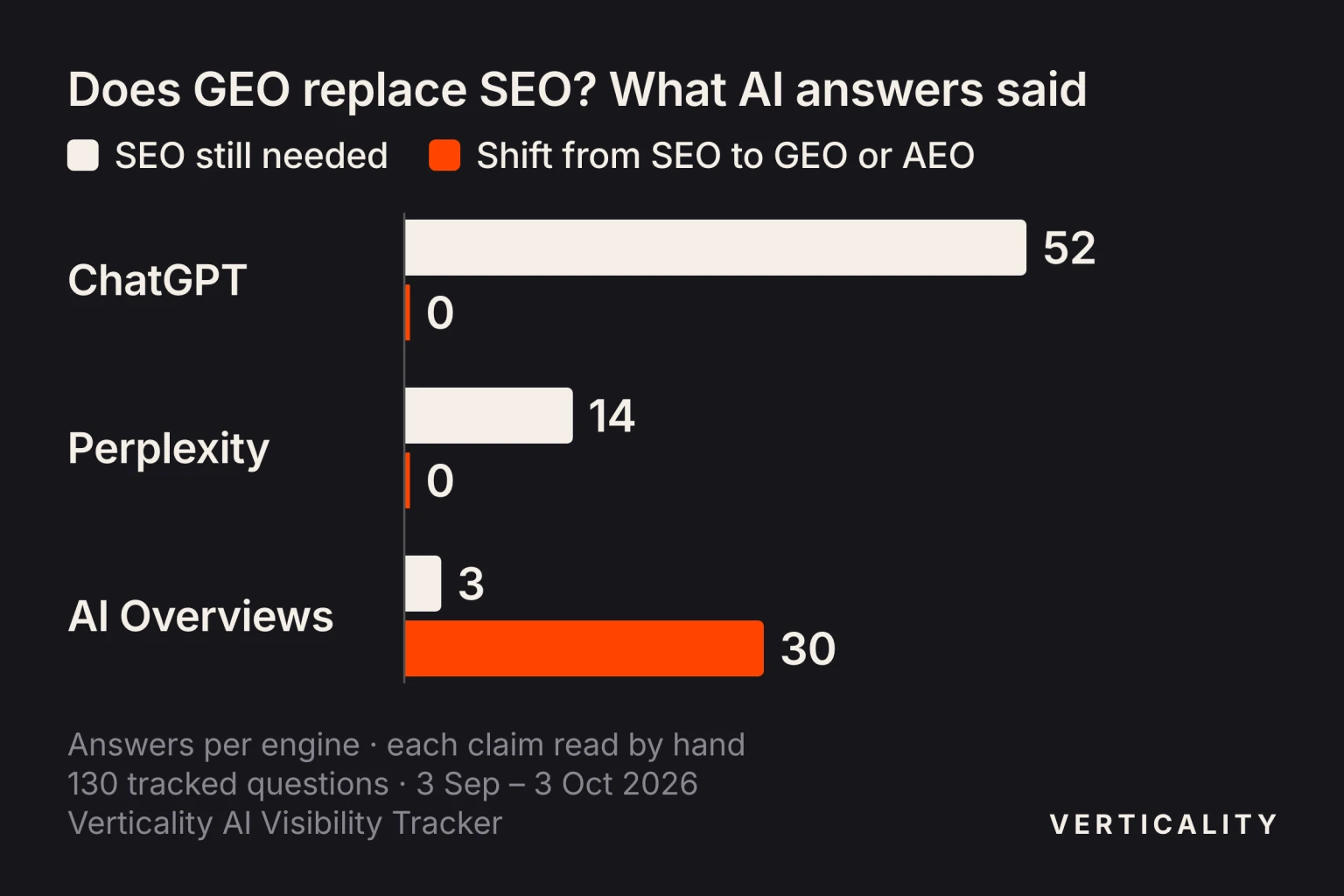
In a month of answers ChatGPT and Perplexity never told the reader to move from SEO to GEO; Google’s AI Overviews did 30 times.
For budget and ownership, that points to one decision: keep SEO where it is and add GEO as its own line, with its own question set and its own report.
Two neighbouring labels sit in the same stack. Answer engine optimization (AEO) focuses on being the single direct answer, in AI Overviews, featured snippets and voice assistants, and has its own comparison in AEO vs SEO. LLM SEO looks at how each large language model finds and names brands, model by model, as covered on our LLM SEO page. How the three labels divide the work is set out in AEO vs GEO.
Frequently asked questions
What is GEO vs SEO?
GEO vs SEO is the difference between being named inside an AI-written answer and being ranked in a list of links. Generative engine optimization (GEO) targets ChatGPT, Perplexity, Google AI Overviews and the other AI engines and counts mentions and citations; search engine optimization (SEO) targets the organic results of Google and Bing and counts positions and clicks. GEO is built on top of SEO, not instead of it.
What does GEO mean in SEO?
In SEO and digital marketing today, GEO almost always means generative engine optimization: work that makes AI search engines cite or recommend a brand. It is also much of what people mean by AI SEO. In ads and local SEO, "geo" still refers to location, as in geo-targeting a campaign to a city; that meaning is unrelated.
Is GEO going to replace SEO?
No. In 30 days of answers to the 130 questions we track (3 September to 3 October 2026), neither ChatGPT nor Perplexity said that GEO or AEO replaces SEO, and 66 of their answers said outright that it does not. Google describes its AI features as rooted in its core Search ranking and quality systems, and Microsoft's Bing guidelines have a section titled "SEO Fundamentals Still Apply to Grounding and AI Experiences".
Is SEO dead now with AI?
No, but it no longer covers every place buyers look. On Google, AI Overviews draw on the same index and ranking systems as the blue links, and in our tracking they cited the page Google ranked first for the same question in 43.0% of answers; Perplexity did in 42.4%. ChatGPT did in only 11.7%, so ranking well is still the base and GEO is the work that reaches the answers ranking does not.
Do I need both GEO and SEO?
Most brands do. SEO gets pages indexed and ranked, and Google will not show a page in AI Overviews or AI Mode until it is indexed and eligible for a snippet. GEO covers what SEO leaves out: ChatGPT and Perplexity, the third-party pages AI answers quote, and mentions measured per engine. With both in place, we see first signals in 4–8 weeks and compounding by month 3–6.
How is GEO measured, and what do I show leadership?
Fix a set of buyer questions, run them on each AI engine on a schedule, and report four numbers: mention rate (how often the brand is named), share of voice against named competitors, citation sources (the pages the answers rely on) and LLM referral sessions in analytics, which ChatGPT tags with utm_source=chatgpt.com. Put them next to the SEO report, so leadership sees rankings and AI mentions side by side.
Related pages
AEO vs SEO
Answer engine optimization next to SEO: the direct answer, the snippet and the voice reply.
What is generative engine optimization?
The definition, the 2023 paper that named it, and how each AI engine finds its sources.
How to measure AI visibility
Mention rate, share of voice and citation sources, with the question set behind them.
GEO agency
How we run a GEO programme for B2B SaaS and DTC brands, engine by engine.
Want your brand named in AI answers?
Our free AI visibility audit asks ChatGPT, Perplexity and Google AI Overviews the questions your buyers ask, shows who gets named instead of you and which sources they cite, and ends with a ranked work plan.
Get a free AI visibility auditNot ready for a call? Run the free AI visibility checker: 40+ buyer questions in ChatGPT and Google AI Overviews, report by email within 24 hours.