AEO vs GEO: What's the Difference, and Where LLM SEO Fits
AEO wins the direct answer an engine lifts from one page; GEO wins a cited place inside an AI-written answer. Side by side, with SEO and LLM SEO placed.

COO · AI Search & Data Architecture
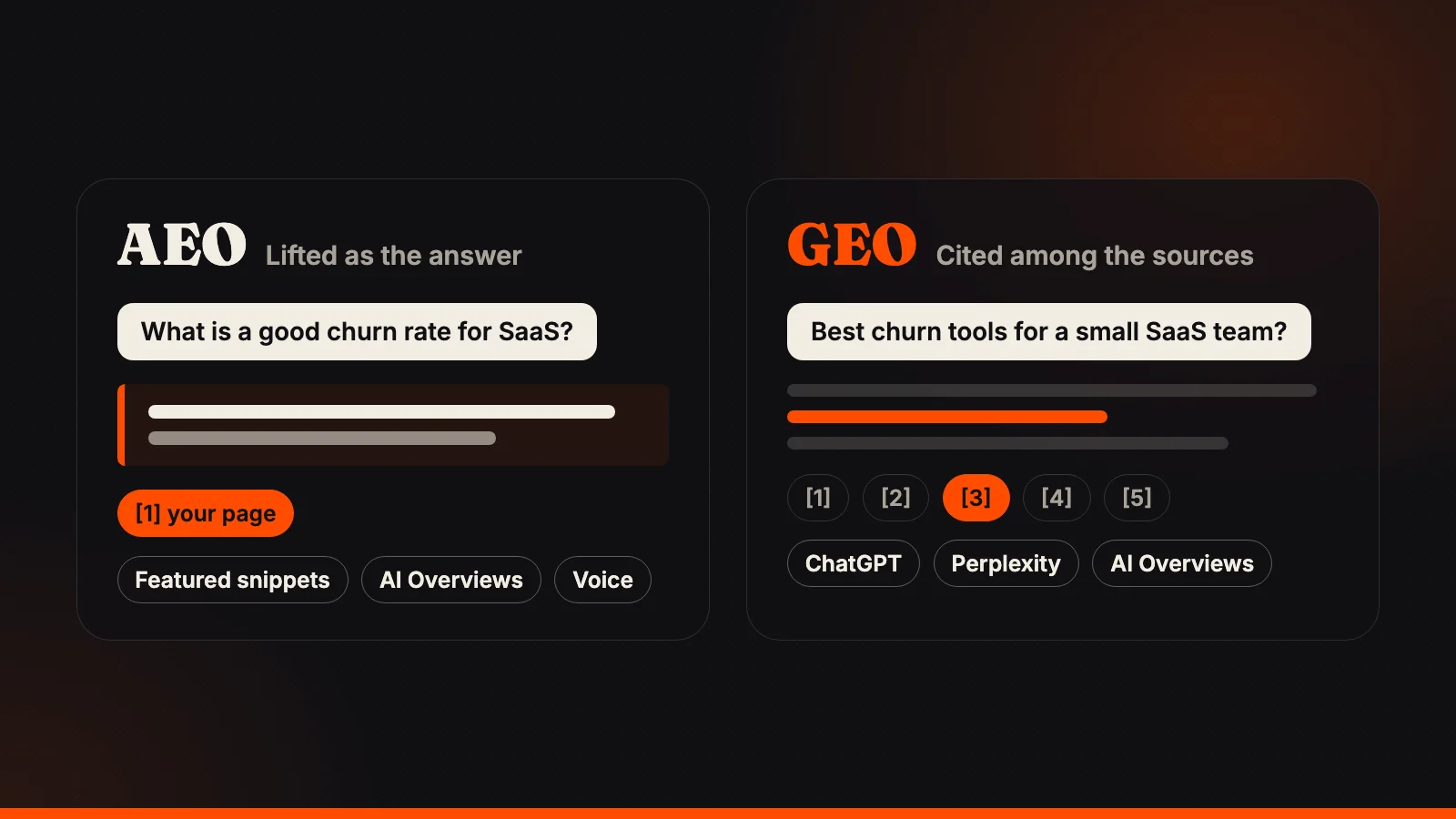
AEO vs GEO comes down to the shape of the answer. Answer engine optimization (AEO) is about one passage of your page being lifted as the reply to a question: a featured snippet, a voice answer, the sentence an AI Overview quotes. Generative engine optimization (GEO) is about your brand being named, and your pages cited, when an AI engine writes its answer from several pages. The two overlap rather than nest, both sit on top of SEO, and the “geo” in GEO means generative, not geographic.
What is answer engine optimization (AEO)?
Answer engine optimization is the editing that lets a search engine or an AI assistant pull a self-contained passage out of your page and hand it to the person asking. You have won when the reply uses your wording and gets your facts right.
The label is older than ChatGPT. In February 2018 Search Engine Watch wrote that voice search was turning search engines into “answer engines”, and that optimizing for them “has come to be known as AEO”. The AI engines still describe it that way. Our tracker puts “What’s the difference between GEO, AEO and LLM SEO?” to ChatGPT, Perplexity and Google AI Overviews daily; of the 89 answers collected from 3 September to 3 October 2026, just 12 placed AEO on AI surfaces at all. The unit of AEO is one question and the passage that answers it.
What is generative engine optimization (GEO)?
Generative engine optimization is the work of getting an AI engine to rely on your brand while it composes a reply: to name you in the text and to list your pages among its sources. You have won when you are in that reply, even if nobody clicks.
The name traces to a 2023 research paper (arXiv:2311.09735), presented at KDD 2024, that measured how far rewriting a page moved its visibility inside generated answers. It applies wherever an engine writes rather than lists: ChatGPT, Perplexity, Gemini, Claude, Microsoft Copilot, and Google’s AI Overviews and AI Mode. A generated answer blends several pages, so the unit of GEO is the brand across everything the engine reads about it, much of it on other people’s sites. The paper and the engines’ retrieval are covered in our explainer on generative engine optimization.
How do AEO and GEO differ, row by row?
| AEO | GEO | |
|---|---|---|
| The question you ask | Can an engine lift my answer to this question? | Will an AI answer name my brand and cite my pages? |
| Shape of the answer | One passage, often quoted close to word for word | A written answer assembled from several sources |
| What you optimise | A question and the passage that answers it | The brand, across every page the engine reads about it |
| Whose pages count | Mostly yours | Yours, plus reviews, roundups, forums and directories |
| Where it shows | Featured snippets, People Also Ask, voice replies, the quoted line in an AI Overview or chat answer | ChatGPT, Perplexity, Google AI Overviews and AI Mode, Gemini, Claude, Copilot |
| Main levers | The answer in the first sentence, headings worded as the question, FAQ blocks, the number or date stated inside the sentence | One consistent positioning line, original facts and data, mentions on the pages engines cite, crawler access for each engine |
| What success looks like | Your wording is the answer, and it is right | Your brand is on the shortlist and your pages are among the sources |
| What you measure | Per question: quoted or not, accurate or not | Mention rate, share of voice for each engine, the citation sources behind each answer |
| What goes wrong | An old price or a retired plan read out as the answer | Competitors named, you left out |
Read down the “whose pages count” row first. AEO is mostly editing your own site. GEO sends much of the work to other people’s pages, which is why it needs its own sources list and its own report.
Is AEO a part of GEO?
Not as a strict subset, and the people who define the terms do not agree either. Wikipedia treats AEO as an alternative name for GEO. Google’s guide names both and then folds them back into its own discipline: “From Google Search’s perspective, optimizing for generative AI search is optimizing for the search experience, and thus still SEO” (Google Search Central, updated 10 July 2026).
Microsoft changed its wording in public. Microsoft Advertising launched its playbook in January 2026 as “From Discovery to Influence: A Guide to AEO and GEO”, and it defined AEO as optimizing “content for AI agents and assistants (like Copilot or ChatGPT)” (the January playbook). By the end of March 2026 the announcement post had been retitled “A Guide to GEO”, and the reissued playbook does not mention AEO once. Bing’s webmaster guidelines use only GEO.
The AI engines disagree with each other on the hierarchy. In the same 89 answers, 37 called LLM SEO the broader term, 7 gave that role to GEO and 2 to AEO, and Perplexity said outright that sources disagree in 21 of its 30 answers. Where all three engines agreed was the split itself: 86 of the 89 answers drew the line between being the direct answer (AEO) and being cited or included in a generated answer (GEO).
Our reading: the two overlap without one containing the other. A featured snippet or a voice reply involves no generation, so it is AEO with no GEO in it. A ChatGPT shortlist of five tools built from several reviews has no single extracted answer, so it is GEO with no AEO in it. Everything between those two poles takes both kinds of work.
Where do AI Overviews, ChatGPT and Perplexity belong?
Sorting engines into an AEO bucket and a GEO bucket is where most explanations break, and Google’s own AI Overview shows why. When we captured it on 3 September 2026, the AI Overview for “aeo vs geo” placed “Google AI Overviews” under GEO. On 3 October 2026 the AI Overview for “geo vs aeo” listed “Google AI Overviews” as an AEO platform, while the same day’s AI Overview for “aeo vs geo” filed “synthesized overviews” under GEO.
The product does not decide; the job does. Google describes AI Overviews and AI Mode as issuing “multiple related searches across subtopics and data sources” before writing a response (Google Search Central). The same feature can quote a single passage for a narrow fact and cite several pages for a broad comparison. Ranking alone no longer predicts which pages it picks: Ahrefs found that 38% of pages cited in AI Overviews also rank in the top 10 for the same query, against about 76% in its July 2025 study (Ahrefs, March 2026, with a changed parsing method).
A worked example makes the split concrete. Take a made-up invoicing tool, Acme.
- The AEO question: “Does Acme integrate with QuickBooks?” The engine wants one passage, and the winning page opens its integrations section with “Yes. Acme syncs invoices and payments with QuickBooks Online in both directions.” The work is on Acme’s own page: the answer first, under a heading that matches the question.
- The GEO question: “What’s the best invoicing tool for freelancers who use QuickBooks?” The engine runs several searches, reads review sites, a Reddit thread, two roundups and the vendors’ pages, and names three or four tools. Acme gets named only if those sources describe it the same way: who it is for, and the QuickBooks sync. Most of that work happens on pages Acme does not own.
The same split shows up in the question this page answers. ChatGPT answered “What’s the difference between GEO, AEO and LLM SEO?” from memory in all 30 of its daily runs, with no web search and no citation. Over the month, the other two engines cited 71 URLs on 53 domains, and two agency pages appeared in 56 and 55 of the 57 answers that cited anything. Whoever wrote those two pages holds the GEO position on this question today.
Where do SEO and LLM SEO fit?
SEO is the layer under both. An engine cannot lift a passage it has not crawled, and Google admits a page to its AI features only after it is indexed and can be shown with a snippet. As a three-way stack, the labels read: SEO earns a ranked link, AEO earns the direct answer, GEO earns a cited place inside the generated answer. Every rung rests on the rung below, which makes SEO vs GEO vs AEO a sequence more than a choice. Our GEO vs SEO and AEO vs SEO pages compare each layer with the list of links.
LLM SEO is the same work seen model by model: how ChatGPT, Gemini, Claude and Perplexity each find sources, which crawler each one uses and what each remembers about a brand. It is also the label the engines most often called the umbrella term. We use the three labels the way our service pages do: GEO for the citation programme, AEO for the answer layer on your own pages, LLM SEO for the per-model mechanics.
Which one should you prioritise?
Prioritise AEO when:
- Your demand arrives as factual questions. “How much does…”, “does it work with…” and “how long does…” queries are answered on the results page itself, and whichever page provides the wording collects the credit.
- AI states your facts wrongly. A stale price, a discontinued plan or a misdescribed audience in an AI Overview is an AEO problem, fixed on the pages engines quote. Our AEO agency starts there.
- You rank, but the answer is buried. A page that holds a top position and opens with three paragraphs of context rarely gets lifted.
Prioritise GEO when:
- Buyers ask for shortlists. “Best X for Y” and “alternatives to Z” answers name a handful of brands, and that shortlist is the first filter of the purchase.
- ChatGPT and Perplexity matter in your category. They answer from their own retrieval, so a strong Google position does not carry over automatically.
- The cited sources are not yours. When the replies about your category lean on roundups, reviews and Reddit threads, the work moves to those pages, which is what our GEO programme covers.
How do AEO and GEO work together?
Most of the work is shared: pages that engines can crawl and index, one description of the brand used everywhere, and facts written so they can be quoted without the surrounding paragraph. AEO adds question-by-question editing and an accuracy check on what engines say. GEO adds the third-party sources, crawler access for each engine and tracking over one fixed list of buyer questions.
Treat them as one programme with two measurements. For each buyer question, record whether your passage is the answer and whether it is correct; for each engine, record your mention rate, your share of voice against the competitors you track and the sources behind the answers. Our guide to measuring AI visibility sets out the question set and the formulas. On that basis we see first signals in 4–8 weeks and compounding by month 3–6.
Frequently asked questions
What's the difference between GEO, AEO and LLM SEO?
AEO (answer engine optimization) makes one passage of your page the direct answer an engine gives to a question. GEO (generative engine optimization) makes your brand one of the sources an AI-written answer cites and names. LLM SEO looks at the same work model by model: how ChatGPT, Gemini, Claude or Perplexity each find, trust and describe a brand. All three sit on top of SEO, and most programmes run them together.
Are AEO and GEO the same thing?
Not quite, though the work overlaps heavily. Wikipedia treats the two as one practice under different names, and Google files both under SEO. The useful line is the shape of the answer: AEO targets the single extracted answer, GEO targets a place among several cited sources. A featured snippet is pure AEO; a ChatGPT shortlist of five tools is pure GEO.
Is AEO replacing SEO?
No. Answer engines lift passages from pages they can already crawl and index, and Google's own guide classes work for its AI features as SEO. What AEO changes is how a ranking page is written: the answer to each question in the first sentence of its section, with the facts stated plainly enough to be quoted.
Is GEO better than SEO?
Neither is better; they win different things. SEO earns a position and a click in the list of links. GEO earns a mention and a citation inside the answer, frequently without any click. If your buyers ask ChatGPT or Perplexity for shortlists, GEO covers ground SEO cannot reach. If they search and click, SEO stays the bigger lever.
How do you do AEO and GEO together?
Start from one list of buyer questions. For each question shaped like a fact, rewrite the page so the answer opens its section and check that engines quote it correctly. For each question shaped like a shortlist, find the sources the engines cite and make sure they describe you the same way your site does. Report both on the same question set; we see first signals in 4–8 weeks and compounding by month 3–6.
Related pages
Answer engine optimization agency
Being the answer Google AI Overviews, AI Mode and ChatGPT extract, and keeping it accurate.
GEO agency
The citation programme across every AI engine, with the third-party sources behind it.
LLM SEO agency
How each large language model finds, trusts and names brands, model by model.
GEO vs SEO
Generative engine optimization next to the list of links: what changes and what stays.
Want your brand named in AI answers?
Our free AI visibility audit asks ChatGPT, Perplexity and Google AI Overviews the questions your buyers ask, shows who gets named instead of you and which sources they cite, and ends with a ranked work plan.
Get a free AI visibility auditNot ready for a call? Run the free AI visibility checker: 40+ buyer questions in ChatGPT and Google AI Overviews, report by email within 24 hours.