AEO vs SEO: What Answer Engine Optimization Changes
AEO makes a page the direct answer an AI assistant, snippet or voice reply gives; SEO ranks it in a list of links. Side by side, when each matters, how to run both.

Founder · Growth Lead
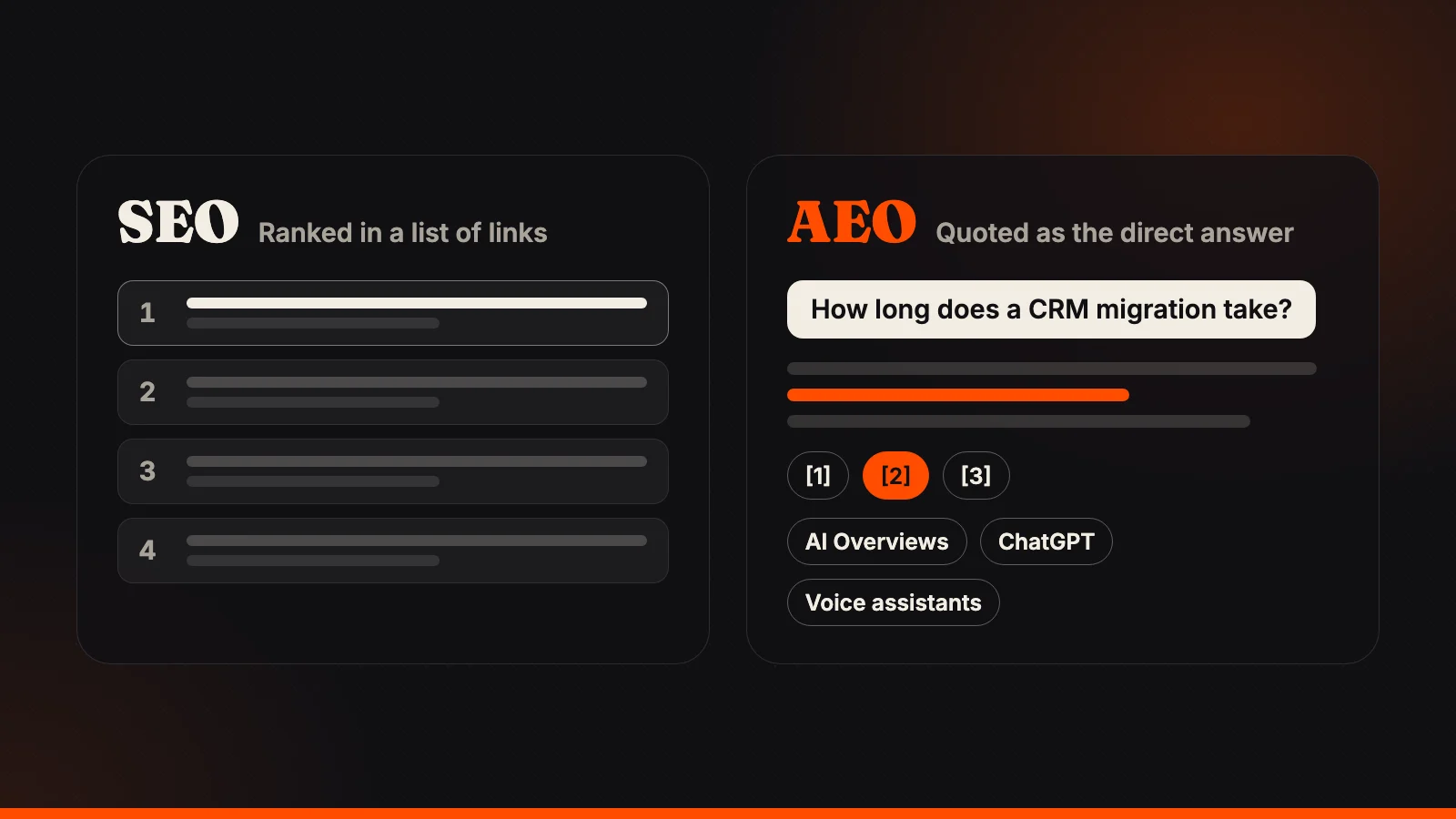
Answer engine optimization (AEO) is the work of making a page the source an answer engine quotes when it answers a question directly, whether in Google AI Overviews, a featured snippet, a ChatGPT reply or a voice assistant. Search engine optimization (SEO), by contrast, ranks that page in the list of links below the answer. AEO does not replace SEO: answer engines quote pages that a search step has already found, so ranking stays the entry point.
What is answer engine optimization (AEO)?
Answer engine optimization shapes a page so that an engine can lift a complete, correct answer from it and give that answer to the person asking, as a sentence on screen or a spoken reply. An AEO win is being the quoted answer with your facts stated correctly, and the person often has what they need without visiting any site.
Answers appear in more places than the ten blue links: Google AI Overviews and AI Mode, featured snippets and People Also Ask boxes, ChatGPT, Perplexity, Gemini, Claude, Microsoft Copilot, and voice assistants that read out one answer. The AI engines draw the same line. Asked “What’s the difference between GEO, AEO and LLM SEO?” every day, ChatGPT, Perplexity and Google AI Overviews tied AEO to featured snippets, People Also Ask or voice assistants in 86 of their 89 answers between 3 September and 3 October 2026.
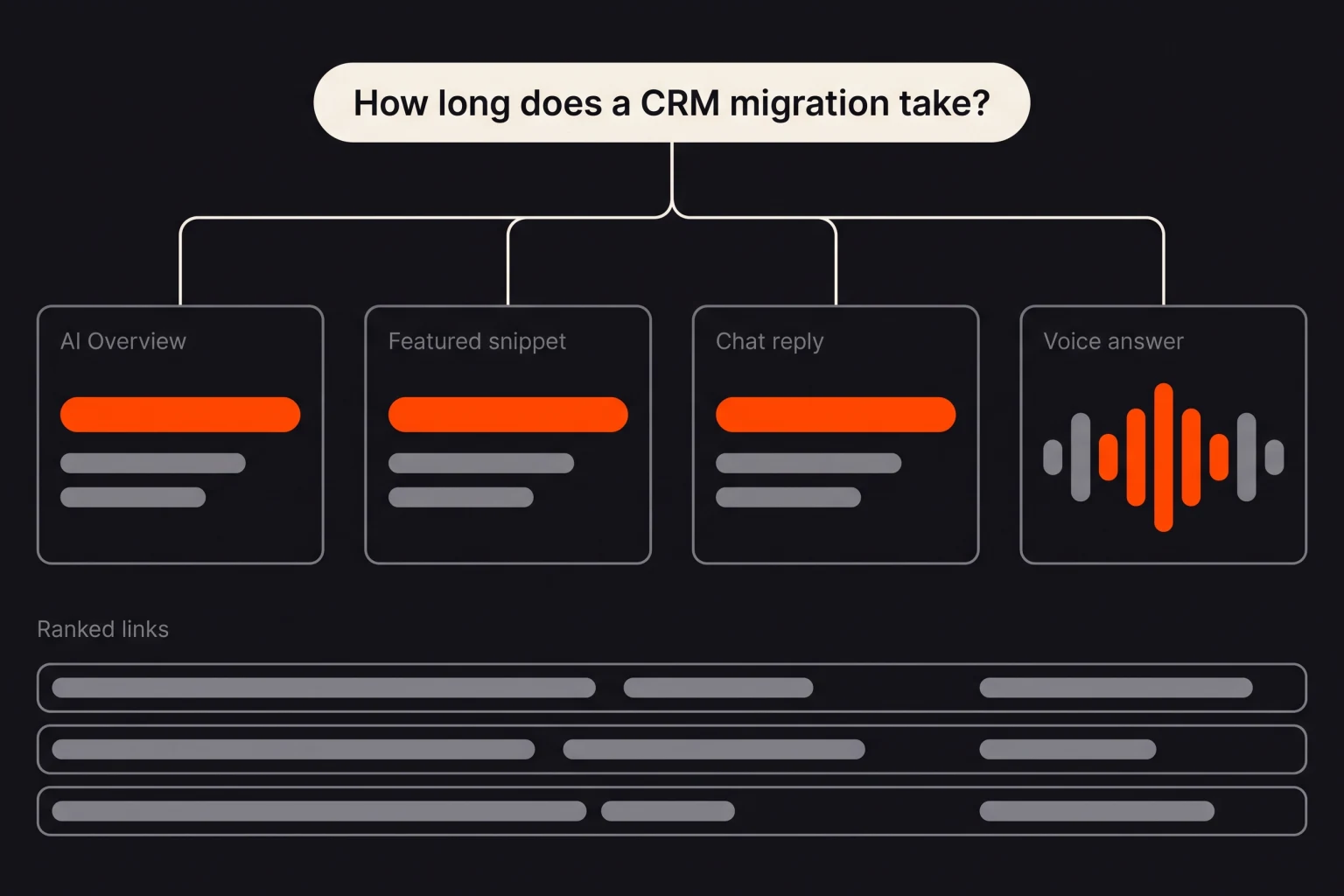
The same passage can be the answer in an AI Overview, a snippet, a chat reply and a spoken reply; the ranked links sit underneath.
They also treat AEO and GEO as close relatives. In 11,635 answers to the 130 questions we track daily over the same month, “AEO” appears 5,236 times and the engines write GEO and AEO side by side (“GEO/AEO”, “GEO and AEO”) 1,863 times, against 433 uses of the full “answer engine optimization (AEO)”. Google’s own guide groups them the same way: “These are both terms you may see used to describe work specifically focused on improving visibility in AI search experiences” (Google Search Central).
What is SEO?
Search engine optimization earns organic positions for a site’s pages in Google and Bing. It covers three jobs: keeping pages crawlable, indexed and fast, matching content to the words people search with, and building the authority that links from other sites carry. An SEO win is a ranking, and the visit that ranking brings.
AEO vs SEO: how do they compare side by side?
| SEO | AEO | |
|---|---|---|
| Where the result appears | Organic results: ranked links with titles and snippets | A direct answer: an AI Overview, a featured snippet, a chat reply or a spoken response |
| Who chooses | A ranking system ordering whole pages | An answer engine choosing the passage that answers the question best |
| Query shape | Keywords: “crm migration cost” | Questions: “how long does a CRM migration take for a 50-person team?” |
| What you change | Titles, internal links, backlinks, technical fixes | The opening sentence of each section, question-shaped headings, FAQ blocks, explicit numbers, dates and prices |
| Unit of success | A ranking and the click | Being the quoted answer, often with no click |
| Main risk | Losing positions to a competitor | Being quoted wrongly: an old price, a retired plan, a competitor’s feature attributed to you |
| What you report | Impressions, positions, organic sessions | Mention rate, share of voice per engine, citation sources, LLM referral sessions, and whether the answer is correct |
| Typical timeline | Several months for a new page to settle into its position | First signals in 4–8 weeks, compounding by month 3–6 |
The “main risk” row is the one SEO teams tend to miss. A ranking can be wrong only in its position, while an answer can be wrong in its content: when an engine summarises your pricing page from last year, the buyer reads the old number as a fact. An engine can even attach another company’s facts to your name: in August 2026, all three ChatGPT answers we collected to “Verticality pricing plans explained” described the plans of Vertically AI, a project-management tool, because no page of ours answered that question directly (how we corrected it). AEO therefore includes keeping every page an engine might quote current and consistent with the others.
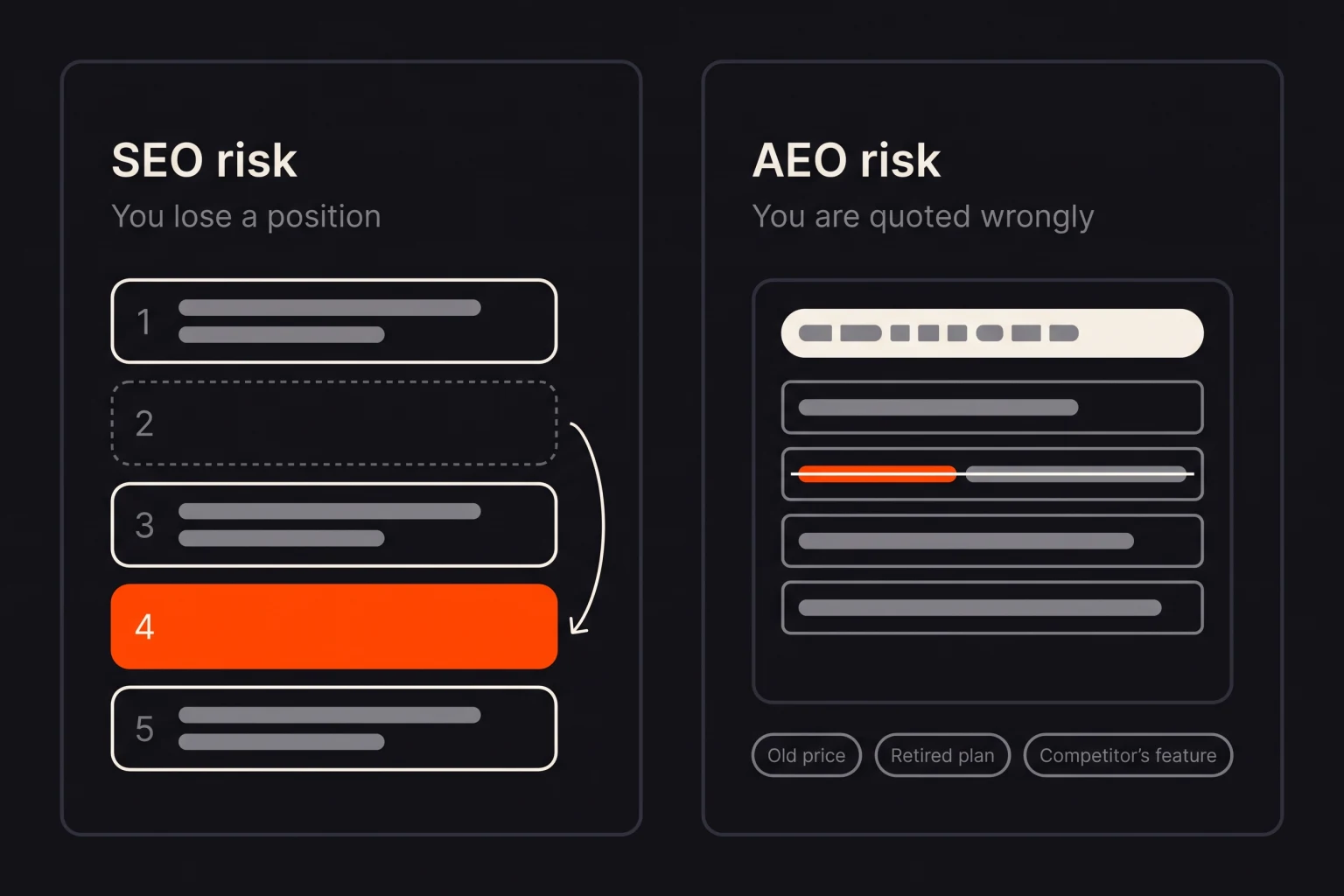
An SEO loss shows up as a lower position; an AEO loss shows up as a wrong sentence about you that reads like a fact.
One lever is often oversold. Structured data helps engines read facts such as prices, ratings and opening hours, but Google says plainly that “Structured data isn’t required for generative AI search, and there’s no special schema.org markup you need to add.” The quotable sentence on the page matters more than the markup around it.
What does AEO vs SEO look like on a real page?
Our own GEO agency page shows the difference. Under its heading it carries five short fact rows (who the programme is for, what it includes, the price, how we work and the timeline), each written as a complete sentence. When our tracker asked ChatGPT “Recommend a GEO agency that gets brands cited in ChatGPT and Perplexity” on 23 September 2026, the answer named Verticality and restated two of those rows almost item for item: “They explicitly work on Reddit threads, roundups, third-party articles, entity/schema work, and citation tracking, with pricing published from $2,500/month.”
By the usual SEO measure the page did not exist for that question: verticality.co was not on Google’s first page for it that day. Between 20 September and 4 October, ChatGPT cited the page in 20 answers on days when we could verify Google’s first page for the same question, and the page was not in Google’s top 10 on any of them. It still had to be found by a search, ChatGPT’s own, but it did not need a top-10 Google ranking to become the answer. What it needed was the answer stated plainly, in a sentence an engine could lift.
When should AEO be your priority?
- Your demand arrives as questions. “How long does…”, “what does it cost to…”, “is X worth it for…” and “X vs Y” queries are the ones answer engines answer in place, and the page that supplies the answer gets the credit.
- The answer already sits above your ranking. When Google shows an AI Overview, fewer people reach the links below it: in Pew Research Center’s March 2025 browsing data, users clicked a traditional result on 8% of visits with an AI summary against 15% without one, and clicked a link inside the summary on 1%.
- AI states wrong facts about you. If ChatGPT or an AI Overview quotes a retired plan or the wrong audience, correcting the source pages is AEO work, and it is the core of what our AEO agency does.
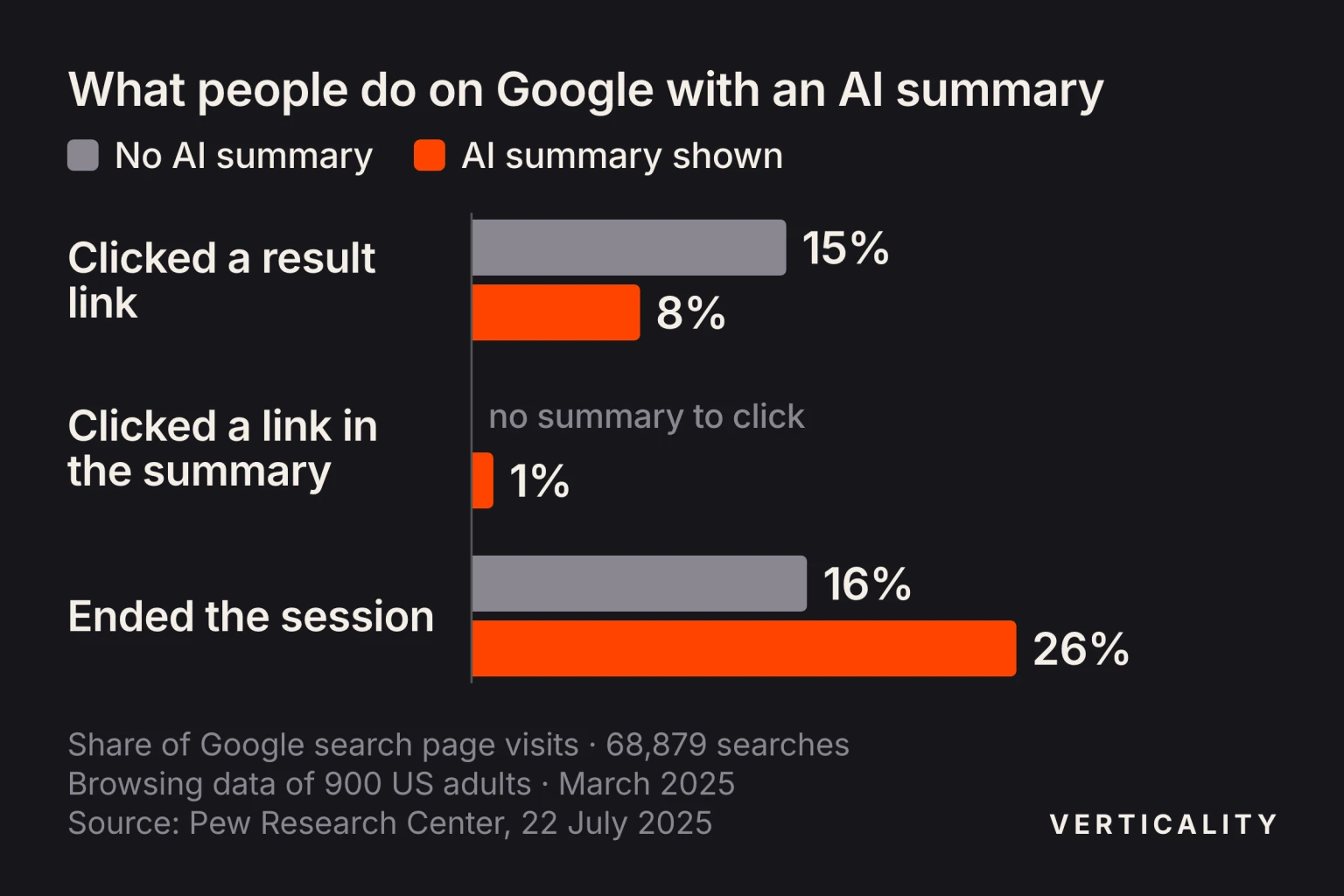
When an AI summary appears, clicks on the ranked links roughly halve and more sessions end on the results page (Pew Research Center).
When should SEO be your priority?
- Google cannot show the page yet. A page appears in AI Overviews or AI Mode only after Google has indexed it and can display it with a snippet, so indexing comes first.
- The query wants a destination, not an answer. Brand searches, product names and “buy” queries end on a product listing or a pricing page, and nobody needs a quoted paragraph to get there.
- Google shows no answer for your queries. Google says AI Overviews appear only “when our systems determine that it is additive to classic Search, and as such, often don’t trigger.” Where they do not trigger, the ranked list is the whole page.
- You sell locally. Map results, the Business Profile and reviews decide most local choices, which is local SEO.
How do AEO and SEO work together?
When our tracker asked ChatGPT “What’s the difference between GEO, AEO and LLM SEO?” on 3 October 2026, it described the labels as steps: SEO ranks the page, AEO gives the page a chance to become the answer, and GEO gets the information into the AI-generated answer. Each step depends on the one before it. A page that is not indexed cannot be the answer, and a page that ranks but buries its answer in the fourth paragraph rarely gets quoted.
The shared ground is the technical and authority work SEO already does: crawl access, indexing, clean rendering, a clear description of who the business is, and links from sites the engines trust. AEO adds an editing discipline on top: open each section with the answer in one or two sentences, name the entity and the number, phrase headings the way buyers phrase questions, and check the answers engines give about you every month. Google adds a warning worth keeping in view: many suggested AEO and GEO “hacks” “aren’t effective or supported by how Google Search actually works”.
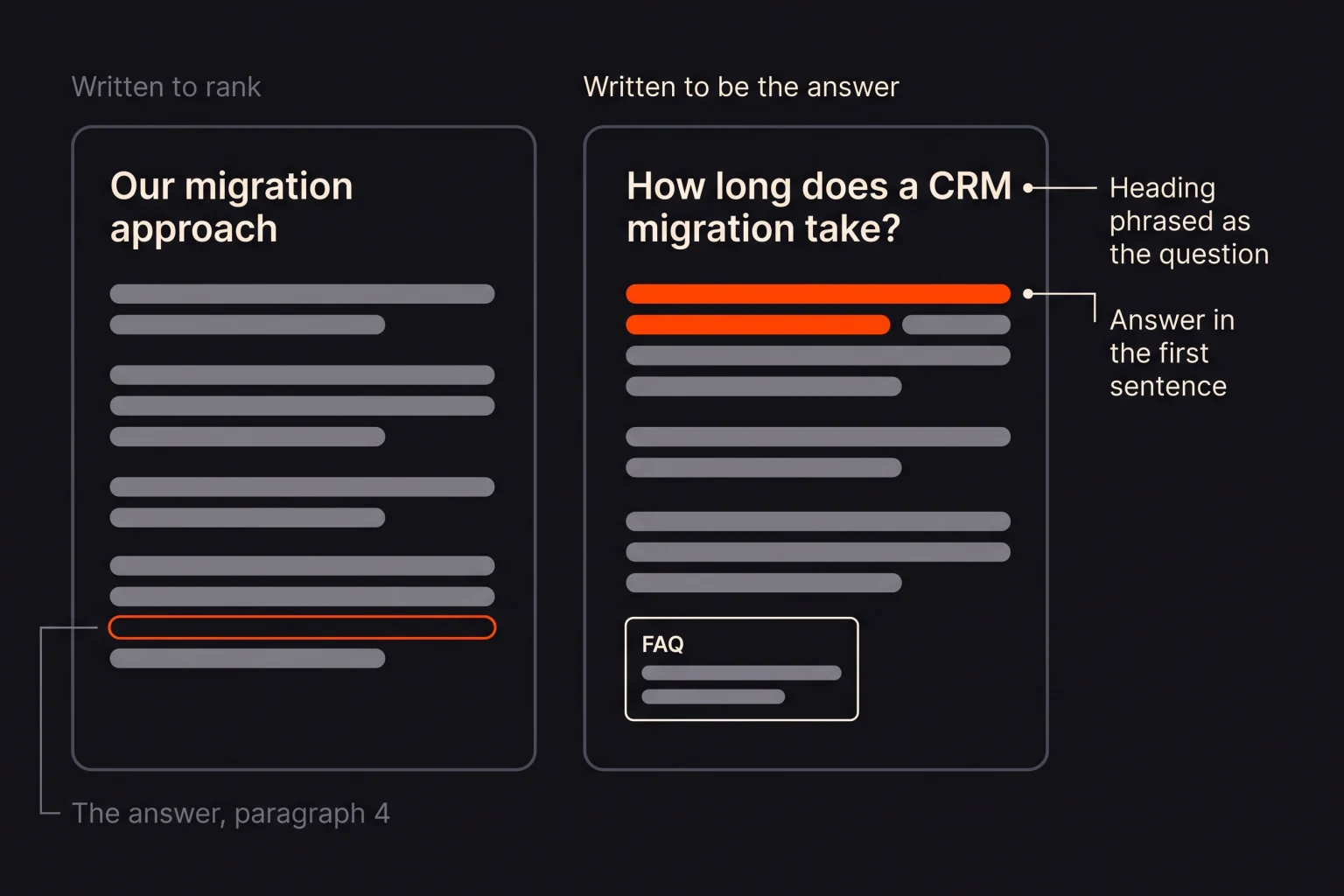
The edit AEO asks for is mostly structural: the heading asks the buyer’s question and the first sentence answers it.
For ownership, that usually means the SEO team keeps the pages and the rankings, and AEO becomes part of how those pages are written and checked, with its own question set in the report. Generative engine optimization (GEO) is the wider version of the same idea, covering citations across every AI engine and the third-party pages they quote; it is compared in GEO vs SEO, and the line between AEO and GEO is drawn in AEO vs GEO.
Frequently asked questions
What is AEO vs SEO?
AEO vs SEO comes down to answer versus result. Answer engine optimization (AEO) makes a page the passage an engine quotes when it answers a question directly, in an AI Overview, a featured snippet, a ChatGPT reply or a voice assistant. Search engine optimization (SEO) ranks the page in the organic list of links. AEO works on top of SEO, because answer engines quote pages that a search step has already found.
What does AEO mean in SEO?
In SEO and digital marketing, AEO stands for answer engine optimization: structuring pages so search engines and AI assistants can lift a direct answer from them. The full form matters because the same three letters also name an apparel retailer, and searches for its brand have nothing to do with search marketing. Google's own guide lists AEO next to GEO as terms for work aimed at visibility in AI search experiences.
What is an example of AEO vs SEO?
Our own GEO agency page is one. On 23 September 2026 ChatGPT answered "Recommend a GEO agency that gets brands cited in ChatGPT and Perplexity" by naming Verticality and restating the page's scope and price lines, while verticality.co was not on Google's first page for the same question. In SEO terms the page had no position for that question; in AEO terms it was the answer, because its facts sat in complete sentences an engine could lift.
Will AEO replace SEO?
No. Google says the best practices for SEO remain relevant because its AI features are rooted in its core Search ranking and quality systems, and it warns that many suggested AEO and GEO "hacks" are not effective. In our tracking, neither ChatGPT nor Perplexity said in 30 days of answers that AEO or GEO replaces SEO. What changes is the format of the win: a quoted answer instead of a ranked link.
Do I need both AEO and SEO?
Yes, if your buyers ask questions before they buy. SEO keeps the pages indexed and ranking, which every answer engine depends on; AEO makes the opening of each section the answer an engine can quote and keeps your facts correct in those answers. With both running, we see first signals in 4–8 weeks and compounding by month 3–6.
How is AEO measured, and what do I show leadership?
Track a fixed set of buyer questions on each engine and report mention rate, share of voice, citation sources and LLM referral sessions, plus an accuracy check: whether the answer states your price, plans and positioning correctly. Add Google Search Console's Generative AI report for AI Overview and AI Mode impressions. Present it beside the rankings report: one view of where you rank, one of where you are the answer.
Related pages
GEO vs SEO
Generative engine optimization next to SEO: citations across AI answers, engine by engine.
AEO agency
How we make your pages the answer in AI Overviews, AI Mode and ChatGPT, and keep it correct.
How to optimize for Google AI Overviews and AI Mode
What Google itself says about its AI features, and what to change on the page.
How to measure AI visibility
Mention rate, share of voice and citation sources, with the question set behind them.
Want your brand named in AI answers?
Our free AI visibility audit asks ChatGPT, Perplexity and Google AI Overviews the questions your buyers ask, shows who gets named instead of you and which sources they cite, and ends with a ranked work plan.
Get a free AI visibility auditNot ready for a call? Run the free AI visibility checker: 40+ buyer questions in ChatGPT and Google AI Overviews, report by email within 24 hours.