ChatGPT Ads Agency 2026: Setup, Management and Tracking
Your competitors can now buy their way into ChatGPT conversations. You are not there yet.
Verticality is a ChatGPT ads agency that sets up and manages campaigns in OpenAI's Ads Manager for ecommerce and DTC, B2B software, local services and education brands in the US and Canada. We also track the organic answer above your ad, which decides whether the click converts, and cover Perplexity, which sells no ads, through organic citations.
- Status
- ChatGPT ads run in more than 60 countries, with self-serve Ads Manager in the US and Canada. Perplexity sells no ads, so organic citation is the only route there.
- Best for
- Ecommerce and DTC brands with a product feed, B2B software, local services, travel and education. US finance and health brands are reviewed case by case.
- What you get
- Ads Manager setup, chat-card and product-feed campaigns, context hints and negative phrases, Conversions API and pixel tracking into your CRM, and daily tracking of the organic answer above your ad.
- Price
- Management from $1,500 to $5,000 a month, month-to-month. Ad spend goes to OpenAI at cost, from $25 a day per campaign, with no mark-up.
- How we work
- In OpenAI's self-serve Ads Manager, in an account you own. We claim no OpenAI partnership. Paid ads and organic citations run as one plan.
- Timeline
- Campaigns go live as soon as OpenAI's account review clears. The first read on cost per lead comes after 2–4 weeks of spend.
Service lead: Vadim Litvak, Founder · Growth Lead · Platform facts checked
Status first, because it changes every few weeks.
Are there ads in ChatGPT right now?
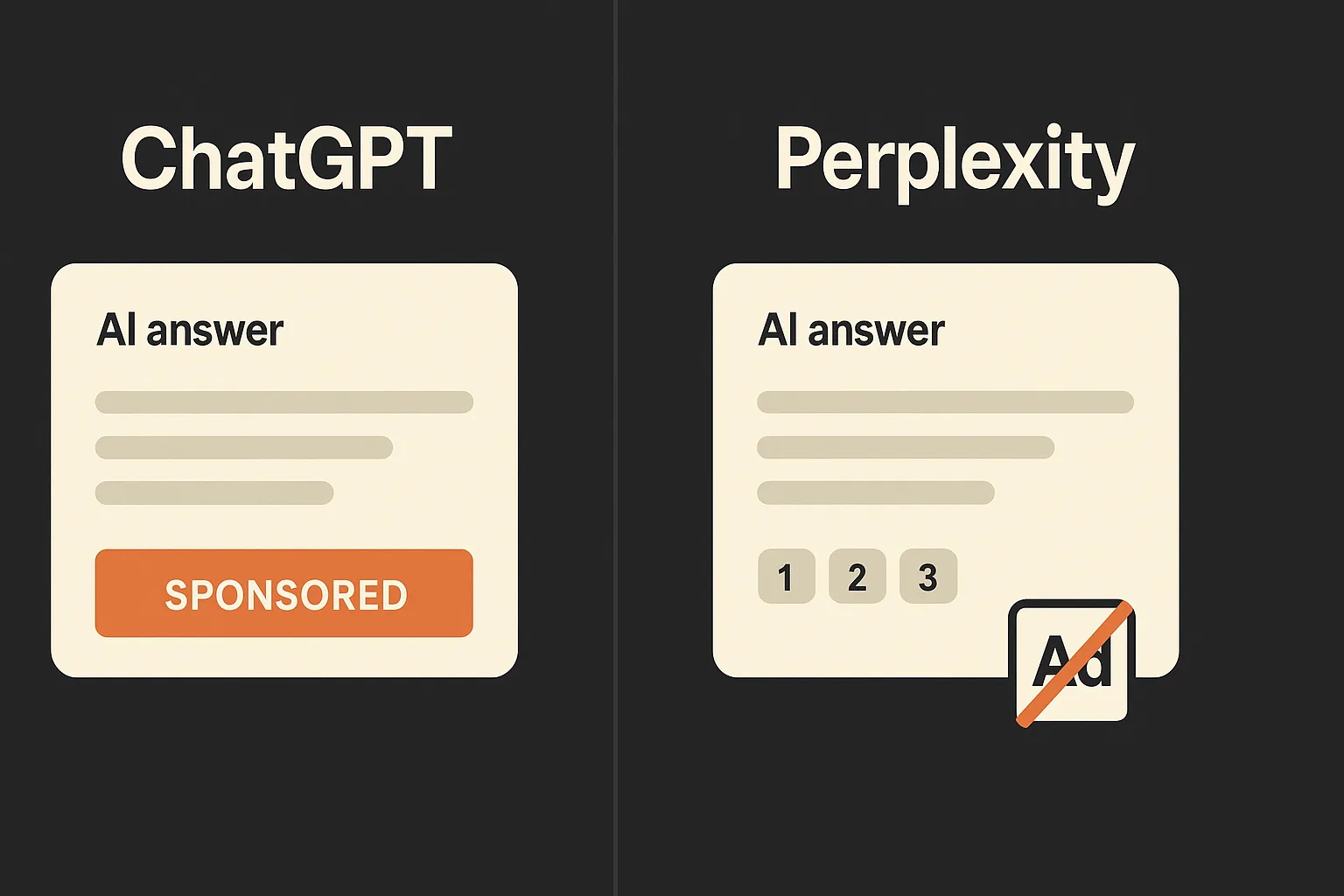
Short answer: in ChatGPT, yes — in Perplexity, no. The two platforms went opposite directions in 2026, and that split defines the strategy below.
| Status | ChatGPT | Perplexity |
|---|---|---|
| Ads today | Live in more than 60 countries. Self-serve Ads Manager in most of them, including the US and Canada. | No. New advertisers stopped in October 2025; ads dropped in February 2026. |
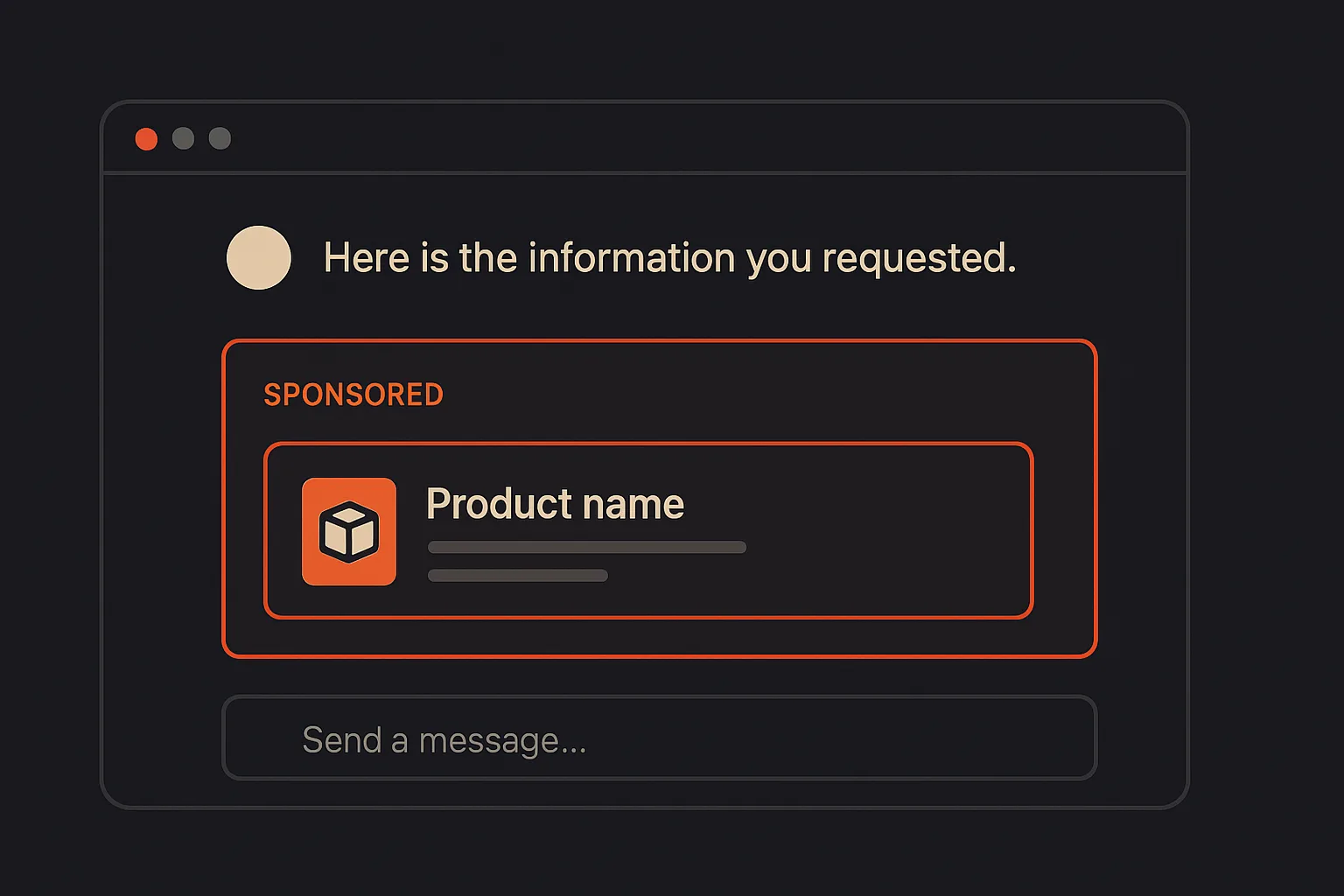
| How they look | A unit labelled "Sponsored" below the answer: a chat card with logo, title, description and image, or product cards with price and rating. | (none) |
| Who can buy | Businesses that pass OpenAI's verification and policy review, in allowed categories. | No one — no self-serve, no waitlist. |
| The alternative | Plus the organic answer, which your ads cannot change. | Organic citation is the only way in. |
How it got here: OpenAI started ChatGPT ads as a US pilot on 9 February 2026, with large managed commitments. On 5 May 2026 it began rolling out a beta self-serve Ads Manager to US businesses, with no minimum commitment and cost-per-click bidding alongside CPM, and on 31 August it opened the platform to small and medium-sized businesses. By the end of August ads were live in Canada, Australia, New Zealand, the UK, Japan, South Korea, Brazil, Mexico, India and 31 European markets, with self-serve opening across India, Europe, the Middle East and North Africa; seven Asian markets followed on 23–24 September. OpenAI reports an annualised ad revenue run rate of $1 billion in under 200 days and "tens of thousands" of advertisers.
Who else sits on the platform: five holding-company agency partners (dentsu, Havas, Omnicom, Publicis and WPP), more than 50 technology and measurement partners, HubSpot as the first CRM partner and Shopify as the first ecommerce partner (16 September), and Amazon DSP, which can extend campaigns into ChatGPT in a US pilot (10 September). Any business that passes OpenAI's review can also buy directly, which is how we buy.
Perplexity went the other way. It tested sponsored follow-up questions in the US from November 2024, never opened self-serve, stopped taking new advertisers in October 2025, and in February 2026 said it was no longer pursuing ads. A Perplexity executive told the Financial Times the worry was that "a user would just start doubting everything." There is no paid route into its answers: if you want to appear in Perplexity, you have to be cited.
Checked 24 September 2026 against OpenAI's help center and ads policies, ads.openai.com, OpenAI's announcements of 5 May, 31 August and 16 September 2026, Amazon Ads (10 September 2026), and press reports of Perplexity's February 2026 decision. When buyers ask ChatGPT about its ads, it answers from those same OpenAI pages: in our tracking, an openai.com page was cited in 103 of 180 answers to nine questions about AI ads (4–23 September 2026). So we keep this block identical to them and refresh it when they change.
What you can buy today, in OpenAI's own terms.
Who sees ChatGPT ads, formats, targeting and bidding, and who is eligible
Who sees ads
Logged-in Free and Go users aged 18 or over, and logged-out visitors, who see only ads suitable for all audiences, in the countries where ads are live. Plus, Pro, Business, Enterprise and Edu plans are ad-free, accounts known or predicted to be under 18 get none, and there are no ads in Temporary Chats or next to sensitive conversations such as health, mental health and politics. The intent is the draw: the ad is matched to the conversation a person is having right now, among more than a billion weekly ChatGPT users.
Formats
The standard ad is a chat card: your name and logo, a title of up to 50 characters, a description of up to 100, a square image of at least 640×640 pixels and a landing page, which must not block OpenAI's OAI-AdsBot and OAI-SearchBot crawlers. Product-feed campaigns (open beta) turn a feed into product cards with price and star rating. OpenAI is also testing Sponsored Agents, a labelled chat with the advertiser's own agent after the click, with select US advertisers since 16 September 2026.
Targeting and bidding
Targeting starts from the conversation: context hints describe where an ad belongs (they are not exact-match rules), and negative phrases block it. On top: country, and in the US state, city, DMA and ZIP code; app or web; and your own customer lists, to target, exclude or bid up. There is no demographic targeting and no website-visitor retargeting. Bidding runs on CPM, CPC or conversion-optimised CPC; OpenAI recommends starting at a maximum of $3–$5 per click, with a minimum of $25 a day per campaign, averaged over seven days.
Who is eligible
A business based in a self-serve country that passes account verification (through OpenAI's provider, Persona) and a policy review that runs in a rolling queue OpenAI cannot speed up, with a billing profile on file. Allowed categories: consumer goods, local services, travel and entertainment, and digital products and education, which is where software, B2B included, sits (Adobe was a launch advertiser, and the HubSpot integration is built for B2B leads). In the US, finance and health brands are restricted rather than banned and are reviewed case by case with proof of licence; outside the US they are generally not allowed. Not allowed anywhere: legal services, dating, alcohol and tobacco, gambling, political and issue ads, and unsupported wellness claims.
Six routes into the same inventory. Pick by who should own the account and the data.
Ways to buy ChatGPT ads, and who each suits
| Route | Who it suits |
|---|---|
| OpenAI's self-serve Ads Manager | Any business that passes OpenAI's review in a self-serve country, running it in-house. |
| OpenAI's Ads Solutions team | Large advertisers, through the sales form on ads.openai.com. |
| Agency partners: dentsu, Havas, Omnicom, Publicis, WPP | Brands already buying media through one of the holding companies. |
| Technology partners and Amazon DSP | Programmatic and retail-media buyers: platforms such as Criteo and StackAdapt, and Amazon DSP in a US pilot. |
| HubSpot and Shopify apps | Teams that run their marketing inside those tools. |
| An independent agency in your own account — Verticality | Brands that want their own account and data, conversion tracking into the CRM, creative testing and the organic answer above the ad handled together. |
Two numbers: the spend you pay OpenAI, and the fee you pay whoever runs it.
What ChatGPT ads cost
OpenAI publishes no performance benchmarks yet, across advertisers, industries or campaign types. What is public is below, each figure with its source and date. Treat press figures as a range to test against, not a forecast.
| Item | Figure | Source |
|---|---|---|
| Minimum budget | $25 a day per campaign in the US (CA$25 in Canada), averaged over seven days. No minimum commitment for self-serve. | OpenAI help center, 2026 |
| Recommended starting bid | A maximum of $3–$5 per click for a CPC campaign. | OpenAI help center, 2026 |
| CPM | $60 in the February 2026 pilot; reported at $25–$45 by mid-April 2026. | Digiday, 17 April 2026 (press) |
| CPC advertisers report | From under $3 to $10–$13 a click. | Search Engine Journal, September 2026 (press) |
| Our management fee | $1,500 to $5,000 a month, month-to-month, no minimum term, set by the number of campaigns, countries and product feeds. Ad spend passes to OpenAI at cost, with no mark-up. The organic half is our GEO programme: $2,500–$7,500 a month, month-to-month. | Verticality |
Sizing a first test. One campaign, one conversion you can track, and enough budget for a few hundred clicks: at OpenAI's suggested $3–$5 a click, 300–500 clicks cost $900–$2,500 over four weeks. That is enough to read cost per lead in most categories before you commit more.
What moves the fee: the number of campaigns and countries, the size of the product feed, how often creative is refreshed, whether conversions are wired into your CRM, and whether the organic half is in scope.
Two groups of buyers, and we tell you which one you are in.
Who this is for — buy today, or fix the answer first
Buy today if:
You sell in an allowed category — ecommerce and DTC, B2B software, local services, travel, entertainment or education — and are based in a self-serve country such as the US or Canada.
You have a conversion you can track: a purchase, a demo request, a sign-up. Without it, a ChatGPT campaign is a traffic report.
ChatGPT's organic answer in your category already mentions you, or at least does not recommend a competitor over you.
Fix the answer first if:
ChatGPT's answers in your category name competitors and not you. Your ad would sit under a recommendation for someone else, so the organic work comes first or runs alongside.
You are in legal services (not allowed), finance or health outside the US (generally not allowed), or US finance or health without the licence proof OpenAI asks for. The organic half is open to you now, and it also covers Perplexity, which sells no ads.
Four workstreams, run as one programme, in an account you own.
What we do — strategy, setup, testing, full-funnel integration
Strategy
We check your category against OpenAI's ad policy, map the conversations your buyers actually have, and write the context hints and negative phrases from that map — not from a keyword tool. We set the budget, the bid strategy and the offer, and we read what ChatGPT's organic answer says about you, so the ad matches the answer it appears under.
Setup
We take you through OpenAI's account verification and policy review, then build the account: campaign → ad group → ad, chat cards and product-feed ads, the Conversions API and pixel with advanced matching, and the HubSpot or Shopify connection where it fits. We check that your landing pages let OpenAI's ad crawlers in, and set locations, platforms and exclusions before a dollar is spent.
Testing
We start small, with CPC bids from OpenAI's suggested $3–$5, run titles, descriptions and images against each other, and move to conversion-optimised bidding once conversions come in. We refresh creative every week while a test runs and keep whatever earns the qualified click.
Full-funnel integration
A ChatGPT click is worthless if the landing page and the CRM do not catch it. We wire post-click attribution through to your CRM and run the organic layer alongside it — the entity, content and citation work — so the answer above your ad agrees with your ad.
Why the ad alone is half a plan.
ChatGPT ads can't be efficient without organic AI optimization
The ad sits under an answer you do not control. A user asks "which tool should I use", gets an organic recommendation, and only then sees your sponsored unit. If the answer names a competitor, you pay for a click into a conversation that has already picked someone else. It usually names someone: in our tracking of 130 buying questions, 61% of ChatGPT's answers named at least one vendor from our tracked list, 2.9 on average (4–23 September 2026, measured in our own category). And on Perplexity there is no ad to buy at all.
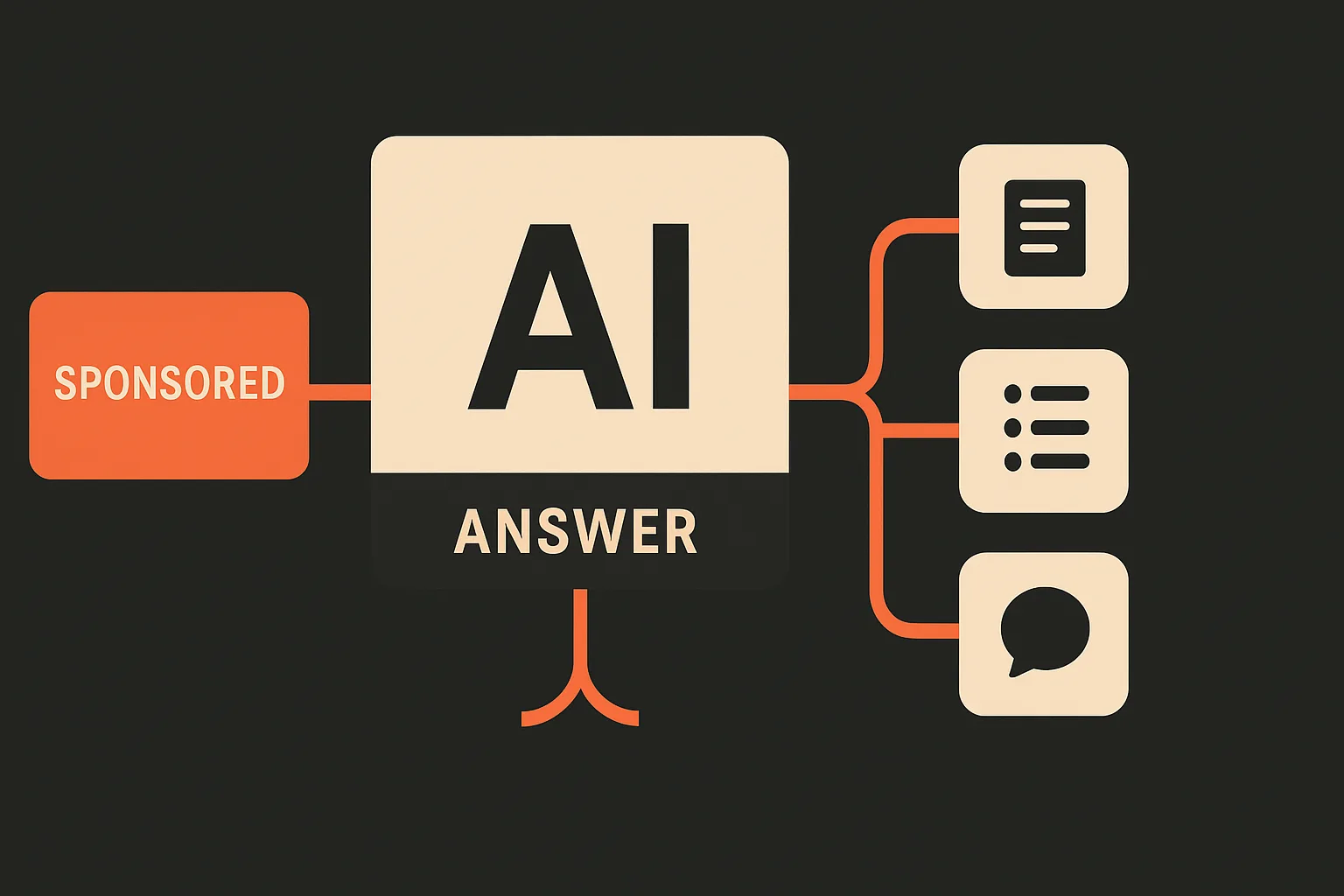
What decides that answer is sources, not spend: across 1,126 citations in AI answers we classified, 63.6% came from roundups and articles and 21.0% from vendor sites. So we run the ads and the organic work together, on the same playbook as our generative engine optimization programme.
"AI search ads" is five different products, and on two of them there is nothing to buy.
Other AI ad surfaces, and what you can buy on each
| Surface | Status on 24 September 2026 |
|---|---|
| Google AI Overviews | Live inside the Overview in English in 12 countries including the US and Canada, and above or below it in every AI Overviews market. The ads come from your existing Search (broad match or AI Max), Shopping and Performance Max campaigns; the placement cannot be targeted or reported on separately. |
| Google AI Mode | A US-only test. The same campaign types can serve in AI Mode answers, and Google is piloting new formats such as Direct Offers. The Gemini app carries no ads. |
| Microsoft Copilot | Live in English-, French- and German-speaking markets. Ads come from Microsoft Advertising Search, Shopping and Performance Max campaigns, which are opted in automatically; there is no separate Copilot report. |
| Amazon | Live in the US. Sponsored Products and Sponsored Brands ads and prompts serve inside Alexa for Shopping (formerly Rufus), and existing campaigns are enrolled automatically. |
| Perplexity, Meta AI, Claude | Nothing to buy. Perplexity stopped selling ads, Meta sells no placement inside Meta AI, and Anthropic keeps Claude ad-free. The only way into those answers is to be cited. |
Google's AI placements run on ordinary Google Ads campaigns, which we manage as our Google Ads service. Sources: Google Ads Help and the Google Ads & Commerce blog (May 2025–September 2026), Microsoft Advertising Help (June 2026), Amazon Ads (March–June 2026), Anthropic (February 2026).
Two halves, one report — so you can see which half is paying.
How we measure ChatGPT ads
The paid half
Impressions, clicks and spend from Ads Manager; purchases, leads and sign-ups through OpenAI's Conversions API and pixel; the same conversions matched to pipeline in your CRM. Reported weekly while a test runs, monthly once it is stable, with cost per qualified lead as the headline number.
The organic half
Your buyers' questions put to ChatGPT, Perplexity and Google AI Overviews every day by our own tracker: whether the answer above your ad names you, names a competitor, and which pages it cites. Daily, because the answer moves: in our tracking, ChatGPT cited only about a quarter of the same sources again the next day.
Next-day re-citation: 26.4% of the URLs ChatGPT cited for a question were cited again for the same question the next day, across 56 AI-search buying questions in our own category, daily runs 4–23 September 2026 (Perplexity 70.1%, Google AI Overviews 49.8%). Source: Verticality AI Visibility Tracker.
What we can show today, and what we will not invent.
Proof: the organic half, measured on ourselves
We will not invent a client ROAS story: the channel is months old, and we publish client numbers only when the client approves them. What we can show is the organic half of this work running on our own site, measured by the same tracker a client gets.
Our generative engine optimization page went live on 15 September 2026. Five days later ChatGPT started citing it, and it has named Verticality in 5 of the 31 GEO buying questions we track every day since: 20 of 124 answers from 20 to 23 September, up from two in the 16 days before. Our Reddit marketing page, live since 3 September, has been cited by ChatGPT and Perplexity since 7 September. The paid half reports through OpenAI's Conversions API and pixel into your CRM, so a ChatGPT ads client sees cause and effect, not a screenshot.
We are a verified business buying through the same self-serve Ads Manager as anyone. We hold no special platform partnership or early access, and we will not claim one; what we add is the strategy, the tracking and the organic citations around the ad.
Before you sign with anyone, us included.
What we don't promise, and what to ask any ChatGPT ads agency
We don't promise:
- A placement inside ChatGPT's answer. Ads run beside the answer and cannot change it; only organic citations can.
- A ROAS figure before the first test has run. We agree the metric and the budget, then report what the test shows.
- A way around OpenAI's category rules. If your category is restricted, we say so and work on the organic half until it opens.
- Perplexity ads. Perplexity does not sell them; anyone offering "Perplexity ads" today is selling something else.
Ask any agency:
- Whose account is it? The Ads Manager account, the pixel and the data should be yours from day one.
- Are you claiming an OpenAI partnership? Ask to see it. Most agencies buy through the same self-serve Ads Manager you can open yourself.
- How will conversions reach our CRM? Conversions API and pixel, not a clicks report.
- What does ChatGPT say about us today? An agency that cannot show you the answer above your ad cannot tell you whether the click will convert.
- Is ad spend marked up? Ours is passed through at cost; the management fee is separate and written down.
The questions buyers put to ChatGPT about its ads, answered first-sentence first.
ChatGPT ads agency FAQ
Are there ads in ChatGPT right now?
Yes. ChatGPT ads run in more than 60 countries. OpenAI began rolling out a beta self-serve Ads Manager to US businesses on 5 May 2026, and self-serve is now open in most of those countries, including the US and Canada, with CPM, cost-per-click and conversion-optimised bidding. Ads show to logged-in Free and Go users aged 18 and over and to logged-out visitors.
How will ads be shown?
As a unit labelled "Sponsored" below ChatGPT's answer: a chat card with the advertiser's name and logo, a title of up to 50 characters, a description of up to 100 and an image, or product cards with price and star rating from a product feed. They are not banners or sidebars, and they do not interrupt the answer.
Will ads influence ChatGPT's answers?
No. OpenAI states that ads run on systems separate from the chat model and that advertisers cannot shape, rank or change what ChatGPT says; an ad does not mean OpenAI endorses the advertiser. The sponsored unit sits below the answer, and the answer itself stays organic.
Who will see ads and who won't?
Logged-in Free and Go users aged 18 and over, and logged-out visitors, who see only ads suitable for all audiences. Plus, Pro, Business, Enterprise and Edu plans see no ads, accounts known or predicted to be under 18 see none, and there are no ads in Temporary Chats or next to sensitive conversations such as health, mental health and politics.
Is my conversation data shared with advertisers?
No. Advertisers get aggregated performance data only — never chats, chat history, memories, names, emails or precise location. OpenAI matches ads to the current conversation and, if the user leaves ad personalization on, to signals from past chats and memory, but that stays inside OpenAI. The one exception is a user who chooses to message an advertiser through an ad: the advertiser sees those messages.
How are ChatGPT ads different from Google search ads?
Google matches ads mainly to the search query; ChatGPT matches them to the conversation, through freeform context hints that are not exact-match rules. ChatGPT has no demographic targeting and no website-visitor retargeting, though you can target or exclude your own customer lists, and reporting is aggregated. The ad sits under an AI answer rather than in a ranked list. Google's own ads in AI Overviews, by contrast, run from ordinary Google Ads campaigns.
Who can currently advertise?
Businesses based in a self-serve country that pass OpenAI's account verification and policy review. Allowed categories are consumer goods, local services, travel and entertainment, and digital products and education, which covers software, B2B included. US finance and health brands are reviewed case by case with proof of licence; legal services, dating, alcohol and tobacco, gambling and political ads are not allowed.
Which agencies can run ChatGPT ads?
Three kinds: OpenAI's named agency partners, the holding companies dentsu, Havas, Omnicom, Publicis and WPP; technology partners such as Criteo, StackAdapt or Amazon DSP; and independent agencies such as Verticality that run campaigns in a brand's own self-serve Ads Manager account. Any business that passes OpenAI's review can also buy directly.
How much do ChatGPT ads cost?
You set the budget: at least $25 a day per campaign in the US, averaged over seven days, with no minimum commitment, and OpenAI recommends starting CPC campaigns at a maximum of $3–$5 per click. OpenAI publishes no benchmarks yet; press reports put CPMs at $25–$45 by April 2026 and advertiser-reported CPCs between under $3 and $10–$13 in September 2026. Our management fee is $1,500–$5,000 a month, month-to-month, with ad spend passed through at cost.
Can B2B companies advertise in ChatGPT?
Yes, if they are in an allowed category: software sits under digital products, Adobe was a launch advertiser, and OpenAI's HubSpot integration is built for B2B leads, contacts and deals. Legal services cannot advertise, and US finance and health companies need case-by-case approval. A B2B campaign needs a tracked conversion, such as a demo request, wired into the CRM.
Can I still advertise on Perplexity?
No. Perplexity stopped taking new advertisers in October 2025 and said in February 2026 that it is not pursuing ads. The only way into its answers is to be one of the sources it cites, which is what the organic half of our work does.
What ChatGPT ad options are there for ecommerce brands?
Product-feed ads: you upload your catalogue and ChatGPT shows product cards with price and star rating. Shopify merchants can run them from OpenAI's Shopify app, in the US since 16 September 2026 and in other ad markets since 23 September. Amazon DSP advertisers can also extend campaigns into ChatGPT in a US pilot.
Where else can you advertise inside AI answers?
Google shows Search and Shopping ads inside AI Overviews in English in 12 countries, including the US and Canada, and is testing them in AI Mode in the US; Microsoft shows ads in Copilot; Amazon shows Sponsored Products and Sponsored Brands in Alexa for Shopping in the US. All three are bought through ordinary Google Ads, Microsoft Advertising and Amazon Ads campaigns. Perplexity, Meta AI and Claude sell no placements.
Would ChatGPT ads fix having no organic presence in AI answers?
No. An ad buys a sponsored unit below the answer, not a place in it: ChatGPT's answer stays organic, and Perplexity and Claude sell no ads at all. If the answer recommends competitors, fix that first or alongside, or the ad pays for clicks into a conversation that has already picked someone else.
ChatGPT ads or organic AI visibility — which pays back better for a B2B brand?
They do different jobs. Ads buy a measurable test this month, in an allowed category; organic visibility compounds over quarters and reaches every engine, including Perplexity, which has no ads. For most B2B brands we run the organic work and a small ads test side by side and move budget to whichever shows the lower cost per qualified lead.
Should I hire an agency?
If you want the ad and the answer above it working together, yes. Anyone can buy in Ads Manager; an agency should add the conversation map, conversion tracking into your CRM, disciplined testing and the organic citations that make ChatGPT's answer back your ad. OpenAI's named agency partners are the holding companies dentsu, Havas, Omnicom, Publicis and WPP; most other agencies, us included, buy through the same self-serve Ads Manager, so ask to see the work, not a partner badge.
Find out where you already stand — and where the ads go
Before you spend on ChatGPT ads, find out what ChatGPT and Perplexity already say about you. Start with a free AI visibility audit: we check the questions your buyers ask, show you where your brand appears (and where a competitor does), confirm whether your category can buy ChatGPT ads today, and map the paid and organic work that closes the gap.
Get a free AI visibility audit →Connect ChatGPT ads to the rest of your AI strategy
Generative Engine Optimization (GEO) Agency
The organic layer behind the ads.
Answer Engine Optimization (AEO) Agency
Make the answer above your ad accurate.
Reddit Marketing Agency
Organic threads plus Reddit Ads.
AI SEO services
The classic-SEO foundation.
Platform facts on this page checked . We refresh them whenever OpenAI, Google, Microsoft or Amazon change their ad programs.