
Reviews affect AI search, but mostly after a buyer already knows your name. ChatGPT, Perplexity and Google’s AI Overviews cite pages that answer the question asked, and a star rating is not a page. Across 40,980 answers to non-branded questions in our tracker, review-site pages were 1.2% of the sources cited, and a single company’s profile was 0.28%. When the question named the brand, 56.6% of answers cited a review site, almost always the profile. So if you have great reviews and no AI citations, the reviews are rarely the problem. One of five signals around them is missing: crawler access, a place on the lists AI reads, answer-first passages on your own pages, one consistent entity across profiles, and current dates.
This guide is built on 28 days of our tracker’s data (4 September to 2 October 2026: 49,180 answers for 10 brands on ChatGPT, Perplexity and Google AI Overviews), on the live robots.txt files of 17 review sites, marketplaces and forums, and on OpenAI’s, Google’s, Microsoft’s and Perplexity’s own documentation, all checked on 3 October 2026.
Do reviews affect AI search at all?
Yes, in three places, and none of them is the discovery question that brings in new buyers.
- When the buyer names you. On questions like “Is [brand] legit?” or “[brand] reviews”, 56.6% of answers in our tracker cited a review site, and 86% of those citations were the company’s own profile or reviews page. ChatGPT searches for reviews when a brand is named: from 29 September to 2 October, 24.3% of the searches it ran for branded questions contained “review”, “rating” or “testimonial”, against 5.7% for non-branded ones.
- In shopping answers. OpenAI says that for a product question ChatGPT “may consider available options, price, reviews, and ease of use”, and that its review summaries “are based on reviews from public websites” (OpenAI Help). How that works for product brands is in our e-commerce guide.
- In local answers, through a licence. Yelp told shareholders in August 2026 that “Yelp ratings and reviews recently began powering ChatGPT’s local experience in relevant categories”, as part of a paid data deal with OpenAI (Yelp Q2 2026 letter, SEC).
The question that decides whether a new buyer ever hears of you is the non-branded one: “Which CRM is best for a 20-person sales team?”, “Who are the best Reddit ads agencies?” On those, review sites mostly stay out of the source list.
| Question type | Answers | Answers citing a review site | Review-site citations that are one company’s profile |
|---|---|---|---|
| Non-branded (“best X for Y”) | 40,980 | 8.5% | 22% |
| Comparative (“X vs Y”, “alternatives to X”) | 4,572 | 14.6% | 58% |
| Branded (“is X legit”, “X reviews”) | 3,628 | 56.6% | 86% |
Verticality AI Visibility Tracker, 10 brands, ChatGPT, Perplexity and Google AI Overviews, 4 September to 2 October 2026.
The engines differ. On non-branded questions Perplexity cited a review site in 17.6% of its answers, Google’s AI Overviews in 5.3% and ChatGPT in 2.7%.
Why don’t great reviews turn into AI citations?
Because the engines search before they answer, and a buyer’s question does not make them search for reviews. Google says AI Overviews and AI Mode may issue “multiple related searches across subtopics and data sources” to build one response (Google Search Central). ChatGPT does the same, and our tracker has stored the searches it writes since 29 September 2026.
From 29 September to 2 October, ChatGPT ran 3,712 searches for 1,966 answers to non-branded questions across the 10 brands we track. 5.7% of those searches contained a review word and 1.0% named a review site. 13.1% contained “best” or “top”, and 26.4% contained a year.
Our own question “Which agencies specialize in AI visibility for B2B brands?” shows the pattern. On 29 September ChatGPT searched for “B2B AI visibility agency GEO generative engine optimization agencies” and “AI search visibility agency B2B enterprise GEO agency”. Neither search asks for reviews, and neither returns a review profile. They return category listings, roundups and agency pages, and those are what the engines cite.
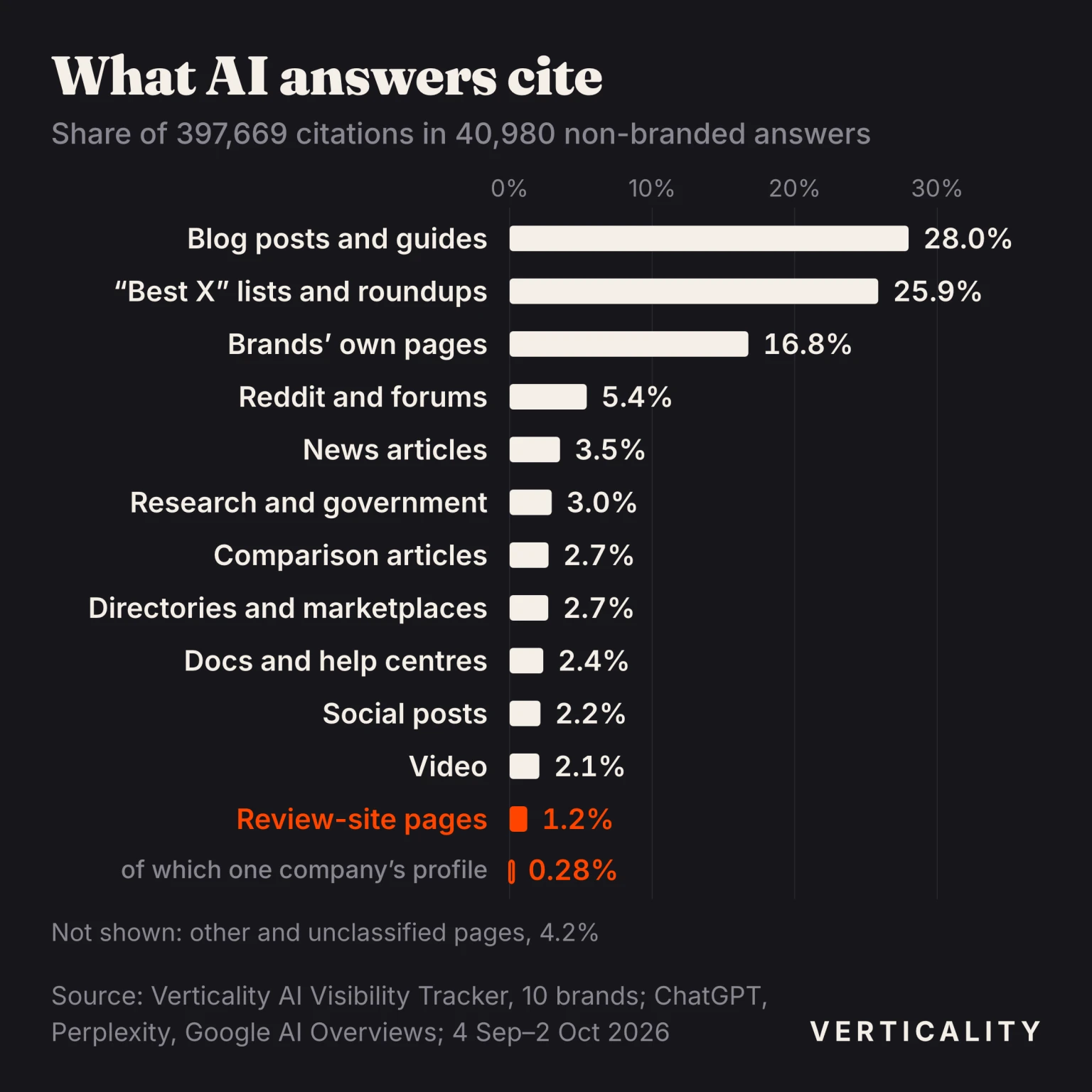
397,669 citations in 40,980 answers: review sites are near the bottom, and a company’s own profile is a quarter of that.
When a review site was cited on these questions, it was usually a listing. 59% of the answers that cited a review site cited a category or “best X” page on it, and 22% a single profile. On our own question set, the review-site page cited most often in 28 days was Clutch’s list of top Reddit advertising agencies, with 458 citations. The most-cited single agency profile on Clutch had 19.
ChatGPT says as much when you ask it. Asked our tracked question “We have great reviews and content, but AI assistants still don’t cite us: what signals are we missing?” on 13 September 2026, it answered that “being well-reviewed ≠ being a good citation source.”
Which review sites can AI actually read?
A review page can only be cited by an engine that can fetch it or license it. We read the live robots.txt files on 3 October 2026 and tested a company profile URL on each site against the crawlers that feed AI search: OAI-SearchBot for ChatGPT, PerplexityBot for Perplexity, and Googlebot, which also feeds AI Overviews and AI Mode.
| Site | ChatGPT search (OAI-SearchBot) | Perplexity (PerplexityBot) | Google AI Overviews (Googlebot) | Note |
|---|---|---|---|---|
| G2, Capterra, GetApp, TrustRadius | Allowed | Allowed | Allowed | G2 blocks single-review pages for training crawlers only |
| Gartner Peer Insights | Allowed | Allowed | Allowed | Single-review pages blocked |
| Trustpilot | Allowed | Allowed | Allowed | Company page open; single-review pages blocked for every crawler |
| Clutch, GoodFirms, DesignRush | Allowed | Allowed | Allowed | |
| BBB, Glassdoor, Product Hunt | Allowed | Allowed | Allowed | Glassdoor names “Perplexity” in its blocks; the outcome depends on the parser |
| Tripadvisor | Partly | Allowed | Allowed | Some location IDs blocked for OpenAI’s crawlers |
| Yelp | Blocked | Blocked | Allowed | Business pages closed to every AI-specific crawler; ratings licensed to OpenAI |
| Amazon | Blocked | Blocked | Allowed | All AI crawlers blocked site-wide |
| Blocked | Blocked | Blocked | Public file blocks everyone; data licensed to Google and OpenAI |
Blocking matters because OpenAI says sites that block OAI-SearchBot “will not be shown in ChatGPT search answers, though can still appear as navigational links” (OpenAI crawlers). Our citation data matches the files. Across all 49,180 answers, ChatGPT linked no Yelp page in 28 days, while Perplexity linked Yelp 372 times and Google’s AI Overviews 355 times.
Perplexity’s count shows that robots.txt is a crawl rule, not a citation rule. Perplexity documents that its user-triggered fetcher “generally ignores robots.txt rules” (Perplexity crawlers), and an engine can also learn a page from search partners and licensed data. We cannot tell which route produced those links; a blocked file does not mean an absent site.
For B2B software and service companies the platforms are open. If your reviews are on G2, Capterra, Trustpilot or Clutch and AI still does not cite you, access to the platform is not the problem; the next four signals are. For a local business on Yelp, ChatGPT reads your ratings only through Yelp’s licence, so the Yelp profile itself is the part you control.
Which signals are missing when reviews don’t get cited?
Five signals decide whether reviews turn into citations. The first two are about where your reviews live; the other three are about your own pages and profiles. If AI names competitors on your buying questions for reasons that have nothing to do with reviews, the wider list of causes is in why ChatGPT recommends your competitors. ChatGPT, Perplexity and Google name versions of them too: across 90 answers to our tracked question, “entity” consistency came up in 84 and freshness in 60.
Crawler access to every page that carries your proof
The review platforms are only half of access. Your own site has to let the same crawlers in. OpenAI’s condition for ChatGPT search is to “allow OAI-Searchbot to crawl the site and confirm that the website host or content delivery network allows traffic from OpenAI’s published searchbot IP addresses” (OpenAI Help). Bot protection on a CDN can return 403 to these crawlers while your robots.txt says “allow”. Our ChatGPT citation checklist covers the CDN side step by step.
Google is the exception. AI Overviews and AI Mode read what Googlebot reads, and Google says Google-Extended “does not impact a site’s inclusion in Google Search” (Google crawlers). Blocking Google-Extended to keep your content out of Gemini training does not hide your reviews from AI Overviews.
A place on the lists AI reads
On a buying question, the engines cite the list, not the reviewed company. “Best X” lists and roundups were 25.9% of all citations on non-branded questions in our data, and on review sites the cited page was a category listing more than twice as often as a profile. Reviews are what moves you up those lists: Clutch says reviews are “the most heavily weighted portion of Clutch’s scoring methodology” (Clutch), and G2 sorts its category pages by a score that weighs the number, recency and quality of reviews (G2). The reviews earn the place; the citation goes to the list.
There are two kinds of list to be on. On the review platform, it is the category or “best X” page for your service and market, not your profile. Off the platform, it is the publisher roundups the engines cite for the same question. We describe how to find and earn those placements in GEO best practices, step 9.
Answer-first passages that restate your proof
Your own pages are cited more often than any review site. Brands’ home, product, service and pricing pages were 16.8% of non-branded citations across all three engines, and 28.1% of ChatGPT’s. That is where your reviews have to become text an engine can quote.
Microsoft describes how assistants read a page: they break content into “smaller, structured pieces that can be evaluated for authority and relevance”, and “can often lift these pairs word for word” when a direct question has a clear answer (Microsoft Advertising). The same guidance warns that “AI systems may not render hidden content”, which is what a star widget loaded by script or an iframe often is.
A badge reading “4.9 ★” gives an engine nothing to lift. A sentence does, for example: “Rated 4.8 out of 5 on G2 from 212 reviews (October 2026). Reviewers single out onboarding in under a week and a support team that answers within the hour.” It names the source, the count and the date, and it carries the attributes a buyer asks about, in words. Put it next to the claim it supports, in the HTML, not only in a widget.
One entity across every profile
Before an engine can credit your reviews to you, it has to decide that your G2 profile, your Clutch profile and your website are the same company. Google’s Organization markup has a property for exactly this: sameAs, which it describes as “a URL to your organization’s profile page on a social media or review site” (Google Organization structured data).
What breaks the match is ordinary: a legal name on one profile and a brand name on another, a description from three pivots ago, the wrong category, or two profiles on one platform splitting your reviews between them. The fix and its check are in GEO best practices, step 7.
Current dates on reviews and pages
A profile whose newest review is two years old reads as a company that may have changed since. OpenAI tells ChatGPT users to open a cited source and “review when it was published or updated” (OpenAI Help), and freshness came up in 60 of the 90 answers to our tracked question. Keep reviews arriving on the platforms that matter for your category, and keep a visible “Updated” date on your own key pages that matches the page’s dateModified. How engines read dates is in step 10.
How do you test each signal?
Each test takes minutes and needs no tool. Run them for the 10 buyer questions that matter most to you.
| Signal | Test | A pass looks like |
|---|---|---|
| Crawler access | Open /robots.txt on your site and on each review site you rely on. Look for OAI-SearchBot, PerplexityBot and the User-agent: * group, then check your CDN’s bot settings for AI crawlers | Search crawlers allowed on your pages and on your profile and category pages; no 403 from your CDN |
| Lists AI reads | Ask ChatGPT, Perplexity and Google each question. List every review-site and roundup URL they cite, and mark the ones that name you | You are named on the listings and roundups cited for your main questions |
| Answer-first passages | Load your homepage and your service or pricing page with JavaScript off. Search the text for your rating, review count and source | Rating, count, platform and date appear as text, next to the claim they support |
| One entity | Put your name, one-line description, category and URL from your site and your top five profiles side by side. Search each platform for a second profile | Same name, category and description everywhere; one profile per platform; sameAs lists them |
| Current dates | Note the date of the newest review on each profile, and compare the visible date on key pages with dateModified in the source | Recent reviews on every profile that matters; visible date and dateModified agree |
One pass is a snapshot. AI answers change from day to day, so repeat the questions over two weeks before you decide what moved; the method is in how to measure AI visibility.
Does review schema help AI cite you?
Not by itself, and Google’s own AI disagrees with Google’s documentation on this. Google’s AI Overview for our tracked question told readers on 9 September 2026 to use “Review and AggregateRating schema so AI can read your review scores instantly.” Google’s documentation says the opposite: “There’s also no special schema.org structured data that you need to add” to appear in AI Overviews or AI Mode (Google Search Central).
Google’s review rules close the other door. If a business “controls the reviews about itself”, its pages using LocalBusiness or Organization markup “are ineligible for star review feature”, and that includes reviews shown “through an embedded third-party widget (for example, Google Business reviews or Facebook reviews widget)” (Google review snippet).
Markup still has a job: Product reviews on a store, Organization with sameAs for the entity match described above. What it cannot do is carry your G2 or Trustpilot reviews into ChatGPT. Those count only where the engine reads them, on the platform or in the text of your own pages.
What do ChatGPT, Perplexity and Google answer to this question?
We asked “We have great reviews and content, but AI assistants still don’t cite us: what signals are we missing?” on 30 days between 3 September and 3 October 2026, 90 answers in all. No answer cited a review-site page. ChatGPT cited documentation: Google Search Central in 18 of its 30 answers, Bing in 10 and OpenAI’s help center in 9. Perplexity cited the same five blog posts from SEO and GEO vendors and agencies, each in 25 of its 30 answers. Google’s AI Overviews leaned on YouTube (17 of 30), LinkedIn (15) and Facebook (10).
The three agree on most of the list: independent corroboration, answer-ready structure and a consistent entity came up in more than 80 of the 90 answers. They split on reviews. ChatGPT and Perplexity treat reviews as reputation that has to be backed by citable facts. Google’s AI Overviews on some days added review schema and “Review Velocity” as signals; Google’s documentation supports neither.
Get the missing signals checked
If you want this run on your own brand, the free AI visibility audit that opens our GEO programme covers it: the questions your buyers ask, the review sites, listings and roundups each engine cites for them, where you are missing, and the pages to fix. For a quick first read, the free AI visibility checker asks 40+ buyer questions in ChatGPT and Google AI Overviews and emails your mention rate per engine within 24 hours.