How E-commerce Brands Get Recommended in AI Shopping Answers
ChatGPT and Google pick products from merchant feeds, Product markup, reviews and third-party lists. What each engine reads, a real answer, and a checklist.

COO · AI Search & Data Architecture
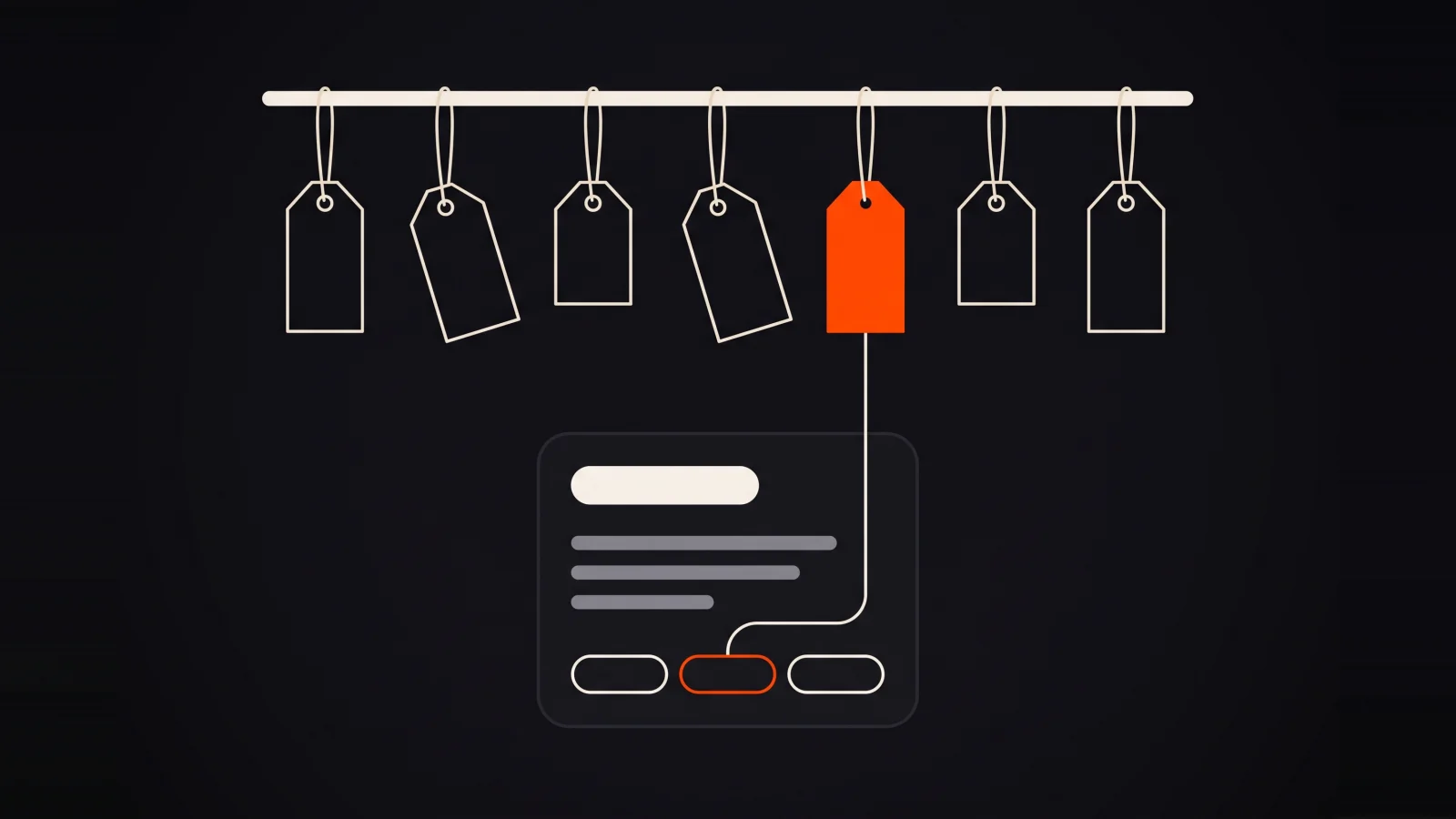
E-commerce brands get recommended in AI shopping answers when the engine holds clean product data for them and independent sources vouch for the product. ChatGPT builds its shortlist from merchant feeds, third-party product data and a crawl of your site; Google builds it from the Shopping Graph, which Merchant Center feeds and the Product markup on your pages fill. Reviews and “best X” lists then shape which of the eligible products the answer actually names.
Every platform fact below links to OpenAI’s or Google’s own documentation, and we re-read each source on 3 October 2026. We asked ChatGPT, Perplexity and Google this guide’s question every day from 4 September to 3 October 2026, 86 answers in total. ChatGPT answered from the platforms’ own documentation: help.openai.com in 19 of its 28 answers, Google’s support site in 19. Google’s AI Overviews cited vendor and agency blogs and YouTube, and not one OpenAI or Google documentation page. So this guide quotes the platforms directly, then shows a real product answer source by source.
Where do ChatGPT and Google get the products they recommend?
Both engines treat a product catalog as the list of what exists, and the open web as evidence about which product is good. The plumbing differs.
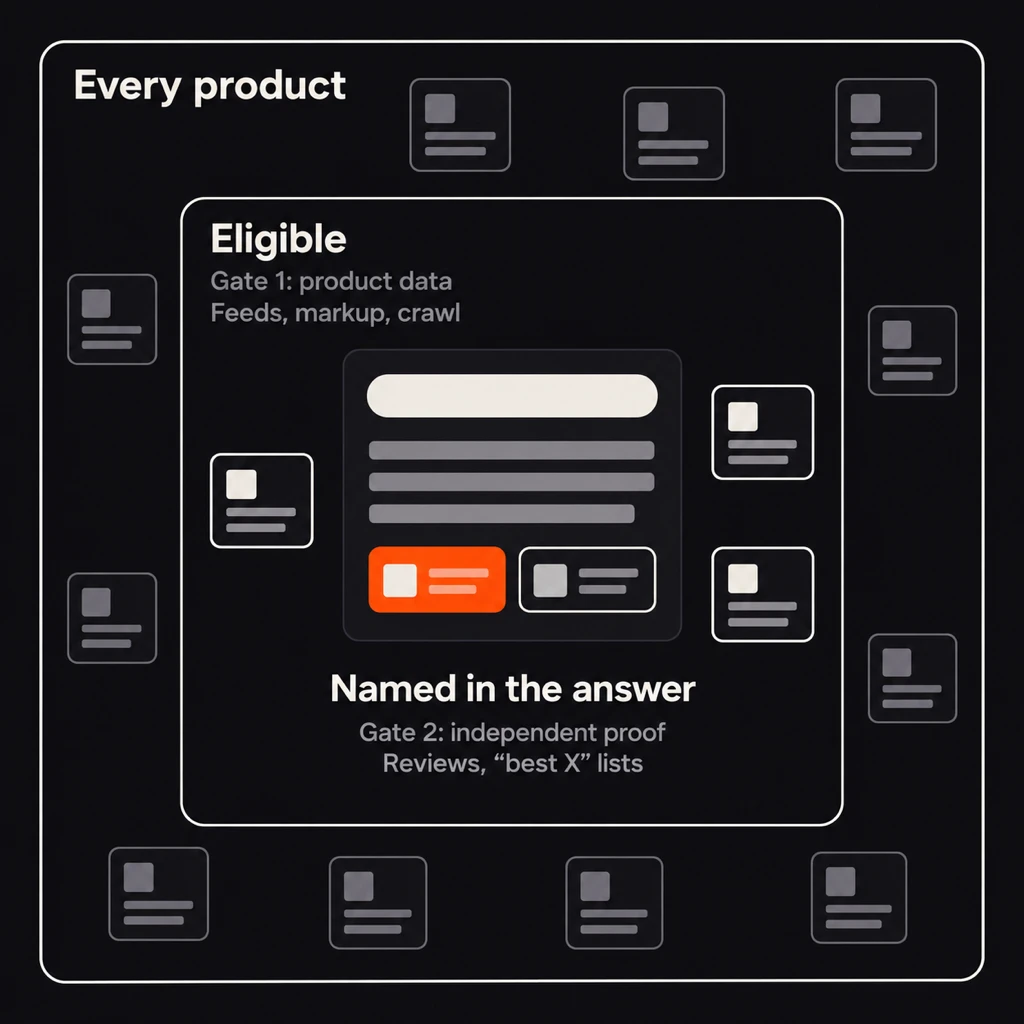
Product data gets you on the shortlist. Reviews and lists decide which product gets named.
| What the engine reads | ChatGPT | Google (AI Mode, AI Overviews, Gemini) |
|---|---|---|
| Product catalog | Feeds sent through the Agentic Commerce Protocol by approved partners; Shopify and Etsy catalogs already integrated; prices from third-party providers | The Shopping Graph, filled by Merchant Center and Manufacturer Center |
| Your own site | Crawled; OpenAI says a feed is optional | Crawled; Product markup is read to add products to Merchant Center |
| Reviews | Summaries “based on reviews from public websites”, not verified by OpenAI | Reviews are part of Shopping Graph data and feed AI review summaries |
| Other web content | ”Other third-party content”; shopping research reads retail sites and public product pages | What is said “in blogs, videos, and forum discussions” |
| Paid placement | Ads are separate from product results | Paid results are labeled “Sponsored” or “Ad” |
Sources: OpenAI, Shopping with ChatGPT search, OpenAI, Powering product discovery in ChatGPT (24 March 2026), ChatGPT for merchants, Google Shopping, sources of shopping info, Google, add products automatically, Google Search Central, AI optimization guide.
The two pipelines are not sealed off from each other. A Peec AI study published on Search Engine Land on 5 March 2026 matched about 5,000 ChatGPT product carousels against shopping results and found that “over 83% were found in the Google top 40 products”, against just under 11% for Bing (Search Engine Land). That data predates OpenAI’s March 2026 shift to merchant feeds. In our own check on 3 October 2026, ChatGPT’s product card for the top pick linked to the brand’s store tagged utm_campaign=openai_catalog and utm_medium=feed, so a direct catalog path now exists alongside whatever ChatGPT still borrows from Google Shopping. A brand that is strong in Google Shopping and present in OpenAI’s catalog covers both.
How does ChatGPT shopping decide which products to show?
OpenAI states that “Product results are selected independently by ChatGPT and are not ads, nor influenced by any OpenAI partnerships.” A product appears when ChatGPT judges it relevant to the shopper’s intent, using the query plus context such as Memory, and the model “may consider available options, price, reviews, and ease of use” (OpenAI help).
When several stores sell the same item, OpenAI ranks the merchants “based on factors like availability, price, quality, and whether they are the maker or primary seller of that item.” For a brand that sells direct and through retailers, that last factor is the one to act on: a complete, in-stock listing on your own store gives ChatGPT a reason to send the shopper to you rather than to a reseller.
How products get into ChatGPT
- Shopify and Etsy. “If you sell through Shopify or Etsy, your catalog is already integrated, and no additional setup or application is required” (ChatGPT for merchants). Shoppers who find a Shopify product check out on the merchant’s own store.
- Everyone else, through the crawl. OpenAI’s merchant FAQ says you do not need a feed if ChatGPT already crawls your site, but “feeds give you greater control.” Crawling requires that robots.txt allows OAI-SearchBot and that your host or CDN lets OpenAI’s published search-bot IP addresses through (OpenAI help). The crawler, CDN and Bing side is covered in our guide on how to get cited by ChatGPT.
- A direct feed. “Onboarding product feeds in ChatGPT is currently available to approved partners” (OpenAI developers); applicants join a waitlist. The spec has nine required fields (item_id, title, description, url, brand, seller_name, image_url, availability, price), a full file at least daily over SFTP plus API updates during the day, and the standard upload targets the US (feed spec). Large retailers such as Target, Sephora, Best Buy and Wayfair already send discovery data this way.
Shopping in ChatGPT “is currently live in the U.S. and will expand to additional regions over time.”
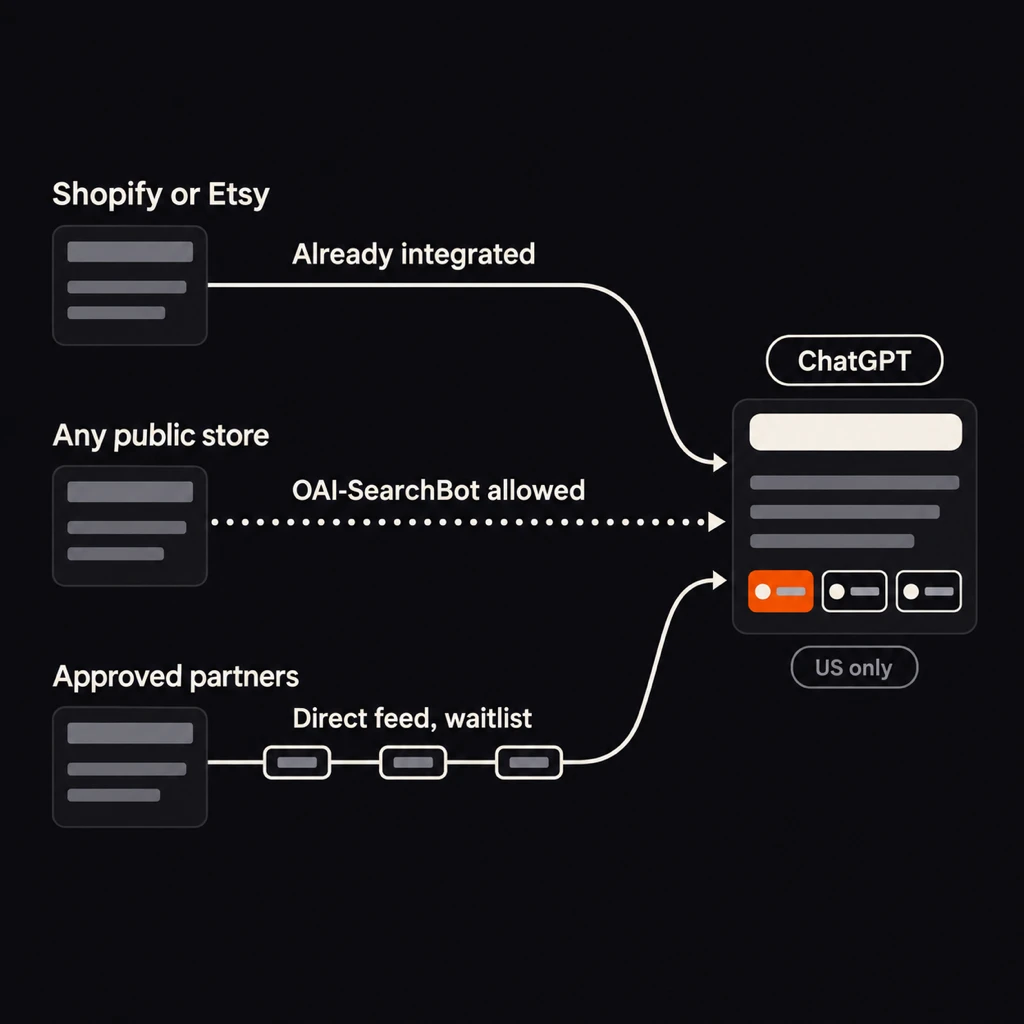
There are three ways into ChatGPT shopping, and Shopify and Etsy stores are already in.
What happened to Instant Checkout
On 24 March 2026 OpenAI wrote that “the initial version of Instant Checkout did not offer the level of flexibility that we aspire to provide,” and that merchants could use their own checkout while OpenAI focused on product discovery. The merchant page now says purchases “are completed on merchant-owned websites or apps,” with no fees on purchases that start in ChatGPT. The help center still mentions an Instant Checkout option “for some eligible products and merchants.” Many 2025 guides still describe in-chat checkout as the main path. Treat ChatGPT as a discovery channel that sends shoppers to your site.
Shopping research reads your product pages
Shopping research, ChatGPT’s mode for comparisons, returns a buyer’s guide after a few minutes. OpenAI says it reads “publicly available retail sites — reading product pages directly, citing sources, and avoiding low-quality or spammy sites,” and that when a retailer blocks automated access it will “either skip those sources or rely on other sites with similar products” (OpenAI help). A bot rule that blocks AI crawlers on product pages removes you from that research and leaves the comparison to retailers that allow it.
How do Google AI Mode and AI Overviews choose products?
Google’s AI shopping runs on the Shopping Graph, which Google describes as “over 60 billion product listings” (Google, May 2026). Brands and stores send product data “directly to Google through tools like Merchant Center and Manufacturer Center,” and that data powers “review summaries, buying guidance, or product recommendations” (Google Shopping help).
Google says there are “no additional requirements to appear in AI Overviews or AI Mode, nor other special optimizations necessary” (Search Central). For stores, its AI optimization guide names the lever: “Using products like Merchant Center (such as Merchant Center feeds) and Google Business Profiles can help your products and services to be visible in both AI responses and other Google Search results.”
On ranking, Google’s help is short: “Products are ranked based on relevance, as well as your search terms and other Google activity,” and results labeled “Top recommendations” are “selected based on relevance to your search, ratings, price, and product features.” Paid results carry a “Sponsored” or “Ad” label (Google Shopping help), and “Ranked lists and info you find in AI Overviews and more aren’t sponsored” (Google Shopping help).
For the content side of Google’s AI answers, see how to optimize for Google AI Overviews and AI Mode. Three 2026 changes matter for a store:
- Conversational attributes. Merchant Center added six optional attributes that “help AI systems and conversational agents better understand your products’ specific nuances”:
question_and_answer,document_link,related_product,item_group_title,variant_optionandpopularity_rank(Merchant Center help). - AI performance insights. Since 16 September 2026, Merchant Center reports your share of AI impressions against competitors you define, on conversational shopping queries in AI Mode and AI Overviews, for English-language queries in Australia, Canada, India, New Zealand and the US (Merchant Center help).
- Checkout in AI Mode. Checkout through Google’s Universal Commerce Protocol “is available for select merchants at this time” (Merchant Center help), for signed-in US shoppers aged 18 and over.
What does a real AI shopping answer cite?
We sent one product question, “best carry-on suitcase under $200”, to ChatGPT (chatgpt.com, twice, 90 seconds apart), Google AI Mode and Google Search on 3 October 2026 between 09:28 and 09:30 UTC, US location, through DataForSEO. Nothing below is edited.
| Engine | Top pick | Sources it cited | Product listings shown |
|---|---|---|---|
| ChatGPT, run 1 | Travelpro Maxlite 5 Carry-On Spinner, $160 | packandporter.com, a “best carry-on luggage under $200” list | 1 card, linking to travelpro.com, tagged openai_catalog and feed |
| ChatGPT, run 2 | Travelpro Maxlite 5 Carry-On Spinner, $160 | Two travelpro.com product pages | 6 cards: travelpro.com, Nordstrom, Best Buy, Staples |
| Google AI Mode | Samsonite Freeform Carry-On Spinner | Forbes Vetted, 3 Google product pages | 4 products sold by the brands themselves, each with a star rating and review count (Samsonite Freeform 4.3 from 2,600 reviews) |
| Google AI Overview | Travelpro Maxlite 5 Expandable Rollaboard | Forbes Vetted, Wirecutter, 3 Google product pages | Popular-products blocks with retailers below the Overview |
What the answers show:
- “Best X” lists carry the citation. Both engines quoted editorial roundups, but not the same ones: ChatGPT read packandporter.com, Travel + Leisure, Good Housekeeping and small comparison sites; Google cited Forbes Vetted and Wirecutter.
- The brand’s own product data reached both engines. In ChatGPT it arrived as a feed-backed card pointing at the brand’s store; in Google, as Shopping Graph listings with the brand as seller.
- Retailers showed up as listings, not as sources. Nordstrom, Best Buy and Staples sold products in ChatGPT’s cards; Amazon ranked first in Google’s organic results. No retailer was cited.
- Reddit ranked but was not cited. A Reddit thread sat second in Google’s organic results for this query. Neither AI Overviews, AI Mode nor ChatGPT cited it. No YouTube result appeared.
- Answers move. ChatGPT’s second run, 90 seconds after the first, kept the top pick but changed every other product and switched its source from a third-party list to the brand’s own pages. The product named in all four answers, the Travelpro Maxlite 5, was also the one present in both pipelines: a brand feed card in ChatGPT and brand-sold listings in Google.
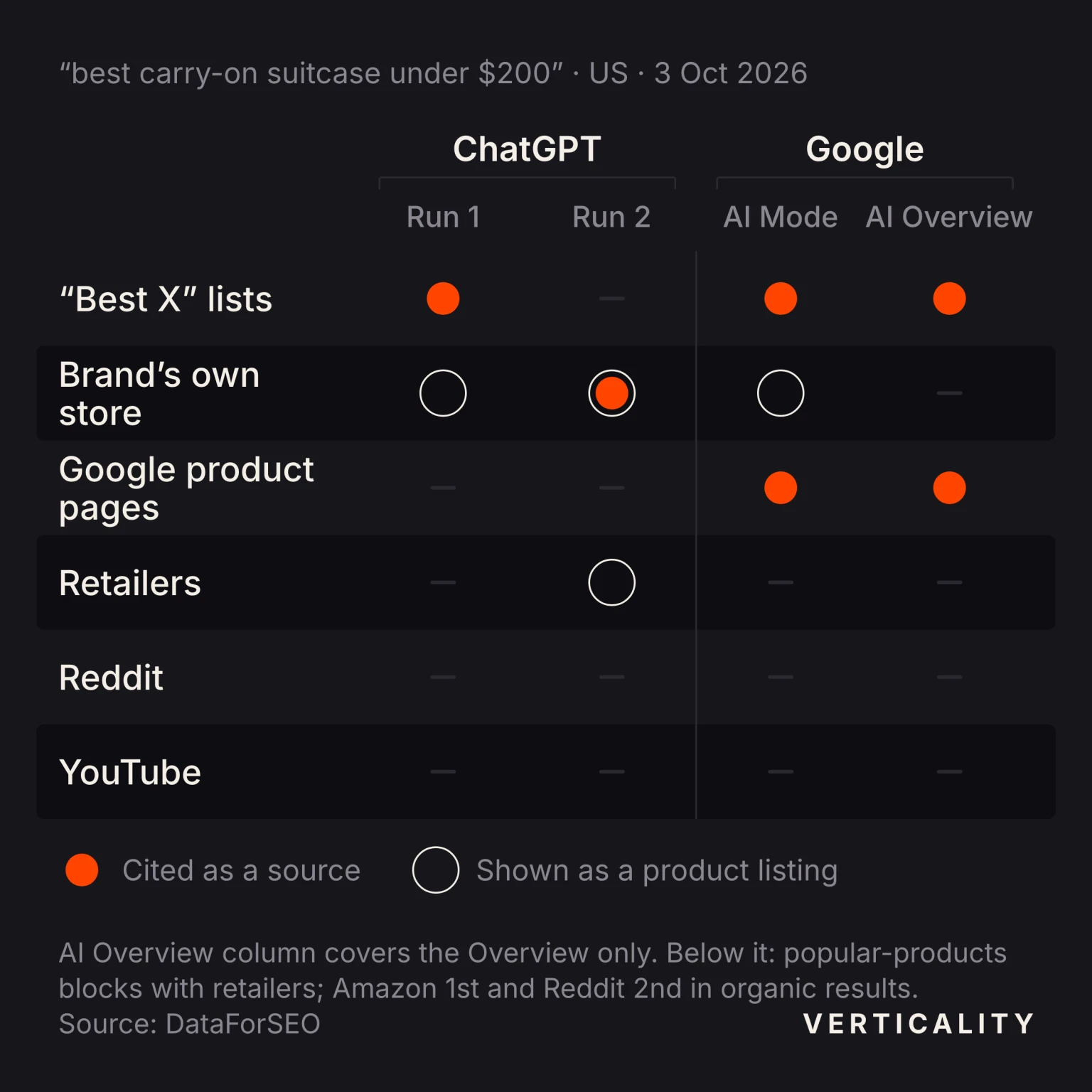
Both engines cited “best X” lists, retailers appeared only as product listings, and Reddit and YouTube were never cited.
One query proves nothing on its own, but the pattern matches larger studies: Ahrefs found “best X” blog lists were 43.8% of the pages ChatGPT used as sources across 750 recommendation prompts, and for product prompts a cited brand page was a product page 87.2% of the time (Ahrefs).
Which sources do AI engines cite across a whole product category?
One query is a snapshot, so we checked the pattern at scale. We track a home-and-garden product category every day for a retail client: 100 unbranded product questions such as “What are the best raised garden beds to buy?”, asked to ChatGPT, Google and Perplexity from 4 September to 3 October 2026. That is 2,800 ChatGPT answers, 2,800 Perplexity answers and 2,900 Google searches, 2,523 of which showed an AI Overview.
| Share of answers citing | ChatGPT | Google AI Overviews | Perplexity |
|---|---|---|---|
| Google product listings | under 1% | 86.0% | under 3% |
| YouTube | 0.1% | 48.2% | 2.7% |
| 0.25% (7 answers) | 33.4% | 36.0% | |
| Amazon | under 0.1% | 8.2% | 36.1% |
| Home Depot | 9.6% | 7.7% | 28.9% |
| Bob Vila | 14.0% | 7.5% | 37.4% |
| NYT Wirecutter | 0% | 4.0% | 24.7% |
Google AI Overviews shares are counted over the searches that showed an Overview.
Three things stand out:
- Each engine trusts a different web. Google’s Overviews lean on its own product listings, YouTube and Reddit. Perplexity leans on Amazon, Home Depot and review publishers. ChatGPT cited Reddit in 7 of 2,800 answers and never cited Wirecutter; it quoted editorial and review sites, and university extension and government sites made up about a fifth of its citations among its most-cited domains.
- Video is a Google lever. YouTube appeared in nearly half of the AI Overviews and almost nowhere else. A product demo or review video is a source Google’s AI actually reads for this category.
- The lists differ by engine. Bob Vila was the top editorial source for ChatGPT and Perplexity; The Spruce led in AI Overviews. “Get into the best X lists” only works once you know which lists each engine reads for your category.
Which product data should you fix first?
Start where both engines read the same thing: the facts on your product pages and in your feed. They must agree with each other and with what the shopper sees.
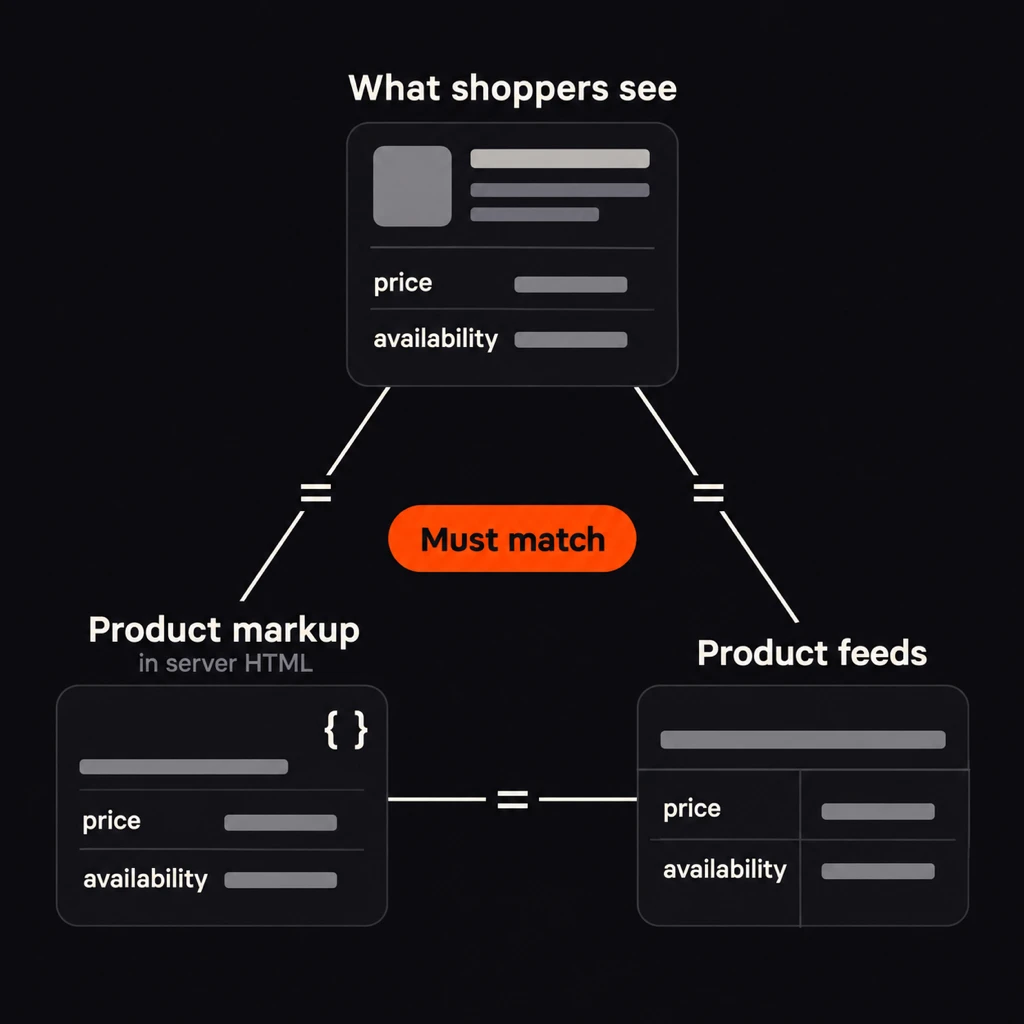
Price and availability have to read the same on the page, in the markup and in the feed.
- Product markup in the server-rendered HTML. Merchant Center matches markup to your feed only if it is in the page source: “The structured data markup can’t be generated with JavaScript after the page has loaded” (Merchant Center help). Merchant listings require an Offer with a price and currency, and automatic item updates need
price,priceCurrency,availabilityandcondition. Google lists “making sure your structured data matches the visible text on the page” among the practices that still apply to AI features. - A Merchant Center feed with no disapproved items. Google recommends both: “Providing both structured data on web pages and a Merchant Center feed maximizes your eligibility to experiences” (Search Central). Google is raising the minimum image size to 500x500 pixels: warnings started on 14 April 2026, enforcement starts on 31 January 2027 (Merchant Center help).
- Attributes shoppers ask for. AI answers filter by size, weight, material, compatibility and use case. The AI performance tab in Merchant Center lists “Popular attributes” missing from your data and “Top terms” shoppers use. Google’s own advice: “Add the relevant search terms into your product titles and descriptions, and populate any missing attributes.”
- An OpenAI-ready catalog. If you apply for a feed, keep titles under about 150 characters and plain-text descriptions under 5,000, make every product and image URL public, and let OAI-SearchBot reach the image host: OpenAI warns that “a 403 response can block feed processing” (OpenAI help).
- Variants as separate items. OpenAI’s spec asks for “one row per purchasable item or variant”; Merchant Center’s
item_group_titleandvariant_optionserve the same purpose. A shopper asking for “the 21-inch in navy” needs that variant to exist as data.
Do reviews on other sites count more than reviews on your own site?
Both count, through different doors. Reviews on your own store feed your markup, your Merchant Center data and the review fields in an OpenAI feed. Reviews on other sites feed the summaries the engines write.
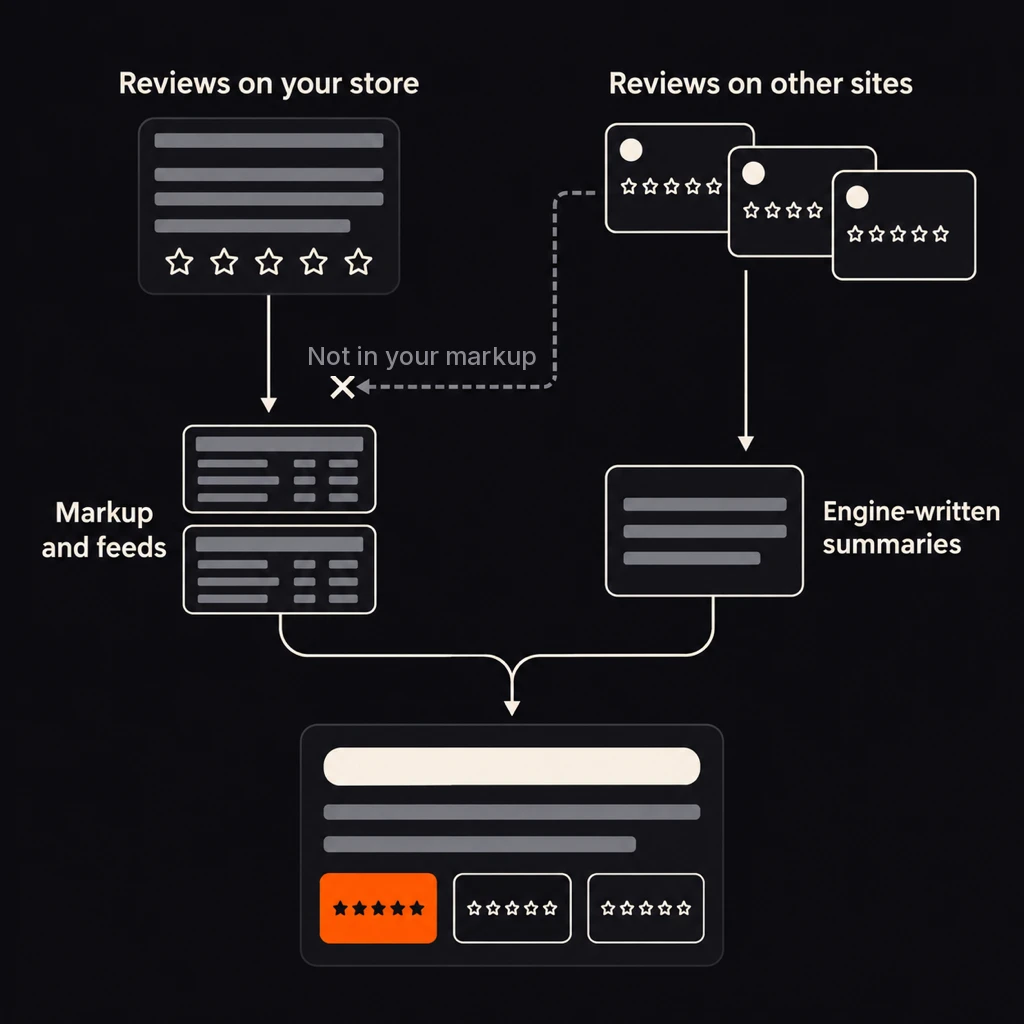
Your store’s reviews feed your own product data. Reviews on other sites feed the engine’s summary.
- ChatGPT. Review summaries “are based on reviews from public websites”, and “Reviews and ratings are not verified by OpenAI.” A feed can carry a product review count and star rating, with seller and store reviews excluded (OpenAI feed spec).
- Google. The Product Ratings program needs “at least 50 reviews across all your products” and requires sharing all of them, “including low-star reviews” (Merchant Center help). Aggregate ratings appear on free listings even without the program. In review markup, Google’s rule is “Don’t aggregate reviews or ratings from other websites.”
In our carry-on check, every product in Google AI Mode’s shopping block carried a star rating and review count. A product without visible ratings competes at a disadvantage in that layout before any model reads a word about it. Fake reviews are not a shortcut: OpenAI’s commerce policies, updated 29 September 2026, prohibit “fake reviews, fabricated endorsements, or artificially inflated” engagement.
How do you get into the “best X” lists AI quotes?
Find out which lists the engines cite for your category before pitching anyone. Ask ChatGPT, Perplexity and Google your top ten product questions, the way a shopper phrases them, and record every cited URL for each engine separately: in the home-and-garden data above, Wirecutter was in a quarter of Perplexity answers and in none of ChatGPT’s. In the carry-on check the cited lists were a mix of national publishers (Forbes Vetted, Wirecutter, Travel + Leisure, Good Housekeeping) and niche comparison sites (packandporter.com, carryonsized.com). Niche sites are often easier to reach and were cited just as readily. Our free AI visibility checker runs the ChatGPT and Google AI Overviews half for you and lists the sources those answers cite.
Then work the list in order of how often each source is cited:
- Get tested. Most roundups that AI quotes test products. Offer samples, spec sheets and a contact who answers questions fast.
- Fix stale facts. If a cited list names last year’s model or an old price, send the editor the current data. An engine repeating a wrong price hurts the click more than not being listed.
- Make your product easy to compare. Lists are built from comparable facts: dimensions, weight, warranty, materials. Publish them as text on the product page so an editor, and an engine reading the same page, can lift them.
Does Reddit matter for AI product recommendations?
For Google and Perplexity, yes; for ChatGPT, hardly at all. Google says its generative AI features “can show what’s being said about products and services across the web, including in blogs, videos, and forum discussions,” and adds that “seeking inauthentic ‘mentions’ across the web isn’t as helpful as it might seem” (Search Central).
The share depends on the engine. In the home-and-garden category we track, Reddit was cited in 33.4% of AI Overviews and 36.0% of Perplexity answers, but in 7 of 2,800 ChatGPT answers. Across five engines, LLM Pulse counted 391,073 citations on about 1,468 US shopping queries (April to July 2026): Reddit and YouTube together were 10.4% of citations, and all major retailers combined 2.9% (LLM Pulse). It also depends on the query: in our carry-on check, a Reddit thread ranked second on Google, yet no AI answer cited it.
The practical work: read the top threads in your category, answer product questions openly as the brand, and correct wrong specs where they appear. Threads shape what editors and shoppers believe, and that reaches the lists the engines do cite. If you want this run as a program, that is what our Reddit marketing team does.
AI shopping visibility checklist
| # | Check | How to verify |
|---|---|---|
| 1 | Merchant Center feed approved, no disapproved items, images at least 500x500 before January 2027 | Merchant Center diagnostics |
| 2 | Titles, descriptions and attributes use the terms and attributes Google reports as missing | Merchant Center, Analytics, Products, AI performance tab |
| 3 | Product and Offer markup in server-rendered HTML, matching visible price and availability | View page source; Rich Results Test |
| 4 | ChatGPT path chosen: Shopify or Etsy catalog live, or feed application filed at chatgpt.com/merchants | Shopify admin; merchant form |
| 5 | OAI-SearchBot allowed in robots.txt, and the CDN or WAF does not block OpenAI’s search-bot IPs on pages and images | robots.txt; firewall logs |
| 6 | Product reviews collected and sent, low stars included; review count and rating in feeds | Product Ratings status in Merchant Center |
| 7 | Cited “best X” lists for your top ten product questions found, contacted, facts current | Your own prompt log |
| 8 | Top Reddit threads in your category answered openly; product videos on YouTube for Google | Thread and video list with dates |
| 9 | Checkout runs on your own site; ChatGPT treated as discovery | Referral path test |
| 10 | AI visibility measured monthly | Merchant Center AI performance; Search Console generative AI report; utm_source=chatgpt.com in analytics |
How to build the prompt set and score the results is in how to measure AI visibility. Run the checklist once a quarter. OpenAI and Google both changed their shopping products several times in 2026, and several of the facts above were different six months ago.
Next step
For B2B software, the levers are different; our guide on how SaaS pages get cited by AI covers that case. For an online store, start with the feed and the markup, then the lists.
To have your own catalog checked, our generative engine optimization program starts with a free AI visibility audit: we ask ChatGPT, Perplexity and Google the product questions your buyers ask, show which sources and competitors they cite, and list the feed, markup and off-site fixes in order.
Frequently asked questions
Do I need to apply to OpenAI for my products to appear in ChatGPT shopping?
Not if you sell on Shopify or Etsy: OpenAI says those catalogs are already integrated and no application is required. Other stores can still appear because ChatGPT crawls merchant sites, as long as OAI-SearchBot is allowed. A direct product feed to OpenAI is currently open to approved partners, and new applicants at chatgpt.com/merchants join a waitlist. ChatGPT shopping is live in the US only.
Can shoppers still buy my products inside ChatGPT with Instant Checkout?
Plan for checkout on your own site. On 24 March 2026 OpenAI said the first version of Instant Checkout was not flexible enough and let merchants use their own checkout, and its merchant page now says purchases are completed on merchant-owned websites or apps. OpenAI's help center still says an Instant Checkout option may appear for some eligible products and merchants, without naming them.
Does Product schema get my products into Google AI Mode?
Not on its own, and no special markup exists for it: Google documents no extra requirements for its AI features. Product markup still matters because Google reads it to add products to Merchant Center, and it recommends both markup and a Merchant Center feed for the widest eligibility. Put the markup in the server-rendered HTML and keep it identical to the price and availability shoppers see.
Can I pay to be recommended in ChatGPT shopping results?
No. OpenAI says ChatGPT product results are selected independently, are not ads and are not influenced by OpenAI partnerships. ChatGPT ads are a separate, labeled format shown below an answer, and products uploaded for ad campaigns do not appear in organic ChatGPT conversations during the beta.
How can I see whether AI shopping answers show my products?
Google Merchant Center has an AI performance tab that reports your share of AI impressions in AI Mode and AI Overviews for English-language queries in the US, Canada, Australia, New Zealand and India. Search Console's generative AI report shows page impressions in the same surfaces. ChatGPT tags its referral links with utm_source=chatgpt.com, so its visits show up in analytics.
Want your brand named in AI answers?
Our free AI visibility audit asks ChatGPT, Perplexity and Google AI Overviews the questions your buyers ask, shows who gets named instead of you and which sources they cite, and ends with a ranked work plan.
Get a free AI visibility auditNot ready for a call? Run the free AI visibility checker: 40+ buyer questions in ChatGPT and Google AI Overviews, report by email within 24 hours.