Why ChatGPT Recommends Your Competitors, Not You: 7 Causes
AI answers recommend the brands named on the pages they read. Seven causes keep a brand off those pages; each comes with a check you can run and a fix.

COO · AI Search & Data Architecture
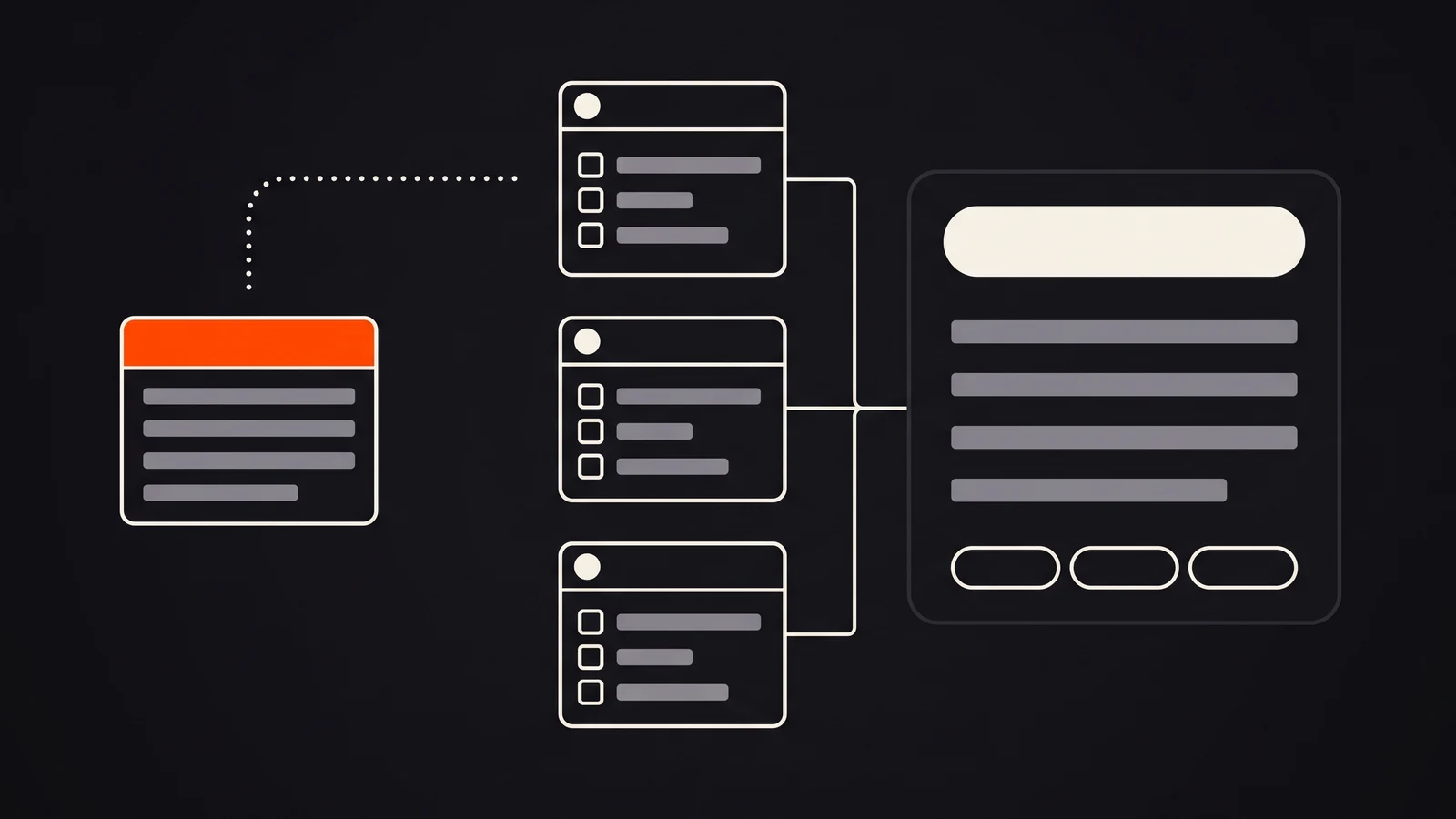
ChatGPT recommends your competitors because the pages it reads before answering name them and not you. For a buying question, ChatGPT, Perplexity and Google’s AI Overviews run web searches, pull a set of pages and build the shortlist from what those pages say: “best X” roundups, Reddit threads, review sites and the vendors’ own service and pricing pages. If the engine can’t fetch your pages, if they don’t use the buyer’s words, or if the third-party pages it reads don’t name you, the answer goes to the brands that are on them. Seven causes explain almost every case, and the sources cited under the answer show which one is yours.
This guide is built on our tracker at ai.verticality.co, which asks ChatGPT, Perplexity and Google the same 130 buying questions every day, on the platforms’ own documentation checked on 3 October 2026, and on our own brand’s starting point: on 3 September 2026 the three engines named Verticality in 0 of 390 answers. In the week to 3 October ChatGPT named us in 7.3% of its answers, Perplexity in 1.9% and Google’s AI Overviews in 0.3%.
Why does ChatGPT recommend my competitors and not me?
An AI engine does not keep a ranked list of brands in its head. For a buying question it searches first. OpenAI says ChatGPT search “typically rewrites your query into one or more targeted queries” for its search providers and may then send “additional, more specific queries” (OpenAI Help Center). Google calls the same move a “query fan-out”: AI Overviews and AI Mode issue “multiple related searches across subtopics and data sources” (Google Search Central). The answer is then written from the pages those searches return.
So the shortlist is whatever the retrieved pages agree on, and for buying questions those pages are mostly lists. In our own category, marketing services, from 4 September to 3 October 2026, when an engine answered a buying question by naming vendors, it cited at least one roundup, “best X” list or comparison page in 63.0% of ChatGPT answers, 87.8% of Google AI Overviews and 95.6% of Perplexity answers. Across the eight other brands we track, the shares were 58.2%, 72.8% and 95.0%.
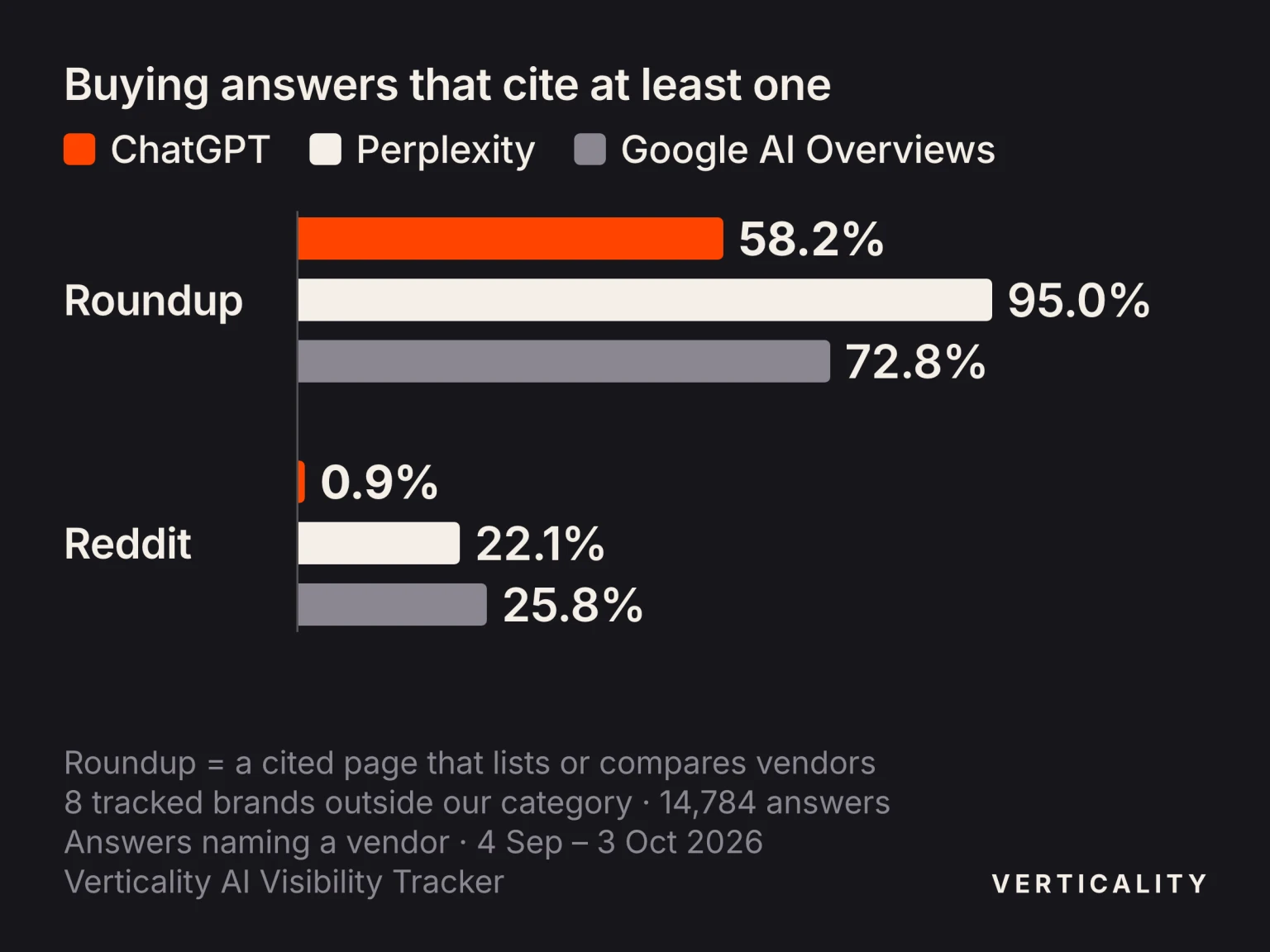
Outside our own category too, most buying answers cite a roundup; Reddit shows up on Perplexity and AI Overviews, almost never on ChatGPT.
The brands named are rarely the source of their own recommendation. When an engine named a competitor in our category, that competitor’s own website was cited in the same answer only 29.8% to 35.6% of the time, depending on the engine; for the other brands we track, 40% to 48%. The rest of the recommendation came from other people’s pages.
Outside studies point the same way. Ahrefs analysed ChatGPT answers to 750 recommendation prompts for software, products and agencies and found that “best X” blog lists made up 43.8% of the source pages; it also saw “a correlation between a brand positioning highly in third-party lists and being more likely to feature in responses” (Ahrefs, December 2025). Peec AI, measuring nearly 200,000 answers across eight engines, found that ranking first in a cited list lifted a B2B SaaS brand’s visibility in AI answers by 16.5 percentage points (Peec AI, May 2026).
We track the question this guide answers, worded the way a frustrated founder asks it: “AI assistants recommend our competitors and never mention us even though we rank on Google — what’s going on and who can fix it?” In 90 answers from 3 September to 3 October 2026, all three engines pointed to third-party mentions every time, and 78% of the answers named roundups and comparison pages. Only 23% raised crawler access (and just 1 of Google’s 30 AI Overviews), and 11% the words buyers use. Those two causes are the ones the engines’ own advice tends to skip, and both are fixed on your own site.
Is it a real gap, or one unlucky answer?
One screenshot proves nothing, because AI answers change from day to day. Of the URLs ChatGPT cited for a question in our tracker, only 26.4% were cited again for the same question the next day; for Perplexity it was 70.1% and for Google’s AI Overviews 49.8% (56 AI-search buying questions, 4–23 September 2026). A competitor named once may be gone tomorrow, and so may you.
Ask the same questions on at least three different days before you decide anything. If competitors keep appearing and you keep missing, read the sources under the answers, not just the text. The pattern in the sources points to the cause:
| What you see across repeated answers | Most likely cause |
|---|---|
| None of your pages is ever cited, even for questions only you can answer | 1. AI crawlers can’t fetch or read your pages |
| The cited pages are “best X” lists, and the brands recommended are the ones on them | 2. You are missing from the roundups |
| Reddit threads sit in the sources, and users in them recommend competitors | 3. Nobody mentions you on Reddit |
| The answer talks about a category your site names differently | 4. Your category wording doesn’t match the buyer’s |
| Asked about your brand by name, the engine mixes you up with someone else or knows little | 5. AI can’t tell what your brand is |
| The answer compares prices or results and names only brands that publish them | 6. No pricing or proof it can quote |
| Competitors are named by many different sources, you by one or none | 7. Too few other sites mention you |
Most brands have two or three of these at once. Check them in the order of the table: if the first applies, nothing after it can work until it is fixed.
Why isn’t ranking on Google enough?
Because the engines don’t search for your keyword, and only one of the three is officially built on Google’s index.
ChatGPT reads pages through OpenAI’s own crawler, OAI-SearchBot, and through “OpenAI’s indexed and cached web content” (OpenAI), plus partner search providers. OpenAI names no provider in its help text and links Microsoft’s privacy statement; Microsoft says Bing powers “AI tools like ChatGPT” (Bing Webmaster Blog, June 2025). None of OpenAI’s search help pages names Google. Perplexity runs its own crawler, PerplexityBot, and searches the web live. Google’s AI Overviews do draw on Google’s index and its “core Search ranking systems” (Google), but they rank pages for the fan-out searches, not for your head term.
The searches themselves differ from the question. In 617 ChatGPT answers we logged from 29 September to 3 October 2026, ChatGPT ran 2.36 searches per question on average; only 1 of 1,459 searches repeated the question word for word, and a typical search kept fewer than half of the buyer’s words. It added “pricing” 58 times when no question contained the word. Ranking for your head term says little about ranking for the longer, rewritten searches the engine actually runs.
Our tracker measures the gap directly. It saves Google’s first page for every tracked question each day, and on the days with a verified page one, only 6.0% of the URLs ChatGPT cited were in Google’s top 10 for the same question; for Perplexity it was 15.2%, and for Google’s own AI Overviews 42.4% (4 September to 3 October 2026). Across the other brands we track the figures were 8.1%, 16.3% and 44.3%. Google’s results here are for the full question as typed, not for the shorter searches a buyer or an engine would run.
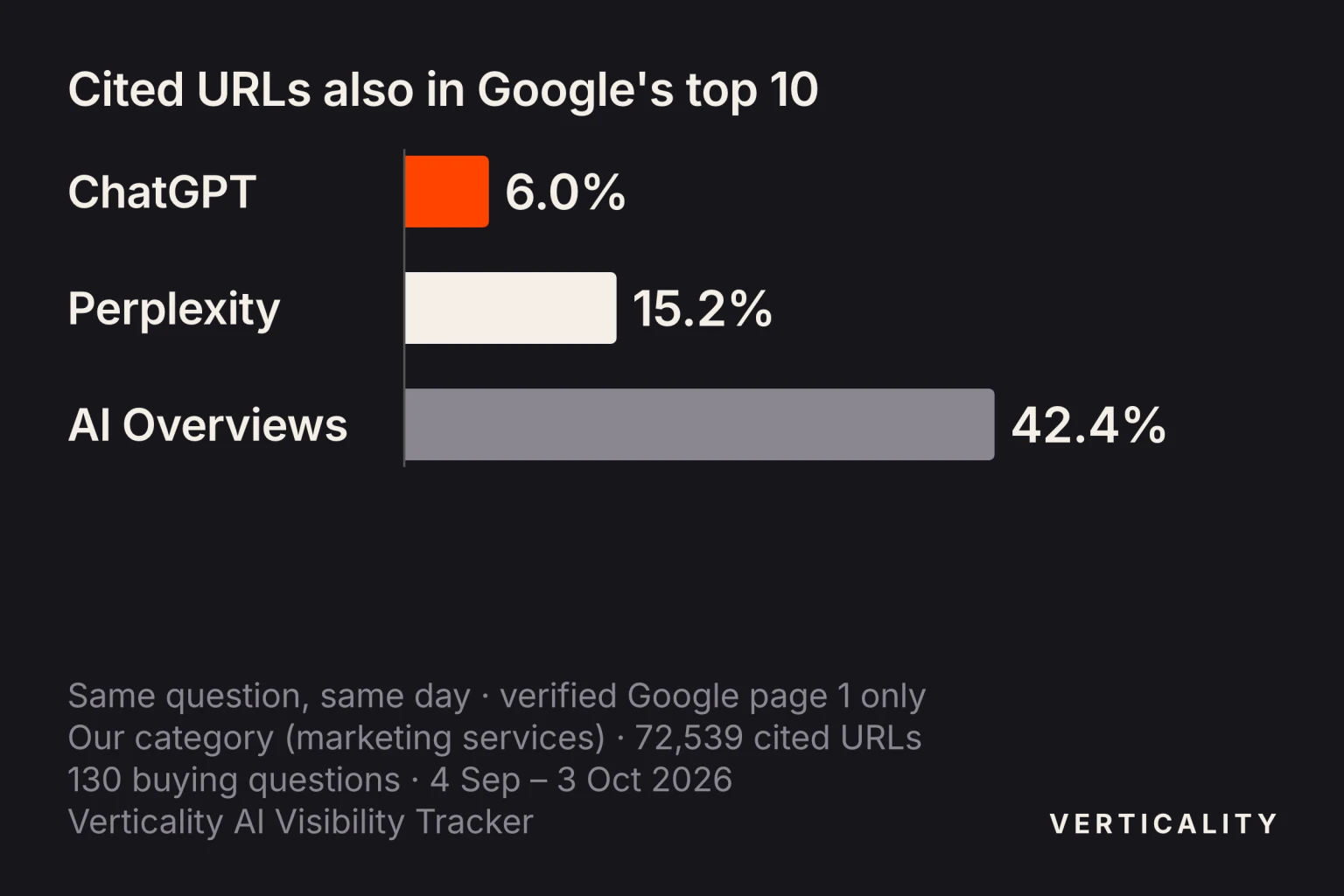
Fewer than half of the pages AI Overviews cite, and 6% of those ChatGPT cites, rank in Google’s top 10 for the same question.
Ahrefs found the same gap at scale: only 12% of the links ChatGPT, Gemini and Copilot cited appeared in Google’s top 10 for the same prompt (Ahrefs, August 2025), and only 38% of pages cited in AI Overviews ranked in the top 10 for the keyword (Ahrefs, March 2026). Google rankings help with AI Overviews and say little about the other two engines.
Can AI crawlers fetch and read your pages?
What it looks like: none of your pages is ever cited, while competitors’ service pages are.
Each engine reads the web with its own search crawler, separate from the one it uses for model training. Blocking GPTBot, OpenAI’s training crawler, does not keep you out of ChatGPT; blocking OAI-SearchBot does: “Sites that are opted out of OAI-SearchBot will not be shown in ChatGPT search answers” (OpenAI crawler documentation). The equivalents are PerplexityBot for Perplexity, Claude-SearchBot for Claude, and Googlebot itself for AI Overviews and AI Mode. Google-Extended, the token many sites block, “does not impact a site’s inclusion in Google Search” (Google).
The block is often not in robots.txt at all but in the CDN. Since July 2025 Cloudflare asks every new domain whether to allow AI crawlers, and its legacy “Block AI bots” option also stops crawlers that mix search and training (Cloudflare). It happened to us: until 3 September 2026 a Cloudflare setting we had never deliberately switched on was blocking Claude’s and Perplexity’s fetchers on verticality.co, and our robots.txt carried Disallow rules we had never written. The full log is in our ChatGPT citation guide.
The third trap is JavaScript. In a December 2024 analysis Vercel and MERJ found that “none of the major AI crawlers currently render JavaScript”, OAI-SearchBot and PerplexityBot included (Vercel). Text that appears only after scripts run is invisible to them.
Check:
- Open
yourdomain.com/robots.txtas it is served and look for Disallow rules under OAI-SearchBot, PerplexityBot, Claude-SearchBot, Googlebot and bingbot. - In your CDN, read the per-crawler log (in Cloudflare, AI Crawl Control) for allowed and blocked requests. A curl test with a borrowed user agent shows how the CDN treats impostors, not the real crawler.
- View the raw source of a key page (not the rendered page) and search for a sentence from its main text.
- Confirm the page is indexed in Bing Webmaster Tools and in Google Search Console.
Fix: allow the search crawlers and decide about training crawlers separately; turn off blanket AI-bot switches in the CDN; render the main text on the server; submit new URLs to Bing. OpenAI and Perplexity both say a robots.txt change can take about 24 hours to reach their systems.
Are you missing from the roundups AI reads?
What it looks like: the sources under the answer are “best X” and “top 10” lists, and the recommended brands appear in roughly the order those lists give.
Lists sit in most buying answers, as the first chart shows, and they shape who is named: the brands near the top of a cited list tend to be the brands in the answer. For our own brand this is the single most common cause: in a 130-question review of the 30 days to 3 October 2026, a roundup was the deciding source on 36 questions, and one list published by a competing agency was cited for 47 different questions.
The weight of lists is moving, so check it per question rather than trusting a rule. Peec AI reported that listicles fell from 15.77% to 7.80% of ChatGPT’s citations in the week after OpenAI’s GPT-5.6 update in August 2026 (a vendor figure posted on LinkedIn). In data from December 2025 to February 2026, Seer Interactive saw ChatGPT and Google’s AI Overviews “move in opposite directions on the exact same prompts”: fewer lists in ChatGPT, flat or more in AI Overviews (Seer Interactive).
Check:
- For each buying question, list the cited URLs that are roundups, comparisons or “alternatives” pages.
- Open each one: are you on it, in what position, and with the right category and price?
- Count how many of your questions each list is cited for. One list cited for 20 of your questions matters more than five lists cited for one each.
Fix: start with the lists cited for the most questions. Send the publisher what an editor needs to include you: what you do in one sentence, who it’s for, the price, and one result with a source. Ask for corrections where you are listed wrongly. Your own comparison page can work when it is fair and disclosed. Our roundup of Reddit marketing agencies for SaaS lists us first and says so, and within weeks of publishing it was cited in 14 Perplexity and 11 ChatGPT answers. Self-ranking lists are still a small share of what engines cite: in Peec AI’s study of 232,000 listicle citations, about 11% went to such self-promotional lists, and only about 4% in ChatGPT (Peec AI). Never pay for an undisclosed placement. Bing’s guidelines say content “should be created for users, not to manipulate ranking systems or trigger citations or AI responses.”
Do buyers mention you on Reddit?
What it looks like: reddit.com threads appear in the sources, and the brands recommended are the ones users name in the comments.
Reddit matters most outside ChatGPT. Across the eight other brands we track, buying answers that named vendors cited a Reddit thread in 25.8% of Google’s AI Overviews, 22.1% of Perplexity answers and 0.9% of ChatGPT answers (4 September to 3 October 2026). On our own AI-search questions the figures were 31.7%, 18.9% and 12.5%. On one of them, a single r/DigitalMarketing thread was cited in 53 Perplexity and AI Overview answers and in none from ChatGPT. Google and OpenAI both signed deals in 2024 for access to Reddit’s Data API (Google, Reddit). ChatGPT’s own use of Reddit swings: Promptwatch measured Reddit’s share of ChatGPT search citations falling from 3.83% to 0.52% in August 2026 and calls the size of the drop provisional (Promptwatch).
Check:
- Search Reddit for your category the way buyers phrase it (“best X for Y”, “X vs Y”, “anyone used X”) and read the threads from the last 12 months.
- Open the Reddit threads the engines cite for your questions. Who is recommended, and is your brand named by anyone other than you?
Fix: take part in the subreddits where your buyers ask, under each community’s rules, with your affiliation disclosed, and answer with specifics rather than links. Threads the engines already cite are the first place to be useful. Reddit’s own rules ask users to “participate authentically” and ban content manipulation (Reddit Content Policy), so fake accounts and bought upvotes cost more than they bring. How we run it for clients is on our Reddit marketing page.
Do you describe your category the way buyers ask for it?
What it looks like: the answer recommends “AI visibility agencies” while your site says “digital PR firm”; the cited pages use the buyer’s term and yours don’t.
The engine’s searches start from the buyer’s words. Google’s own advice is to “think about the words that a user might search for”, and it notes that experts and newcomers search with different words (Google SEO Starter Guide). This is not about exact keywords: Google also says its AI systems “can understand synonyms” (Google). The problem is a page that never says plainly which category it belongs to, so it never matches the searches for that category.
Check:
- Write down ten ways buyers ask for what you sell: from sales calls, the questions on Reddit, Google’s “People also ask” and the follow-up questions the engines suggest.
- Compare them with your title tags, H1s and first paragraphs. Does the category name a buyer uses appear on the page that sells it?
- Ask ChatGPT and Perplexity to describe your company in one sentence and note the category they put you in.
Fix: name the category in the buyer’s words in the title, H1 and first sentence of the page that sells it, and say who it is for. Build one page per service you really sell, not one per synonym: Google warns that creating content for every fan-out variation mainly to influence its AI answers violates its scaled content abuse policy (Google).
Can AI tell what your brand is?
What it looks like: asked about you by name, an engine confuses you with a similarly named company, gives an old description, or says it found little.
An engine can only recommend an entity it can pin down. Google says Organization structured data on your home page can help it “disambiguate your organization”, with sameAs links to your official profiles (Google). Bing’s guidelines say “clear entity definition improves grounding visibility and citation accuracy”. Markup is not a pass, though: Google states that “structured data isn’t required for generative AI search”, and its knowledge panels are built from “various sources across the web”. The consistency of your facts across the web matters more than any single tag. We learned this on our own name: in August 2026 ChatGPT answered questions about Verticality’s pricing with the plans of Vertically AI, a project-management tool, and in October it still reviewed verticality.agency, an unrelated TikTok agency, when asked for our reviews. How we traced those answers, and which we have fixed so far, is in how to correct what ChatGPT says about your brand.
Check:
- Ask each engine about your brand by name: what it does, what it costs, what its reviews say. Check every fact and every cited source.
- Compare your name, one-line description, category, location, founding year and pricing on your site, LinkedIn, Crunchbase, review platforms and directories.
- Test your home page markup in Google’s Rich Results Test and search your brand name for a knowledge panel.
Fix: use one name and one description everywhere; add Organization markup with sameAs links to the profiles you control and keep it matching the visible page; claim your Google knowledge panel if you have one. Where a similarly named company exists, say plainly on your About page what you are and are not.
Do you publish pricing and proof AI can quote?
What it looks like: the answer compares prices, terms or results, and names only the vendors whose pages state them.
No platform document or published study measures how often AI engines cite pricing or case-study pages, so this cause rests on our own data. ChatGPT searches for prices even when nobody asks: it added “pricing” to 58 of the 1,459 searches we logged, in questions that never mentioned price. Asked what a GEO agency costs on 30 September 2026, it named four agencies by their published prices, ours among them. On 14 September, recommending Verticality for Reddit marketing and citing our service page, it gave the reason in one line: “Publishes pricing starting at $1,900/month, which makes it easier to test than agencies that only quote after a sales process.”
One limit in our data: pricing pages get cited when the question is about price (all four ChatGPT answers to our cost question from 29 September to 3 October cited at least one agency’s pricing page), but rarely when an engine recommends vendors. A named vendor’s own pricing page was cited in 1.5% or fewer of competitor mentions on every engine. What counts is that the number is written somewhere the engine reads; ours sits on the service pages themselves.
Check:
- Ask the engines your price question (“How much does [category] cost?”) and two comparison questions. Whose pricing pages are cited?
- Is your price on a public page as text, or only in a PDF, an image or behind “contact us”?
- Do your case studies state a result, a timeframe and the type of client, in text?
Fix: publish a price range and what it includes, in plain HTML. Turn your best results into case pages with the number, the period and the client type, and date them. If you can’t publish prices, publish how pricing works and the typical range.
Do enough other sites mention you?
What it looks like: competitors are named across engines by many different sources, while you appear on one page or none.
This is the cause with the strongest outside evidence. In a study of 75,000 brands, Ahrefs found that branded web mentions correlate with visibility in AI answers at 0.66–0.71 across ChatGPT, Google AI Mode and AI Overviews (Ahrefs, December 2025); in its earlier AI Overviews study, backlinks correlated at only 0.218. It is a correlation, not proof of cause, but it matches what we see: of the 131,069 citations in answers to our own 130 questions in the 30 days to 3 October 2026, 89.5% pointed to third-party sites. Researchers at the University of Toronto describe the same “systematic and overwhelming bias towards Earned media” in AI search (arXiv, 2025).
Our own brand shows the gap from the other side. Of our 247 mentions in the 30 days to 3 October, 227 came with a verticality.co page cited in the same answer. Competitors are named from other people’s pages; we are named almost only from our own. Closing that gap is the slowest of the seven fixes.
Mentions only count when they are real. Google notes its AI features “can show what’s being said about products and services across the web” and that “seeking inauthentic ‘mentions’ across the web isn’t as helpful as it might seem”.
Check:
- Count pages that mention your brand, linked or not, against your three closest competitors (a mentions tool, or a search for the brand name excluding your own domain).
- List the publications, podcasts, communities and partner pages that mention competitors and not you.
Fix: go where your buyers already read: trade press, podcasts, partner and integration pages, review platforms, industry reports. First-party data is the easiest thing for other writers to quote; publish numbers only you have, dated and sourced.
How do you test whether AI recommends your brand?
A quick test takes an afternoon. Pick ten buying questions in your buyers’ words: two “best X for Y”, two “X vs Y”, one “how much does X cost”, one “who can fix [problem]”, and four from your sales calls. Ask each one in ChatGPT, Perplexity and Google (record the AI Overview), each in a new chat, and repeat on three different days. That is 90 answers.
Log one row per answer: whether your brand is named, which competitors are named, and every cited URL. Then label each cited URL: your page, a competitor’s page, a roundup, a Reddit or forum thread, a review site, media, or documentation. The label that dominates the answers you are missing from points to the cause in the table above.
With ten questions, one answer moves an engine’s rate by more than three points, so treat this as a diagnosis, not a measurement. The full method with metrics is in how to measure AI visibility. For a first read without building the spreadsheet, our free AI visibility checker runs 40+ buyer questions through ChatGPT and Google’s AI Overviews and sends you the competitors named and the sources cited within a day.
Want us to find the cause for your brand?
We run this diagnosis as the free AI visibility audit that opens our GEO programme: your buyers’ questions on ChatGPT, Perplexity and Google, the pages each engine cites instead of yours, and which of the seven causes is behind each gap, ranked into a work plan. It starts with a 30-minute call. What the audit contains is set out in what an AI visibility audit includes.
Frequently asked questions
Can you pay ChatGPT to recommend your business?
No. OpenAI states that ads do not influence ChatGPT's answers and that advertisers cannot shape, rank or alter its responses; ads appear as separate, labelled units. Google says the ranked lists in AI Overviews are not sponsored either. Money reaches AI recommendations only indirectly, through the pages and mentions the engines read.
Why does Perplexity mention our brand when ChatGPT does not?
The two engines read different pages for the same question. In our tracker, only 2.6% of the URLs Perplexity cited for a buying question were also cited by ChatGPT on the same day, and ChatGPT cites Reddit and LinkedIn far less often. A brand that lives in community threads can show up on Perplexity and be missing from ChatGPT.
Can a new brand get recommended by AI search?
Yes. ChatGPT, Perplexity and Google's AI Overviews search the web while answering, so a new page can be used within days of being crawled: ChatGPT first cited Verticality's GEO agency page five days after it went live in September 2026. Being recommended against established competitors takes longer, because it also needs mentions on the third-party pages the engines read.
How do I get ChatGPT to recommend my business?
Let OpenAI's search crawler, OAI-SearchBot, reach your pages, describe what you sell in the words buyers use, publish prices and proof in plain text, and get named accurately on the roundups and threads ChatGPT already cites for your buyers' questions. The crawler and page steps are covered in Verticality's guide to getting cited by ChatGPT.
How long does it take for AI answers to change after a fix?
Crawler fixes register fast: OpenAI and Perplexity say robots.txt changes take up to about 24 hours to reach their systems. Recommendations move slower, because they depend on third-party pages. Verticality plans for first signals in 4–8 weeks and compounding results by month 3–6.
Want your brand named in AI answers?
Our free AI visibility audit asks ChatGPT, Perplexity and Google AI Overviews the questions your buyers ask, shows who gets named instead of you and which sources they cite, and ends with a ranked work plan.
Get a free AI visibility auditNot ready for a call? Run the free AI visibility checker: 40+ buyer questions in ChatGPT and Google AI Overviews, report by email within 24 hours.