Generative Engine Optimization Best Practices: 2026 Checklist
GEO best practices for 2026 as an 11-step checklist: why each step matters, how to check it in minutes, and the Google, Bing or OpenAI page behind it.

COO · AI Search & Data Architecture
Generative engine optimization (GEO) best practices in 2026 are the steps that let AI search engines reach a page, trust what it says and quote it. Open the site to AI search crawlers and to Bing, write answer-first pages that carry facts nobody else publishes, make the brand unambiguous, and earn a place in the third-party articles and threads the engines already cite. Google’s own guide, last updated on 10 July 2026, puts the baseline plainly: optimizing for its AI features is “still SEO”.
Each of the 11 steps below has three parts: why it matters, how to check it in a few minutes, and the platform document behind it. Every source was re-read on 3 October 2026.
What are the GEO best practices for 2026?
The checklist, in the order we run it for clients:
- Let AI search crawlers in. Allow OAI-SearchBot, PerplexityBot and Claude-SearchBot in robots.txt and in the CDN or firewall.
- Get indexed in Bing. Copilot answers from Bing’s index and ChatGPT search uses partner search providers; announce new URLs through IndexNow.
- Stay indexed and snippet-eligible in Google. AI Overviews and AI Mode only link pages that can show a snippet.
- Turn on the AI reports Bing and Google already offer. Bing’s AI Performance report and Search Console’s Generative AI report.
- Answer first, in passages that stand alone. Each section opens with the answer and names its subject.
- Publish facts nobody else has. First-party numbers, quotes and sources, each with a date.
- Make the brand an unambiguous entity. Organization markup with sameAs, one name and one description everywhere.
- Publish pricing and proof. A price range, terms and results in plain text an engine can lift.
- Get named in the roundups and Reddit threads the engines cite. Earned and disclosed, never bought.
- Show when each page was updated. A visible date, dateModified and sitemap lastmod that agree.
- Measure with a fixed prompt set. The same buyer questions on the same engines, run again and again.
Where does this checklist come from?
The checklist pairs what the platforms document with what the engines cite in practice. Verticality asks “What are generative engine optimization best practices in 2026?” to ChatGPT, Perplexity and Google every day through its tracker at ai.verticality.co. Between 4 September and 3 October 2026, ChatGPT cited Google’s developer documentation in 22 of its 28 answers, arXiv papers in 19, Bing’s own pages in 15 and OpenAI’s help center in 14. Perplexity and Google’s AI Overview answered the same question mostly from agency, media and software-vendor articles; two sites appeared in all 29 Perplexity answers.
The two kinds of source disagree more often than you would expect. On 3 October 2026, Google’s own AI Overview for “generative engine optimization best practices” advised adding FAQPage and HowTo markup, while its first reference was Google’s guide saying that generative AI search needs no special schema.org markup. Where the articles and the documentation differ, this checklist follows the documentation, and every step below links it.
How do you apply each practice, and how do you check it?
1. Let AI search crawlers reach your pages
Each AI search engine builds its own index with its own crawler, and a block at any layer keeps that engine from reading the site. OpenAI’s crawler page says OAI-SearchBot is used “to surface websites in search results in ChatGPT’s search features”. Perplexity says PerplexityBot exists to surface and link websites in its results, and Anthropic warns that blocking Claude-SearchBot “may reduce your site’s visibility” in Claude’s search answers. Training crawlers are separate: a site can allow OAI-SearchBot and still disallow GPTBot.
robots.txt is only half of it. On 3 September 2026 we found Cloudflare’s legacy “Block AI bots” rule returning 403 to Claude-User and Perplexity-User on verticality.co while our robots.txt allowed every bot, and switched it off the same day; we tell that story in full in How to get cited by ChatGPT.
How to check: open /robots.txt and look for Disallow lines under these user agents or under User-agent: *. In the CDN, confirm the three crawlers are allowed (in Cloudflare: AI Crawl Control). In server logs, match requests carrying these user agents against the published IP lists: openai.com/searchbot.json, perplexity.com/perplexitybot.json and claude.com/crawling/bots.json. After a change, allow a day: OpenAI quotes about 24 hours, Perplexity up to 24 hours.
Sources: OpenAI crawlers, Perplexity crawlers, Anthropic crawler help (updated 7 April 2026).
2. Get your pages into Bing’s index
Bing’s index feeds more AI answers than Bing’s own results page. Microsoft says Copilot Chat is grounded in data from the public web from the Bing search service, and OpenAI says ChatGPT search sometimes partners with other search providers, Microsoft among them. Bing’s Webmaster Guidelines now cover Copilot and grounding throughout, and they warn that duplicate URLs “reduce Bing’s confidence in selecting a URL for grounding results or citations”.
On 24 September 2026, the only two verticality.co pages missing from Bing were service pages that shared much of their wording with neighbouring pages; Bing listed both as “Discovered but not crawled”, and ChatGPT had cited neither. We rewrote both and resubmitted them through IndexNow the same day.
How to check: in Bing Webmaster Tools, run URL Inspection on your key pages and submit the XML sitemap. Search Bing for the exact URL. Confirm key pages carry no NOARCHIVE directive, which Bing says keeps content out of Copilot responses. For new or changed pages, send the URL to IndexNow, which shares it with Bing and the other participating engines; Google is not one of them.
Sources: Bing Webmaster Guidelines, IndexNow, Microsoft Copilot Chat privacy (updated 18 August 2026), ChatGPT search help (updated 21 August 2026).
3. Stay indexed and snippet-eligible in Google
Google’s rule for AI Overviews and AI Mode is the same as for a normal result with a preview: the page must be indexed and eligible to show a snippet. Since 31 August 2026 there is also a site-level switch in Search Console, “Search generative AI”, which is set to include every site by default. A nosnippet rule also stops the page’s content from being used as a direct input for AI Overviews and AI Mode, and max-snippet limits how much of it they can use.
How to check: run URL Inspection in Search Console on the pages you want cited and confirm “URL is on Google”. Search the page source and the X-Robots-Tag header for nosnippet, max-snippet and data-nosnippet around key content. In Search Console, open Settings, then Search generative AI, and confirm it still says Include.
Sources: Google AI optimization guide (updated 10 July 2026), robots meta tag (updated 24 March 2026), Search generative AI control.
4. Turn on the AI reports Bing and Google already give you
Bing’s AI Performance report, in public preview since 10 February 2026, shows which of your pages were cited in Microsoft Copilot, Bing’s AI summaries and select partner experiences, how those citations trend, and the grounding queries the AI used to retrieve them. In June 2026 Bing added Intents, Topics, Citation Share and a period-over-period Compare. Bing notes that the data is a sample and that a citation is not a click. When we opened it for verticality.co on 24 September 2026, it showed 16 citations over three months.
Google’s Generative AI performance report in Search Console counts how often your URLs appeared in AI Overviews and AI Mode; it reached every site worldwide on 31 August 2026. It shows impressions by page, country, device and date; it has no clicks, and its help page lists no filter that separates AI Overviews from AI Mode.
Neither report covers ChatGPT or Perplexity. For ChatGPT, OpenAI tags its referrals: links clicked in ChatGPT search arrive with utm_source=chatgpt.com, so they show up as a source in Google Analytics.
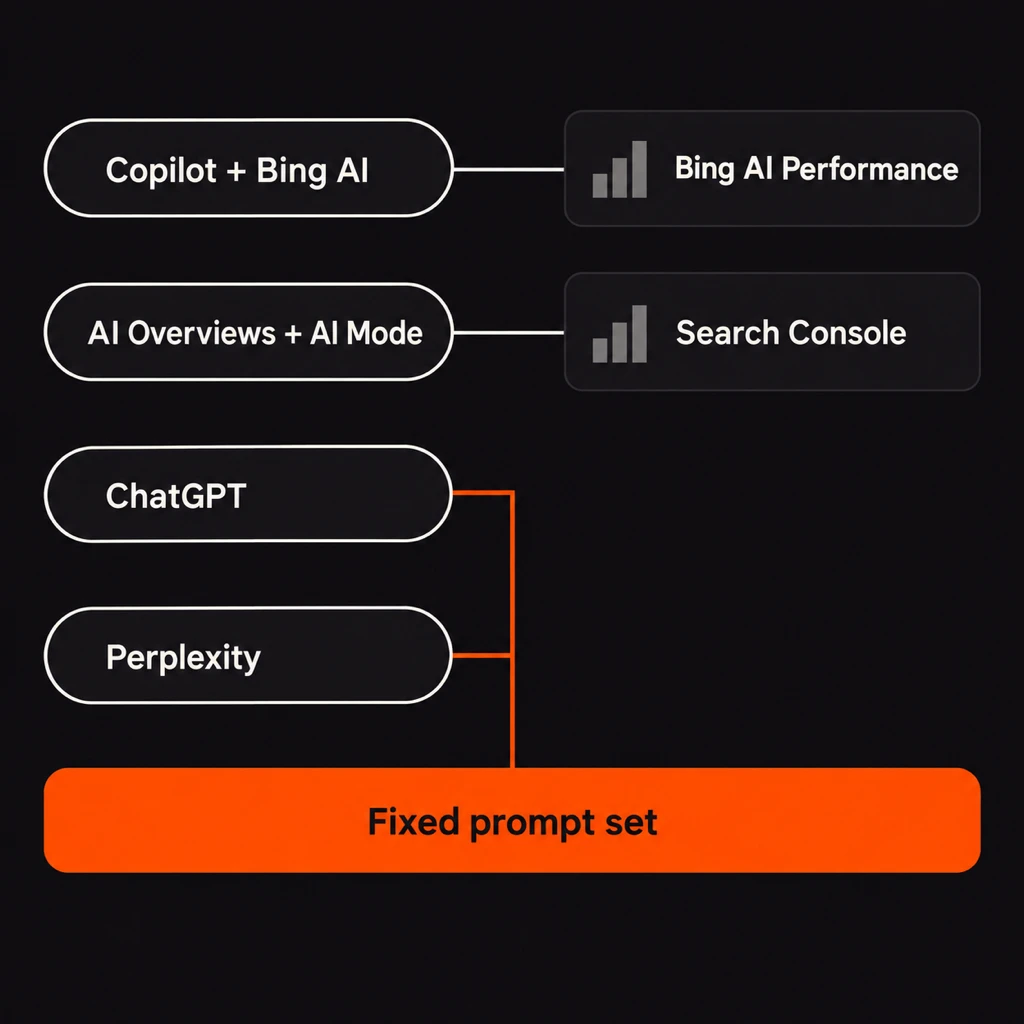
Bing and Google each report citations in their own AI answers; neither covers ChatGPT or Perplexity, which a fixed prompt set (step 11) does.
How to check: in Bing Webmaster Tools, open AI Performance. In Search Console, open Performance, then Generative AI. In GA4, filter sessions by source chatgpt.com.
Sources: Bing AI Performance help, Bing announcement (10 February 2026), Bing June 2026 update, Search Console announcement (3 June 2026), report help, OpenAI publisher FAQ (updated 29 August 2026).
5. Answer first, in passages that stand on their own
AI engines retrieve passages, not whole pages, and judge each passage against the question. A July 2026 review of 45 GEO studies (Martinez, arXiv 2607.14035, a preprint) rates relevance to the query and position near the top of the retrieved context as the levers with the strongest evidence. Bing’s guidelines say the same in their own words: a URL is more likely to be cited “when content stands on its own”, and long introductions before the main topic should go. In practice: the first sentence under each heading answers that heading and names the product, company or place, with no “it” or “this” pointing back to earlier text.
Google adds a limit. Its guide says there is no need to break content into tiny pieces and no ideal page length. Structure is for readers first; we described the paragraph formula we use in How SaaS pages get cited by AI.
How to check: read the first sentence under every H2 on its own. If it does not answer the heading, or the subject is only a pronoun, rewrite it. Count the sections that open with background instead of the answer.
Sources: Google AI optimization guide, Bing Webmaster Guidelines, arXiv 2607.14035.
6. Publish facts nobody else has
Google’s AI optimization guide says content people find unique and useful will likely shape a site’s presence in AI search more than any other suggestion it makes, and gives “7 Tips for First-Time Homebuyers” as its example of commodity content. The research points the same way: in the original GEO paper (Aggarwal et al., KDD 2024), adding quotations, statistics and cited sources raised a page’s share of the AI answer by roughly 30–40%. That test ran on GPT-3.5 with the page already among the five sources, so read it as “evidence helps a retrieved page”, not as a traffic forecast.
First-party data is the easiest unique fact to own: your prices, your customer counts, your test results, your own measurements, each with a date and a method.
How to check: on each key page, count the numbers that come with a source and a date. If the count is zero, the page is commodity content in Google’s sense. Then list the facts the top three results for your target question share, and cut the ones you only repeat.
Sources: Google AI optimization guide, Aggarwal et al., arXiv 2311.09735.
7. Make your brand an unambiguous entity
An engine has to decide which company a page is about before it can recommend it. Google says Organization markup helps it “disambiguate your organization in search results”, and its sameAs property lists your profiles on other sites: LinkedIn, Crunchbase, review sites, directories. The markup is not an on-switch: Google states that structured data isn’t required for generative AI search. Bing’s guidelines add that clear entity definition improves citation accuracy. The value is consistency, so the company name, one-line description, category and location should read the same on your site and on every profile sameAs points to.
How to check: run the homepage through Google’s Rich Results Test and confirm Organization is detected with logo and sameAs. Paste the one-line description from your site and your top five profiles side by side; they should match. Ask ChatGPT and Perplexity “What is [brand]?” and note any confusion with a similarly named company.
Sources: Google Organization structured data (updated 8 September 2026), Google AI optimization guide, Bing Webmaster Guidelines.
8. Publish pricing and proof in plain text
Buyers ask AI engines what a product costs and whether it works, and the engines answer with whatever is published, yours or someone else’s estimate. On 30 September 2026, ChatGPT answered “How much does a GEO agency cost?” with a range and then a list of agencies’ published prices, ours among them (“Verticality lists $2,500–$7,500/mo”), citing the page where that range is printed. Every agency in that list was one that publishes a number.
Proof works the same way. A case study with the starting point, the result, the dates and the method is quotable; “trusted by leading brands” is not.
How to check: ask ChatGPT and Perplexity “How much does [brand] cost?” and see which source each one cites. Open your pricing page with JavaScript disabled and confirm the price is in the HTML text, not in an image or behind a form.
Source: Verticality AI Visibility Tracker, ChatGPT answer of 30 September 2026 to tracked question #64.
9. Get named in the roundups and Reddit threads the engines cite
Most AI citations point to pages the brand does not own. In our 3 September 2026 measurement of 31 buying questions about GEO agencies, 63.6% of cited sources were articles and roundups published by others, and 21.0% were vendor and agency sites. A 2025 University of Toronto study (Chen et al., arXiv 2509.08919) found the same tilt for US software queries: 72.7% of the sources in GPT-based AI search were earned media (third-party publishers and reviews), against 45.4% in Google’s classic results. Reddit’s weight depends on the engine: across 56 AI-search questions from 4 to 23 September 2026, reddit.com appeared in 35.0% of Google AI Overviews, 30.9% of Perplexity answers and 7.9% of ChatGPT answers. Axios reported in August 2026, from Promptwatch data, that Reddit’s share of ChatGPT citations had fallen from 3.83% to 0.52%.
Google sets the boundary: its guide says seeking inauthentic mentions “isn’t as helpful as it might seem”, because its spam systems sit underneath its AI features. A placement has to be earned: a listing you qualify for, an answer in a thread from a disclosed account, a mention a journalist chose to make.
How to check: for your ten most valuable buyer questions, list the third-party URLs each engine cites and mark the ones that name you. The unmarked rows are your outreach list, ranked by how many questions each page covers.
Sources: Verticality GEO agency research, Verticality AI Visibility Tracker, Axios, 20 August 2026, Google AI optimization guide.
10. Show when each page was last updated
AI search answers lean on current pages, and engines read dates from several places at once. Google says it does not depend on a single date factor and asks for a visible, labelled date (“Published”, “Last updated”) plus datePublished and dateModified in Article markup, with the two matching. Bing calls the sitemap lastmod field “a key signal” for deciding what to recrawl, and asks that it change only when the content of that URL actually changed, not every time the sitemap is rebuilt.
There is no published refresh interval. Advice to “update every 90 days” is a rule of thumb, not something any engine documents; change the date when the facts change, and change the facts when they go stale.
How to check: on a key page, compare the visible “Updated” date, dateModified in the page source and the <lastmod> for that URL in the sitemap. All three should agree.
Sources: Google byline dates (updated 10 December 2025), Bing on sitemaps in AI-powered search (31 July 2025).
11. Measure with a fixed prompt set
AI answers change from one run to the next, so a single manual check is noise. A 2026 study of repeated AI search queries (Schulte et al., arXiv 2604.07585) found that about 65% of cited sources changed from one day to the next. Our tracker shows the same churn by engine: for the same question, ChatGPT cited only 26.4% of the previous day’s URLs again, Perplexity 70.1% and Google AI Overviews 49.8% (4–23 September 2026).
The fix is a fixed set of buyer questions, asked on each engine every day or several times a week and compared over two- to four-week windows, so that a change in the numbers reflects a change in your visibility rather than a lucky run. How to build that set and read the rates is covered in How to measure AI visibility. For a one-off starting point, the free AI visibility checker asks 40+ buyer questions in ChatGPT and Google AI Overviews, more than once each.
How to check: write down the questions you track. If the list changed in the last month, or each question was asked once, the trend you see is not yet a trend.
Sources: Schulte et al., arXiv 2604.07585, Verticality AI Visibility Tracker.
What changes for ChatGPT, Perplexity and Google AI Overviews?
- ChatGPT (full guide): needs OAI-SearchBot access, draws on partner search providers such as Microsoft’s, and leans on official documentation more than the others; a quarter of the URLs it cited for our 56 AI-search questions from 4 to 23 September 2026 were platform docs.
- Perplexity (full guide): runs its own index through PerplexityBot, cites about 20 URLs per answer and keeps its citations the most stable from day to day.
- Google AI Overviews and AI Mode (full guide): are rooted in Google’s core ranking systems, need no special markup, and are the only engine of the three that cites YouTube often (in 44.5% of the Overviews we tracked from 4 to 23 September 2026).
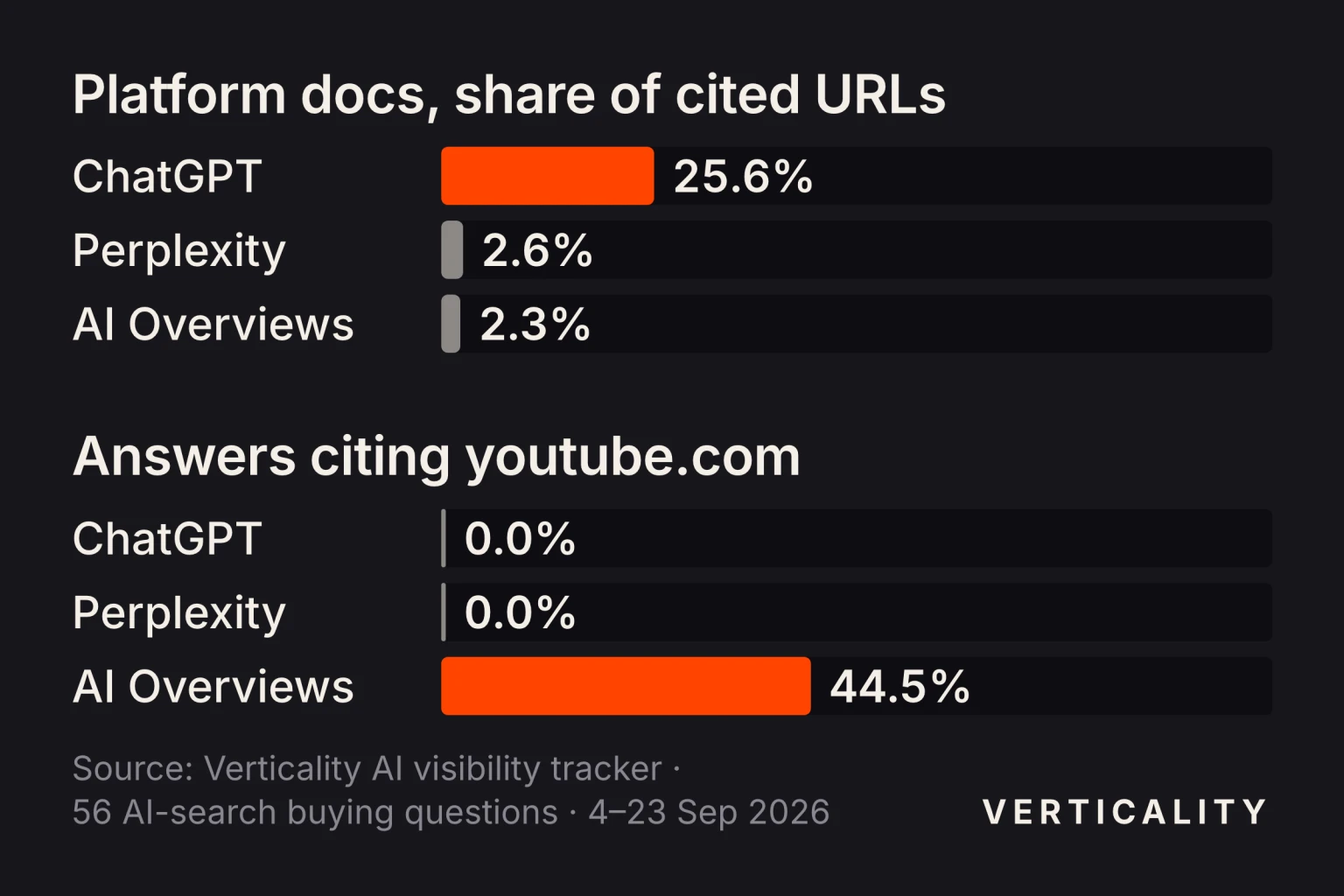
ChatGPT leans on platform documentation, and only Google’s AI Overviews cites YouTube. 56 AI-search buying questions, 4–23 Sep 2026; measured on the buying questions in our own category (marketing services), not a cross-industry census.
Which GEO tactics are myths in 2026?
- llms.txt as a ranking factor. Google’s guide says such a file will neither harm nor help visibility in Google Search, because “Google Search ignores them”. The file does not control crawler access either; robots.txt does. We publish one at /llms.txt as a plain summary for assistants and agents that read it; we do not count on it for rankings or citations.
- Opening GPTBot to get into ChatGPT search. Several popular GEO checklists tell you to allow GPTBot. OpenAI’s documentation separates the two: GPTBot collects training data, and OAI-SearchBot is the crawler that puts pages into ChatGPT search results.
- Keyword stuffing for LLMs. The GEO paper found that adding keywords offered “little to no improvement” in AI answers, Google’s spam policies treat it as manipulation, now explicitly including AI responses, and Bing’s guidelines list keyword loading meant to trigger citations or AI responses as abuse.
- Schema as an on-switch. Google says structured data isn’t required for AI Overviews or AI Mode and there is no special AI markup; Bing says it may support clearer grounding but guarantees nothing.
- Chopping content into tiny chunks. Google says there is no requirement to break content into small pieces and no ideal page length.
- A page for every fan-out query. Pages built mainly to catch query variations count as scaled content abuse under Google’s spam policy.
- Bought or fake mentions. Google says its AI features depend on the same systems that block spam in normal results, so seeking inauthentic mentions helps less than it seems.
- Tools that claim insider data. Google says no third-party tool has access to its internal ranking or AI systems.
In what order should you work through the checklist?
Start with access, because nothing else counts until engines can read the page: steps 1 to 3 are configuration work measured in days, even if indexing then takes longer. Set up measurement next (steps 4 and 11), so you have a baseline before content changes. Then fix the pages buyers ask about (steps 5 to 8), and run third-party placements (step 9) alongside, since they take the longest. Step 10 is upkeep.
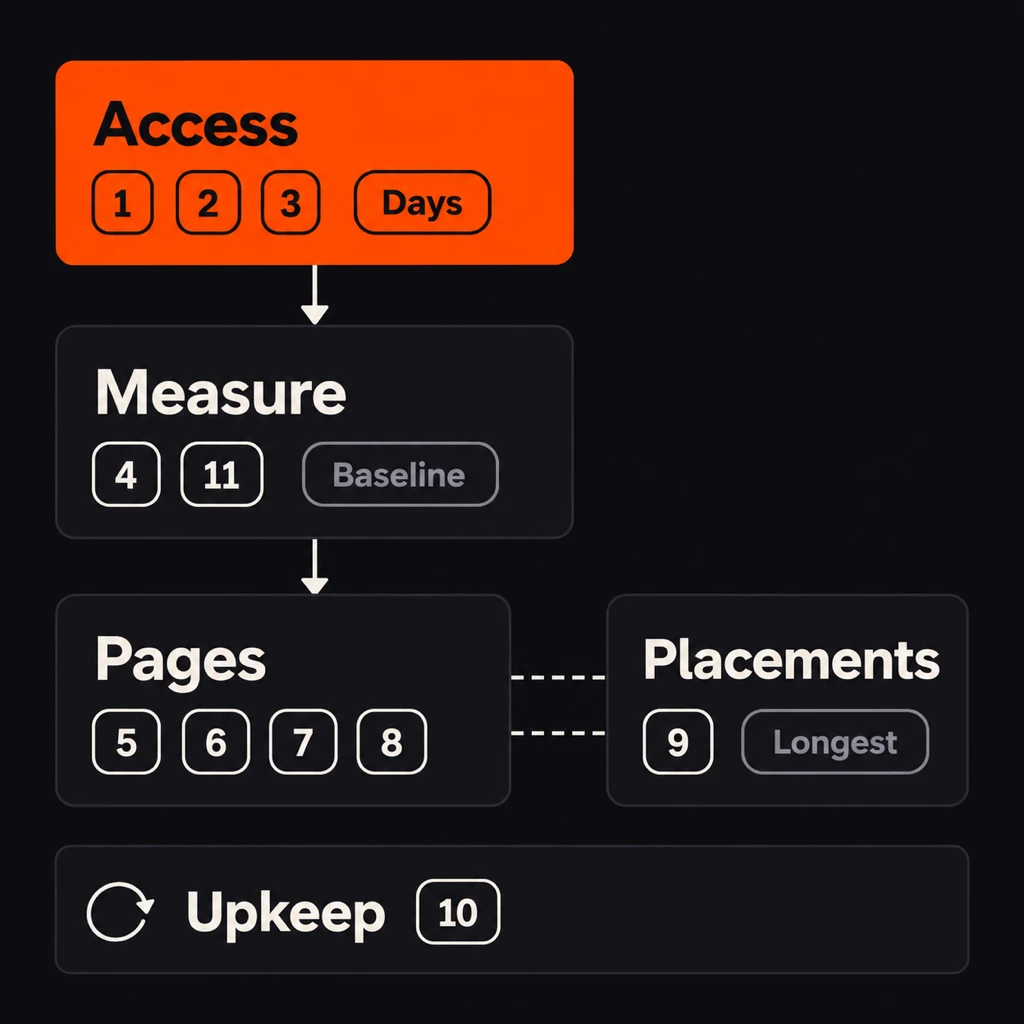
Access first, a baseline before content changes, placements alongside the page work, dates as upkeep.
In our programmes, first signals arrive in 4–8 weeks and compound by month 3–6. On verticality.co, the tracker counted 0 mentions in 450 answers on 3 September 2026, the day we removed the Cloudflare block. Our GEO page went live on 15 September, and ChatGPT first cited it on 20 September, five days later.
Want us to run this checklist on your site?
Every Verticality GEO programme opens with a free audit built on this checklist, plus the measurement: your mention rate on each engine across 50–200 of your buyers’ questions, the competitors named in your place, every source the engines cite, and a ranked plan of what to fix and which placements to earn. The programme costs $2,500–$7,500 a month, month-to-month. See how the GEO programme and the free audit work.
Frequently asked questions
What is the most important GEO best practice in 2026?
Access comes first: if a CDN or robots.txt blocks OAI-SearchBot, PerplexityBot or Claude-SearchBot, or a page is missing from Bing or Google, no content work can get it cited. After that, Google's July 2026 AI optimization guide names unique, non-commodity content as the factor likely to matter more than any other suggestion it makes.
Does llms.txt help with generative engine optimization?
Not in Google. Google's AI optimization guide says an llms.txt file will neither harm nor help visibility or rankings in Google Search, because Google Search ignores it. Some assistants and agents do read the file, so it can serve as a plain summary of a site, but it is not a ranking or citation factor.
Do I need schema markup to appear in AI Overviews?
No. Google states that structured data isn't required for generative AI search and that there is no special schema.org markup for it. Organization markup with sameAs links is still worth having, because Google uses it to disambiguate a company from others with similar names.
How do I check whether ChatGPT can find my website?
Check three things: robots.txt and the CDN allow OAI-SearchBot from OpenAI's published IP list, the page is indexed in Bing (ChatGPT search partners with other search providers, Microsoft among them), and analytics shows referrals tagged utm_source=chatgpt.com. OpenAI notes that robots.txt changes take about 24 hours to reach search.
How long do GEO best practices take to show results?
At Verticality we see first signals in 4–8 weeks and compounding by month 3–6. Technical fixes such as unblocking AI crawlers act within days, while third-party mentions in roundups and Reddit threads take the longest to build.
Want your brand named in AI answers?
Our free AI visibility audit asks ChatGPT, Perplexity and Google AI Overviews the questions your buyers ask, shows who gets named instead of you and which sources they cite, and ends with a ranked work plan.
Get a free AI visibility auditNot ready for a call? Run the free AI visibility checker: 40+ buyer questions in ChatGPT and Google AI Overviews, report by email within 24 hours.