How to Correct What ChatGPT Says About Your Brand: Fix the Source
OpenAI has no correction form for companies. Find out if the wrong fact came from a web search or from training data, fix that source, then re-check weekly.
COO · AI Search & Data Architecture
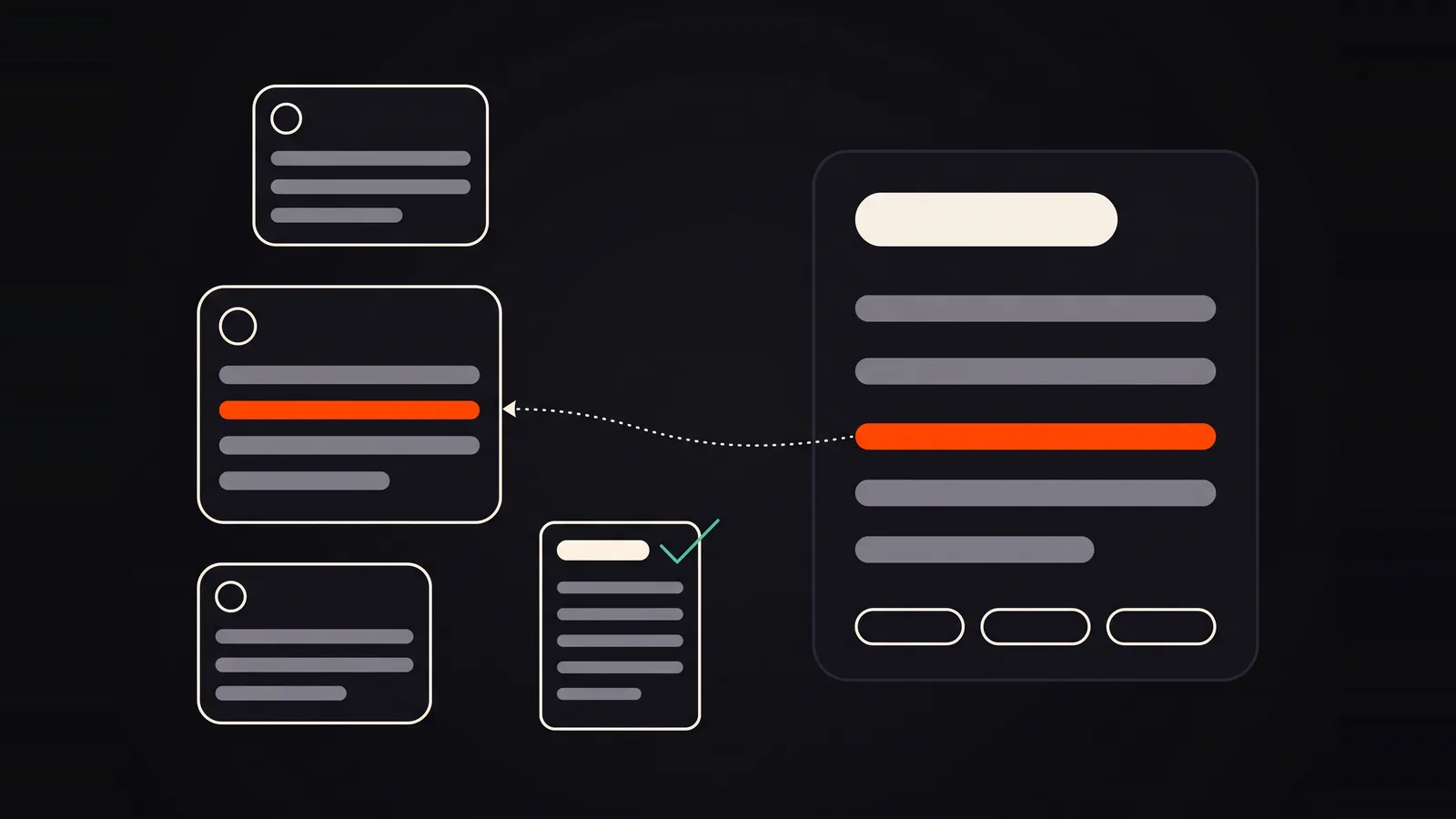
OpenAI has no form that lets a company correct what ChatGPT says about it. You change the answer by changing its source. First work out where the wrong fact comes from. If the answer links to sources, ChatGPT found the fact in a live web search, so open the links and fix, answer or outweigh the page that says it. If the answer links to nothing, the fact comes from what the model learned in training, so publish the correct fact where ChatGPT’s search will find it. Then ask the same questions every week until the answers change.
The sources here are OpenAI’s help pages as they read on 3 October 2026, plus one case of our own: in August, ChatGPT answered a question about Verticality’s pricing with another company’s price list, and in October it got the price right.
Can you ask OpenAI to correct what ChatGPT says about your company?
Not for company facts. We went through every channel OpenAI documents on 3 October 2026, and none of them takes a correction to a company’s prices, features, founding date or locations. Asked this very question on 3 October, ChatGPT agreed: “there’s no direct ‘edit what ChatGPT knows about my company’ control”. Here is what does exist.
| Channel | Who it is for | What it can do about a wrong fact |
|---|---|---|
| privacy.openai.com or dsar@openai.com | A person whose personal data appears in ChatGPT’s answers | OpenAI “will consider” a correction or removal “based on applicable law and the technical capabilities of our models”. ID required. Covers a founder’s personal details, not the company |
| Content report form | Content that “may violate OpenAI’s Terms of Use or applicable laws” | The form has no “inaccurate information” reason. A reported domain may be filtered so ChatGPT stops “relying on unreliable sources” |
| Thumbs down on an answer | Any user | Feedback. “The entire conversation associated with that feedback may be used to train our models.” No correction, no reply |
| Product feed | Merchants in ChatGPT’s shopping results | Keeps product prices and details current. Products only |
| publishers-feedback@openai.com | Publishers with feedback on ChatGPT search | A general feedback address from the 2024 search launch |
| Correcting ChatGPT in your own chat | You | Memory “personalizes responses” from your own chats. Nothing in OpenAI’s documentation says a correction typed in one chat changes what anyone else is told |
If the wrong claim is about a person, such as a founder’s career or a lawsuit that never happened, the privacy route exists. OpenAI says it assesses accuracy “based on the information provided with your request and cannot independently investigate disputed facts”, so send the evidence with the request (OpenAI Help Center). If the claim is about the company, the fix is in the pages ChatGPT reads.
Where does ChatGPT get wrong facts about your brand?
From one of two places, and you need to know which one before you fix anything.
What the model learned in training. OpenAI’s help center says: “Without search enabled: Responses are based on what the model has learned during training” (OpenAI Help Center). Training data stops at a cutoff date. On 3 October 2026 the default models in ChatGPT were GPT-5.6 Luna for Free and Go users and GPT-5.6 Sol on paid plans, and OpenAI’s model pages give both a knowledge cutoff of 16 February 2026 (OpenAI). A price you changed in March is a fact the model cannot know without searching. There is also nothing to edit: OpenAI’s models “do not store or retain copies of the data they are trained on.”
A live web search. ChatGPT “may search the web automatically when your question would benefit from current information”, and its search tools are “enabled for all models by default”. When it uses its search partners, it rewrites your question into targeted queries for them and builds the answer from the pages it gets back (OpenAI Help Center). OpenAI’s own warning: “Search results and citations can be incomplete, outdated, or incorrect.” An old Reddit thread, a 2023 review or your own retired pricing page can all end up in the answer. Reddit is especially easy for ChatGPT to reach: since May 2024 OpenAI has had access to Reddit’s Data API, “which provides real-time, structured, and unique content from Reddit” (Reddit).
Within those two sources, wrong answers about brands follow four patterns:
| What you see | What usually happened | First fix |
|---|---|---|
| Old facts and no links | The answer came from training data | Ask again with search on; publish the current fact where search finds it |
| A link to a page that states the wrong fact | Search found an outdated or wrong page | Fix, answer or outweigh that page |
| A description of a different company with your name | The engine matched your name to another entity | Put your category next to your name everywhere; give each buyer question a page under your name |
| A link to your page, plus a detail your page does not state | The model filled a gap or misread a term | State the fact in one plain sentence; spell out abbreviations |
The third pattern is the one we ran into ourselves.
How do you tell whether a wrong fact came from search or from the model?
Run this test before you change anything. It takes about ten minutes per question.
- Ask as a buyer would, from a clean session. Memory and custom instructions shape your own ChatGPT, so test logged out or with memory switched off. Use buyers’ words: “[Brand] pricing”, “[Brand] reviews”, “is [Brand] legit”, “[Brand] vs [competitor]”.
- Ask each question three times. Every answer is generated afresh, and the sources rotate. From 4 to 23 September 2026, ChatGPT repeated only 26.4% of the pages it had linked for a tracked question when we asked the same question a day later. One answer is an anecdote.
- Look for sources. OpenAI’s own test is “whether sources from the web are cited to in the response”. Inline links and a Sources button mean a web search ran.
- If there are links, open each one and find the sentence. OpenAI’s advice is to “Open a cited source to check that it supports the answer”. The page that contains the wrong claim is your target. If none of the linked pages contains it, the model combined or misread what they say.
- If there are no links, the answer came from training data. Ask again and click the web search icon, or ask ChatGPT to search the web. If the searched answer is right, your pages already work, and the old fact will only appear when ChatGPT answers without searching. If the searched answer is still wrong, go back to step 4.
- Search the exact wording of the wrong claim in Google and Bing, in quotes. A claim with no link in the answer often still lives on a page somewhere.
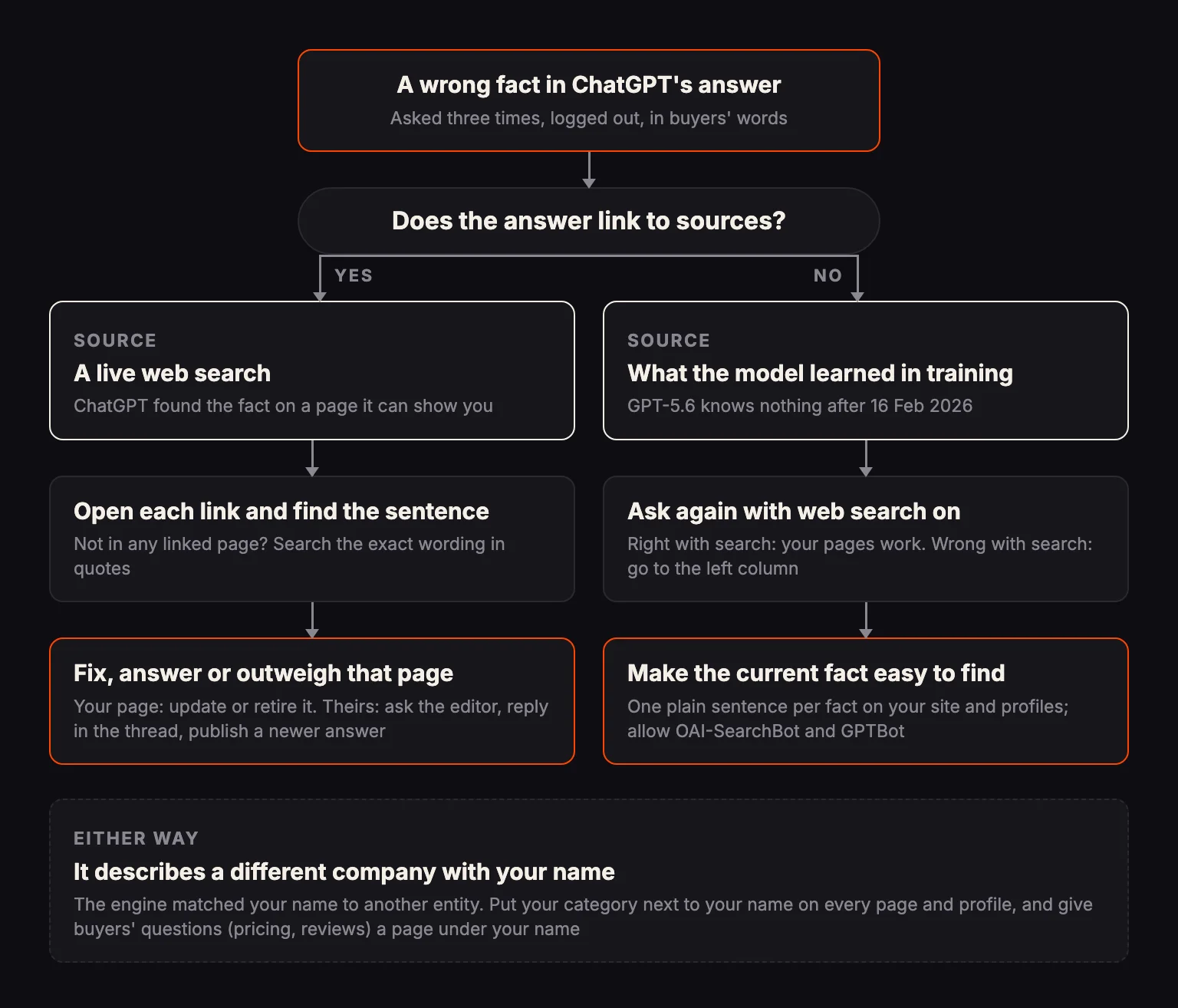
Links in the answer mean a web search ran, so the fix is a page. No links mean the model is answering from what it learned in training.
Write down the date, the question, the answer and every link. That log is what you compare against after the fix.
What happened when ChatGPT confused us with two other companies?
On 15 August 2026 we asked ChatGPT eight questions about Verticality, three times each, through the same collector our tracker uses. Two went wrong in exactly the ways this guide is about.
- “Verticality pricing plans explained.” All three answers described Vertically AI, a project-management tool, with its Free plan, a $50-a-month Team plan and Enterprise pricing, and linked vertically.ai. Our site did list prices then, as “Starting from” lines on each service page, but no page answered the question as a buyer asked it, and ChatGPT matched our name to a different product that publishes a plan table.
- “Verticality agency reviews and ratings.” Two of three answers reviewed verticality.agency, a TikTok live-streaming agency, using a ScamAdviser check and a Scam Detector score of 34.8 out of 100. The third described us and flagged the two names. That day, one of ChatGPT’s three answers about our services cited our LinkedIn page, not our website, and called us “a full-service digital marketing and web development agency”.
Between the two tests we changed three things on our own site. On 3 September we added Organization schema with our legal name, Toronto address and profile links, and page titles that put the category next to the name (“Verticality — AI Search Marketing Agency”). On 15 September we published our GEO programme page with a priced table of three tiers, and on 18 September a page on how the work runs. On 3 October we asked the same questions again, three times each, through the same collector.
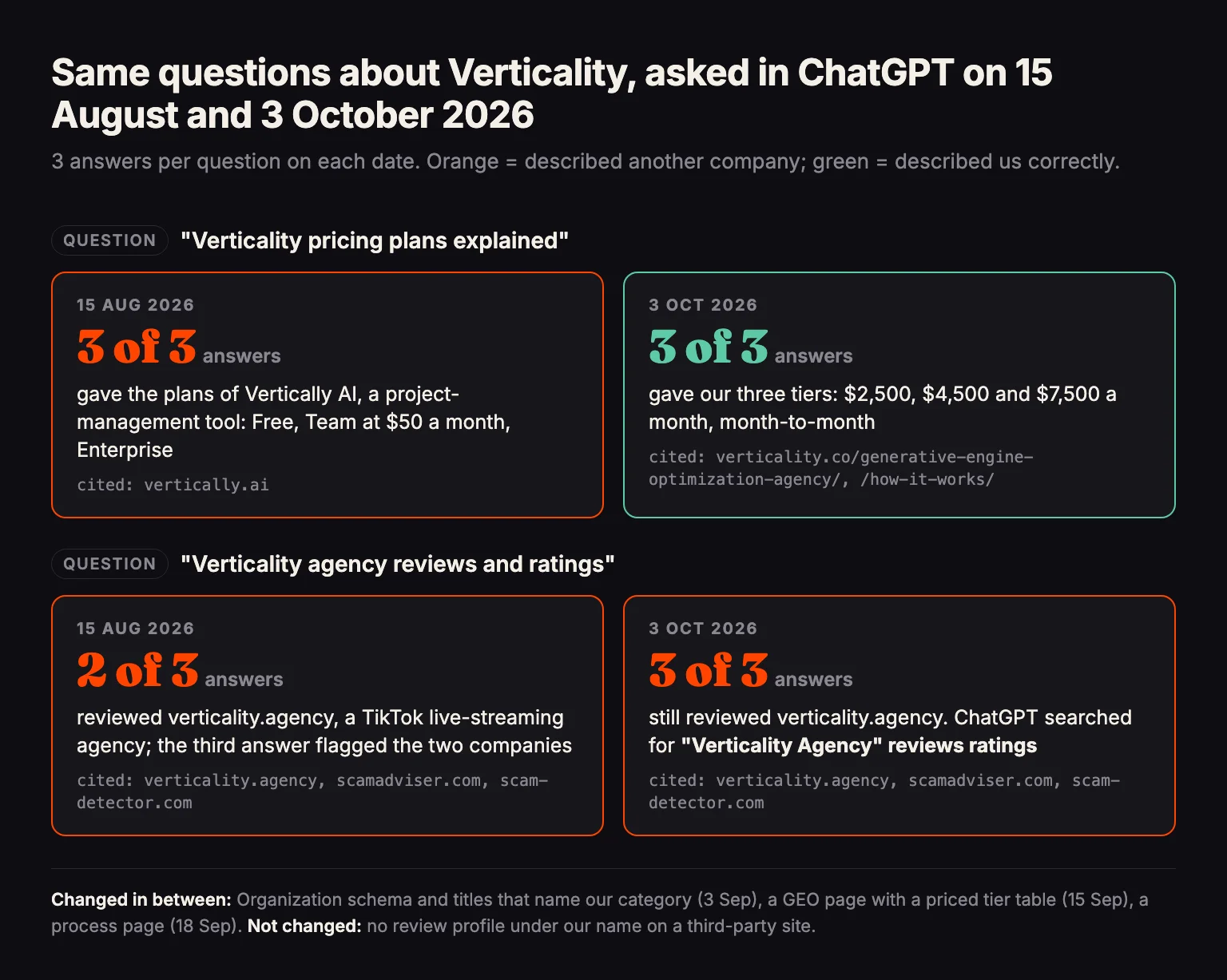
The price question fixed itself once a page answered it. The reviews question did not, because no review page under our name exists for search to find.
- Pricing: fixed. All three answers gave our tiers correctly, $2,500, $4,500 and $7,500 a month, month-to-month, and linked our GEO programme page and how it works. Both pages went live after the August test and after GPT-5.6’s February cutoff, so the right answer came from search.
- Reviews: still wrong. All three answers reviewed the TikTok agency again. The collector also records the searches ChatGPT runs, and for all three answers it searched for
"Verticality Agency" reviews ratings, the other company’s name, letter for letter. The review-type pages it found, ScamAdviser and Scam Detector, are about that company. We have no review profile on a third-party site, so a question about our reviews has nothing of ours to find.
The lesson is which kind of page answers which kind of question. Facts you publish, such as price, plans and services, can be fixed on your own site. Questions about trust, such as reviews, ratings and “is it legit”, are answered from third-party pages, so the fix for those is a profile or review page under your name that search can match.
A correct site is not the end of it. On the same day, Perplexity called verticality.co “a geotargeting and analytics service” and listed “Geotargeting and location-based analytics (GEO)” among our services, although our pages spell GEO out as generative engine optimization. Check every engine your buyers use, not only ChatGPT.
How do you fix a wrong fact that ChatGPT found in a search?
Work from the sources you control outwards. Your own pages change the same day; third-party pages change when someone else agrees to change them.
- Fix or retire your own outdated pages. Old pricing pages, launch posts, PDFs and help articles with old plan names are the easiest sources to fix and the most often forgotten. Update them, redirect them to the current page, or put a dated note at the top: “This plan was retired in March 2026. Current pricing is here.”
- Publish the facts buyers ask about, one plain sentence each. Price and what it includes, plans, main features, who the product is for, founding year, headquarters, legal name. Name the brand in each sentence so it can be quoted on its own, and show the date the page was last updated. If buyers ask “[Brand] pricing”, one page should answer exactly that question.
- Mark up who you are. Use Organization schema with your legal name, address, founding date and
sameAslinks to your profiles. Google says the markup can help it “disambiguate your organization in search results” (Google Search Central), and schema.org has a property built for name clashes,disambiguatingDescription, “used to disambiguate from other, similar items”. OpenAI’s documentation says nothing about structured data, so treat markup as support for the visible sentences, not a substitute. - Update the profiles you control. On LinkedIn, a Page super admin can edit the company details. On Crunchbase any signed-in user can edit a profile, and locked fields need verified employment. On G2 you claim the listing, and G2 approves claims within 1–3 business days. On Google Business Profile, Google reviews edits before they go live. Use the same category and location wording as your site.
- Ask third-party publishers to correct the page. For a roundup, review or comparison with an old price or a wrong feature, email the editor the exact sentence, the correct fact and a link to the page that shows it. One specific, checkable change is easier to act on than a request to rewrite a review.
- On Wikipedia, ask; do not edit. The conflict-of-interest guideline says such editors are “strongly discouraged from editing affected articles directly, and can propose changes on article talk pages instead”, using the
{{edit COI}}template, and paid editors must disclose who pays them (Wikipedia). Volunteers review the requests, and there is no set deadline. - Make sure the corrected page can be fetched. If your robots.txt or CDN blocks OAI-SearchBot, ChatGPT search cannot read your correction. OpenAI says a robots.txt change takes about 24 hours to reach search. The crawler checklist is in how to get cited by ChatGPT.
- Report a domain only if it is genuinely unreliable. OpenAI’s report form is for Terms of Use and legal violations, and reported domains “may be reviewed by OpenAI’s Model Quality team, which may apply filters or other mitigations”. A scam site posing as your brand is a fit. A critical review is not.
What can you do about old Reddit threads that ChatGPT cites?
You cannot edit or delete another person’s post, and often you cannot reply to it either. If a subreddit has archiving switched on, posts lock after six months: “redditors will not be able to vote or comment on posts older than six months” (Reddit Help). What you can do:
- Reply if the thread is still open. Post from a disclosed account with the current fact and a link to the page that states it. Reddit’s Brand Affiliate tag exists for posts “having commercial intent”, and its rules say “Participate authentically” and ask people not to “impersonate an individual or entity in a deceptive manner” (Reddit Rules). A plain correction with a date reads better than a defence.
- Ask the author. The person who wrote an outdated comparison can edit their own post. A short message with the current facts costs nothing.
- Answer the same question somewhere current. If the old thread asked “Is [Brand] worth it?”, it should not be the only answer search can find. A newer thread in the same subreddit, within its rules, and a page on your own site that answers the complaint directly both give search something newer to read.
- Fix the complaint if it is still true. If the thread is right about a bug or a price, no correction will hold until the product changes.
- Do not plant threads or buy upvotes. It breaks Reddit’s rules, and ChatGPT’s own answer to this question warns: “Don’t try to manipulate Reddit or manufacture consensus.”
If you want disclosed Reddit work run for you, that is what our Reddit marketing team does.
Can you fix facts that come from ChatGPT’s training data?
Not directly, and not quickly. A model keeps no copy of the pages it learned from, so there is nothing to edit, and OpenAI does not publish when the next model will be trained or released. Two things are in your control.
Make the searched answer the right one. ChatGPT decides when to search, and OpenAI says it does so “when your question would benefit from current information”. Questions about prices, plans and recent changes are that kind: all three of our October pricing answers ran a search. If the searched answer is right, a buyer who asks about your pricing gets your pricing.
Let the next model learn your current facts. OpenAI trains on “information that is publicly available on the internet”, among other sources, and its GPTBot crawler collects it. Disallowing GPTBot tells OpenAI not to use your pages for training. It does not remove anything a model has already learned, so blocking it means the next model learns about you only from other people’s pages. For a brand with a wrong fact in circulation, that is the wrong trade.
Expect a lag either way. The default models in ChatGPT on 3 October 2026 learned nothing after 16 February 2026, so a model can stay in service more than seven months after its cutoff.
How long does it take for ChatGPT to show corrected information?
It depends on where the wrong fact lives.
| Where the wrong fact lives | What sets the pace | What the platform says or what we saw |
|---|---|---|
| Your own page | When ChatGPT’s systems fetch it again | OpenAI: “there is no refresh SLA for a specific URL”. A robots.txt change: about 24 hours. Our GEO page was first cited by ChatGPT five days after it went live |
| A profile you control | The platform’s review | G2 claims: 1–3 business days. Google Business Profile: edits reviewed before they go live |
| A third-party article | The publisher | No deadline |
| Wikipedia | Volunteer reviewers | No deadline |
| Training data | The next model | Not published. GPT-5.6, the default on 3 October 2026, has a 16 February 2026 cutoff |
Our pricing case gives an upper bound, not a speed. The pages that fixed the answer went live on 15 and 18 September, and the answers were right when we checked on 3 October. We did not test in between, so we do not know the day it changed. Be wary of anyone quoting a fixed timeline such as “two to four weeks”: OpenAI publishes none, and third-party pages move at their own pace.
How do you check that a correction worked?
Re-run the test from earlier in this guide, on a schedule, with the same questions:
- A fixed set of 10 to 20 questions about your brand: pricing, plans, reviews, “is [Brand] legit”, “[Brand] vs [competitor]”, “alternatives to [Brand]”, where you are based, and the feature people most often get wrong.
- Three runs per question, every week, logged out, worded the same way each time.
- A log per answer: the claim, right or wrong, and every link. Our rule of thumb: a fix has held when the wrong claim is missing from all three runs two weeks in a row and the links point to the corrected pages.
- The other engines too. Perplexity and Google’s AI Overviews read different sources, so the same question can be right in one and wrong in another.
Keep these brand questions apart from the buying questions you use to measure visibility, because a question with your name in it invites a mention. How we set up and report both is in how to measure AI visibility. For a first read on the buying questions, our free AI visibility checker runs more than 40 of them through ChatGPT and Google AI Overviews and sends you the result by email within a day.
Get the wrong answers traced for you
If you would rather hand this over, our AEO programme does exactly this work: we collect the wrong answers, trace each claim to the page it came from, publish a dated facts page, get outdated sources corrected and re-test every week. Or start with the free AI visibility audit in our GEO programme, which begins with a 30-minute call.
Frequently asked questions
Can I ask OpenAI to correct what ChatGPT says about my company?
Not for company facts. OpenAI's privacy channels, privacy.openai.com and dsar@openai.com, take correction or removal requests only for inaccurate personal information about an individual, and its content report form covers Terms of Use and legal violations. To change what ChatGPT says about a company, change the pages it reads: your own pages, the profiles you control and the third-party pages it cites.
Does telling ChatGPT it is wrong fix the answer for other people?
No. OpenAI describes memory as a setting that personalizes your own ChatGPT, and nothing in its documentation says a correction typed into one chat changes what other users are told. A thumbs-down sends the conversation to OpenAI as feedback that may be used to train its models, with no promise of a correction.
Why does ChatGPT cite old Reddit threads about my product?
ChatGPT searches the web when a question needs current information, and Reddit threads stay online for years. OpenAI has also had access to Reddit's Data API, with real-time content, since May 2024. If a subreddit archives posts, threads older than six months cannot get new comments, so the fix is a current, disclosed answer in an open thread and a page on your own site that answers the same complaint.
How long does it take ChatGPT to show corrected information?
OpenAI publishes no timeline and says there is no refresh SLA for a specific URL. Answers built from a web search can change once the corrected page is crawled: Verticality's pricing answers in ChatGPT were correct on 3 October 2026, after pages published on 15 and 18 September. Facts from training data change only with a newer model; the default GPT-5.6 models in ChatGPT have a 16 February 2026 knowledge cutoff.
Should I block GPTBot so ChatGPT stops repeating wrong information?
No. Blocking GPTBot does not remove anything a model has already learned; it only keeps your pages out of the training data for future models. Blocking OAI-SearchBot is worse: OpenAI says opted-out sites are not shown in ChatGPT search answers, and search is the only place a correction can appear before the next model.
Does schema markup fix what ChatGPT says about a brand?
Not on its own. OpenAI's documentation for site owners does not mention structured data. Google says Organization markup helps it disambiguate an organization, which matters when another company shares your name, but ChatGPT quotes the sentences on a page, so each fact has to be in the visible text as well.
Want your brand named in AI answers?
Our free AI visibility audit asks ChatGPT, Perplexity and Google AI Overviews the questions your buyers ask, shows who gets named instead of you and which sources they cite, and ends with a ranked work plan.
Get a free AI visibility auditNot ready for a call? Run the free AI visibility checker: 40+ buyer questions in ChatGPT and Google AI Overviews, report by email within 24 hours.