How to Change What Perplexity Cites When a Competitor's Blog Wins
Perplexity keeps citing pages it already picked. Map the competitor URLs it cites per question, publish a better answer to each, and get into its sources.

COO · AI Search & Data Architecture
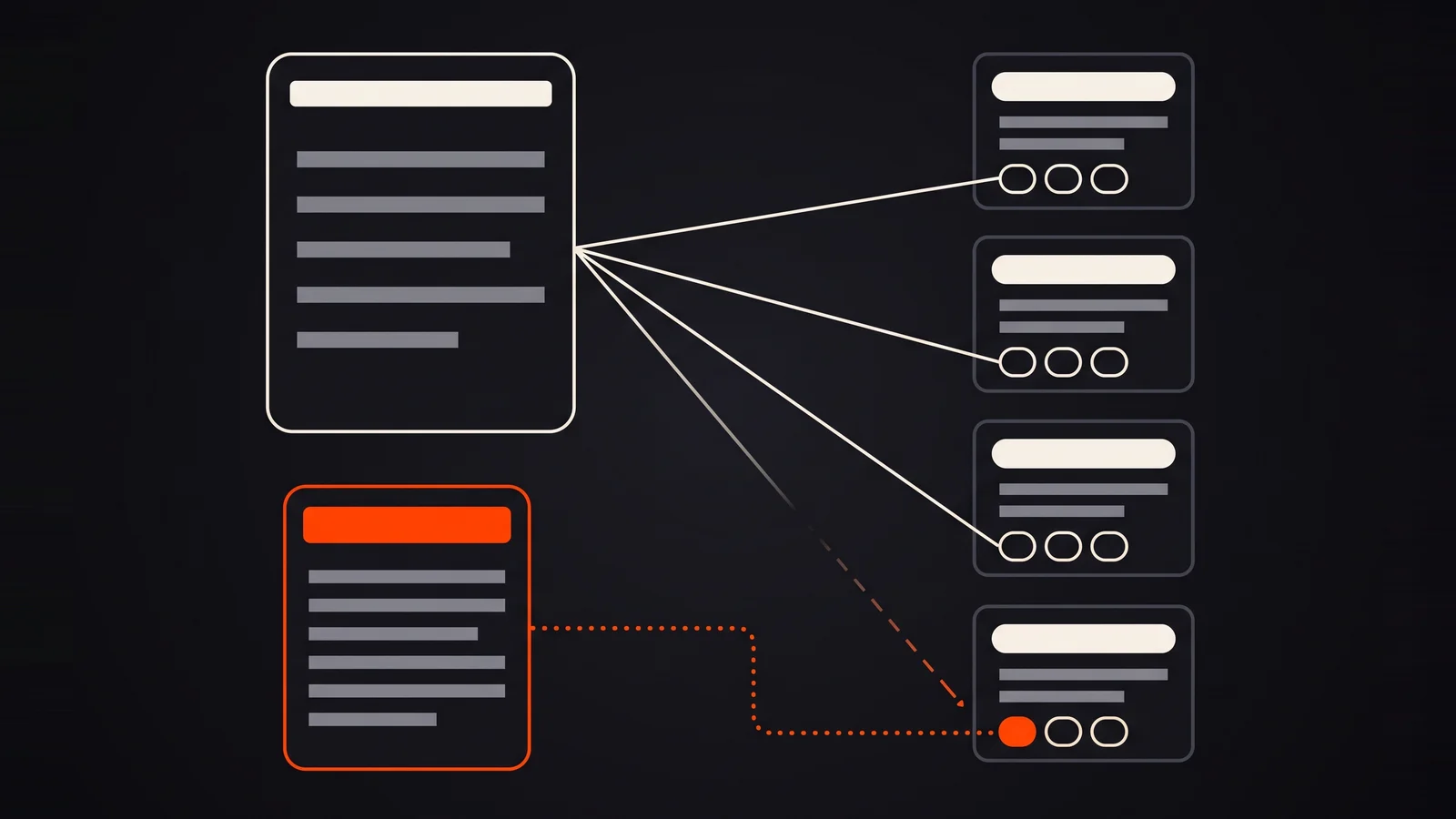
If Perplexity cites a competitor’s blog for every question in your category, you take the answers back one question at a time. List the competitor URLs Perplexity cites for each question your buyers ask, publish your own page that answers that exact question with more specific, better-sourced facts, make sure PerplexityBot can crawl it, and get your brand into the third-party pages Perplexity keeps reusing. Plan for weeks, not days: of the three AI engines we track, Perplexity holds on to its favourite pages most tightly.
This guide is for site owners whose pages Perplexity passes over, not for Perplexity users choosing which sources to search. It draws on Perplexity’s own documentation, checked on 3 October 2026, and on our tracker at ai.verticality.co, which asks Perplexity 130 buying questions in our category every day through Perplexity’s developer API. Perplexity says the API uses “the same search system” as the app “with differences in configuration”, so the app can show a different source list for the same question.
Why does Perplexity cite the same competitor blog for every question?
Two habits combine. Perplexity sticks with pages it has already chosen, and a site with a separate page for each way a buyer can phrase a problem keeps getting chosen.
The stickiness is measurable. Across the 130 buying questions we tracked from 4 September to 3 October 2026, the most-cited third-party page for each question appeared in a median 96.6% of Perplexity’s answers to it. The same figure was 78.6% on Google’s AI Overviews and 58.6% on ChatGPT. For 113 of the 130 questions, a single page sat in at least 80% of Perplexity’s answers. From one day to the next, Perplexity cited 73.9% of the same URLs again for the same question (4–29 September), against 50.2% on AI Overviews and 29.1% on ChatGPT.
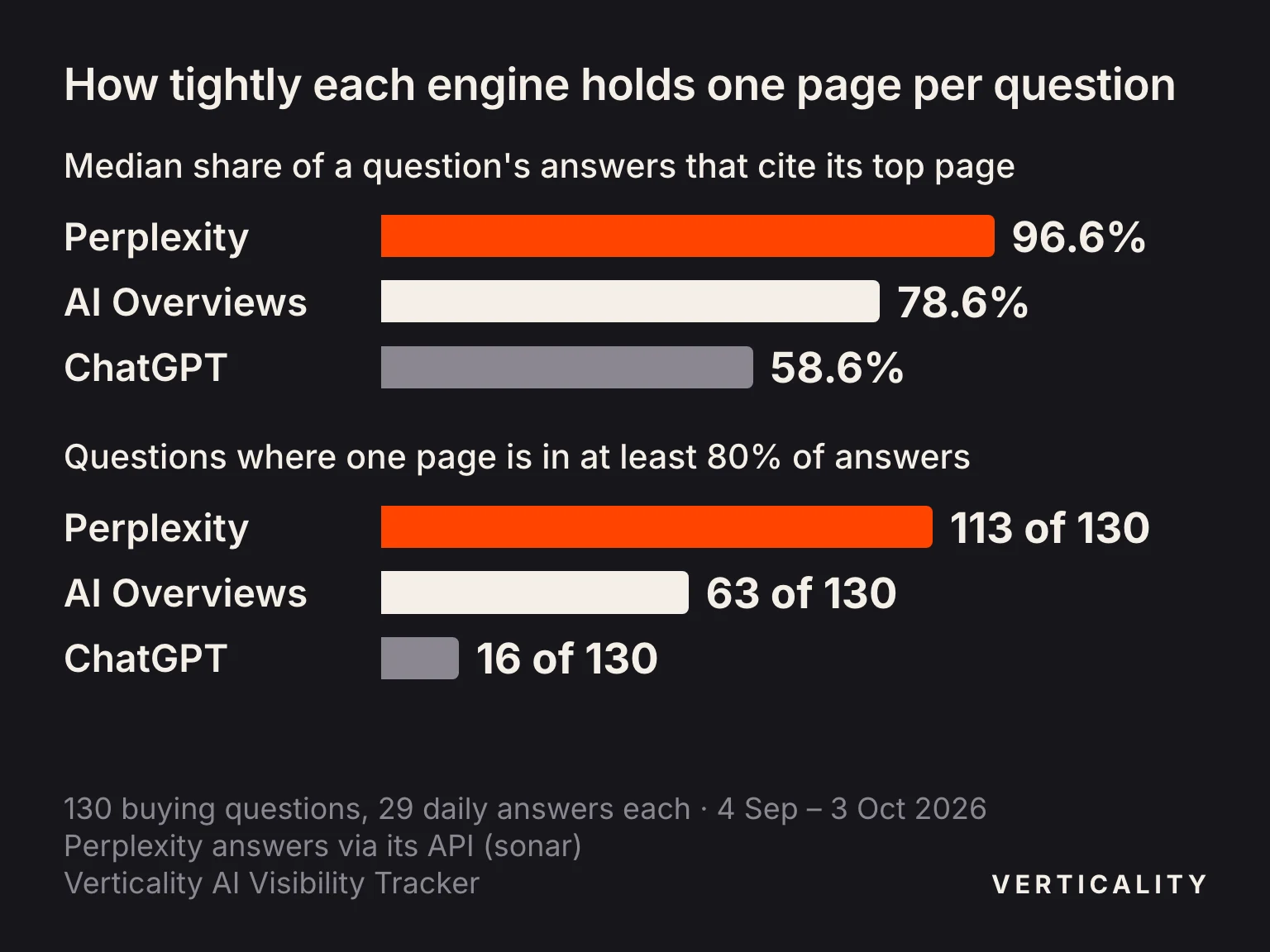
Perplexity keeps returning to the same page for a question far more often than Google’s AI Overviews or ChatGPT.
Part of that gap is mechanical. Until 30 September, Perplexity’s API answers listed about 20 sources each, so any one page had more chances to appear. Counting only the sources Perplexity actually referenced in the answer text, the median is still 86.2%.
The second habit explains why one site wins across a whole category. Perplexity’s search team says its index scores “sub-document units”, passages rather than whole pages, against the query (Perplexity). A blog that publishes a page for each wording of a problem has a close-matching passage for almost every question buyers ask. Perplexity also puts several pages from one site into a single answer more readily than other engines: before 30 September, one site supplied three or more of the sources in 25.3% of Perplexity’s answers, against 9.2% on ChatGPT and 2.4% on AI Overviews.
What does a competitor’s lock on Perplexity look like?
Our tracker asks Perplexity the question this guide answers: “Perplexity cites a competitor’s blog for every question in our category and we’re invisible — how do we change what it cites?” Over 29 daily answers it cited 149 different URLs, but a few carried it. One “how to get cited by AI” guide was cited in 22 of the 29 answers, two “how to get cited by Perplexity” playbooks in 21 each. Verticality was named or linked in none.
On 30 September the answers changed shape. The API answers in our tracker began listing 10 sources instead of about 20, three days after Perplexity ended support for its Sonar Chat Completions API (Perplexity docs). Across all 130 questions, only 22.2% of the URLs cited on 29 September were cited again on 30 September.
On this question, one site took most of the new slots. Sight AI (trysight.ai), which sells AI visibility tracking and an AI blog-writing tool, supplied 7 of the 10 sources on 30 September and 4, 6 and 6 of 10 on the next three days. Those were 11 different pages, each titled for a slightly different wording of the same problem: “Brand Not Showing Up In Perplexity?”, “Why Is My Brand Missing From Perplexity?”, “Fix Poor Visibility In Perplexity AI”. None was new. All 11 were published between February and July 2026, and none had been updated since 18 June.
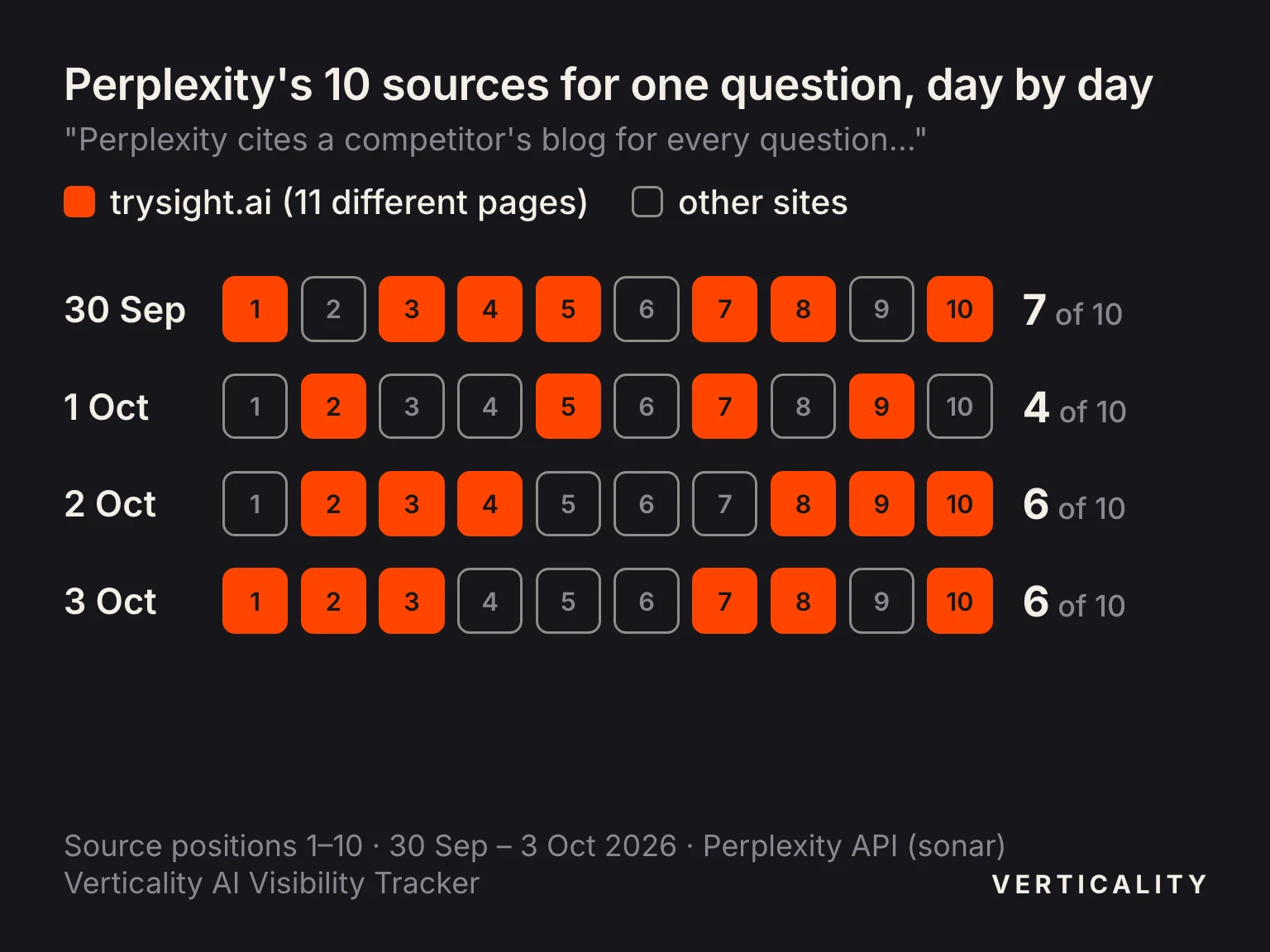
After the source list shrank to 10, one site’s pages filled up to 7 of the 10 slots for this question.
That is what “Perplexity cites one competitor blog for everything” usually means in practice: not one great article, but one site with a page that matches each wording of the question. The same pattern shows up across our category. On the 16 “how to get cited by AI” questions we track, Semrush had its own page cited on 9 of the 16, with 21 different URLs; trysight.ai used 25 URLs on 6 questions, each URL on exactly one question.
How does Perplexity choose which pages to cite?
Perplexity does not publish a ranking formula for answers. What it does publish describes a search engine of its own, and each part of it tells you something about the competitor’s advantage.
- Its own index. Perplexity’s search team says the index “tracks over 200 billion unique URLs” (Perplexity). PerplexityBot builds it, and Perplexity’s help center adds that it “partners with third-party crawlers” (Perplexity Help Center).
- What gets crawled again. A model decides which URLs to re-index, weighted by “the importance and likely update frequency of the specific URL”. The index keeps documents “from authoritative domains” ready to serve.
- How candidates are ranked. Retrieval combines keyword and semantic matching, and results are scored as whole documents and as passages. A prefilter removes “clearly non-responsive or stale content”, and several ranking stages end with “cross-encoder reranker models”.
- How many sources an answer uses. Perplexity’s help center describes standard search as “1–2 sources” and Pro Search as “dozens of sources”, with Pro Search splitting the question into several searches (Perplexity Help Center). In a default answer, a few sources do most of the work.
- Domain labels. Perplexity now marks some cited sites as Government, Academic or Trusted. It rates “the whole website a source comes from, not each individual page”, asks whether a site corrects its mistakes and says who wrote each piece, and says payments do not affect the label (Perplexity Help Center). It does not say whether labels change which sources get cited.
Two consequences follow for a site owner. Your page has to match the buyer’s question at the level of a passage, and your domain has to be one Perplexity keeps crawling. Nothing in Perplexity’s documentation mentions backlinks, schema markup or llms.txt.
Can Perplexity reach your pages at all?
Check this before anything else, because Perplexity has two agents and they treat your rules differently (Perplexity crawlers).
| User agent | What Perplexity uses it for | How it treats robots.txt |
|---|---|---|
| PerplexityBot | Builds the search index: it is “designed to surface and link websites in search results” and is not used to crawl content for AI foundation models | Follows it. A disallowed site can still appear as its domain, headline and “a brief factual summary” |
| Perplexity-User | Fetches a page when a user’s question calls for it | ”Generally ignores robots.txt rules”, because a user requested the fetch |
Perplexity says robots.txt changes can take “up to 24 hours” to reach its systems, and publishes the IP ranges for each agent at perplexity.ai/perplexitybot.json and perplexity.ai/perplexity-user.json.
The firewall matters as much as robots.txt. In August 2025 Cloudflare accused Perplexity of crawling with undeclared user agents, removed it from its list of verified bots and added its signatures to the managed rule that blocks AI crawlers (Cloudflare). Perplexity replied that Cloudflare had confused it with another company’s traffic (Perplexity). On 3 October 2026 none of the 713 bots in Cloudflare’s Radar directory was a Perplexity agent, so a site with Cloudflare’s AI-bot blocking on can turn Perplexity away while its robots.txt allows it.
It happened to us. On 3 September 2026 we found that Cloudflare’s legacy “Block AI bots” switch on verticality.co had blocked about six Perplexity-User requests in the previous 24 hours and allowed none. Perplexity first cited verticality.co on 7 September, four days after we switched it off. Our Reddit marketing page also went live on 3 September, so we cannot say which change made the difference.
Cloudflare’s own write-up shows what a block costs you. When its block kept Perplexity’s undeclared crawler out, Perplexity still answered, using “other websites”, and the answers “were less specific”. A page Perplexity cannot fetch does not leave a gap; someone else’s page fills it.
The access check takes four steps:
- robots.txt allows PerplexityBot, in the file visitors actually receive, not the one in your repository.
- The CDN or firewall allows both user agents from the published IP ranges. Perplexity’s crawler documentation includes allow-rule steps for Cloudflare and AWS.
- Your server or CDN log shows 200 responses to PerplexityBot on the pages you want cited.
- The answer is in the HTML, not in a tab, an image or a script that fills the page after load.
What does the competitor’s page have that yours doesn’t?
We read the 19 pages Perplexity cited most for that question. Their citation counts are more impressive than the pages.
- They are built as step lists that repeat the buyer’s wording. 17 of the 19 are numbered playbooks, and most titles use the phrase buyers type, such as “How to Get Cited by Perplexity”. Only 7 state the answer in their opening paragraph; the rest open with a statistic, a pitch or a story.
- Most are recent, but the date did not decide. 15 of the 17 pages with a machine-readable date were published or updated in 2026, and the median page had last been updated 72 days before our month began. Yet the oldest, last updated 290 days earlier, was cited in 21 of 29 answers. Perplexity calls information staleness “one of the biggest failure modes for AI agents” and filters stale content, but a fresher date on a page that matched the question less well did not beat it.
- Few bring evidence of their own. Only 2 of the 19 publish first-party data, and only 6 explain that Perplexity runs two agents that treat robots.txt differently. Three say Perplexity draws on Bing’s index and cite nothing for it, while Perplexity documents its own crawler and index.
That is the opening. On most of these questions the page that wins is the one that matches the buyer’s wording, not the one with the best evidence. Match the wording, then bring what the competitor does not have: your own numbers, your prices, a test you ran.
How do you take a question back from a competitor’s blog?
Work question by question, starting with the questions closest to a purchase.
- Write down the questions. 20 to 50 questions your buyers ask in your category, in their words. Include each phrasing that matters: “why is my brand missing from Perplexity” and “how do we change what Perplexity cites” can be served by different pages.
- Map the competitor’s URLs per question. Ask each question in Perplexity on several days and log every cited URL. You are looking for the competitor page that answers each question, not the competitor’s domain in general. Because Perplexity holds on to its choices, a week of runs gives a usable map.
- Find out why you are missing. For each question, check whether you have a page that answers it at all. If you do, check your logs for PerplexityBot visits to it. To tell “not retrieved” from “retrieved and passed over”, query Perplexity’s Search API, which Perplexity says runs on “the same global-scale infrastructure” as its answer engine, and see whether your URL comes back for the question.
- Publish one page per question. Put the answer in the first two sentences, name the subject in every sentence that carries a fact, and give each number a source and a date. Add what the competitor page lacks: first-party data, a price, a worked example. Use the buyer’s wording in the title and the first heading.
- Get into the pages Perplexity already reuses. On our 16 “how to get cited by AI” questions, Perplexity cited linkedin.com in 49.6% of its answers and reddit.com in 37.5%, and publishers such as HubSpot, Search Engine Journal and Semrush on 11 or 12 of the 16 questions. A useful LinkedIn post, a Reddit answer that helps, or an expert quote in a publisher’s article puts your name inside a source Perplexity already trusts.
- Keep the facts current. Update a page when its facts change and show the updated date. Perplexity re-crawls pages by how often they change, so a page that changes when the facts do gets read again.
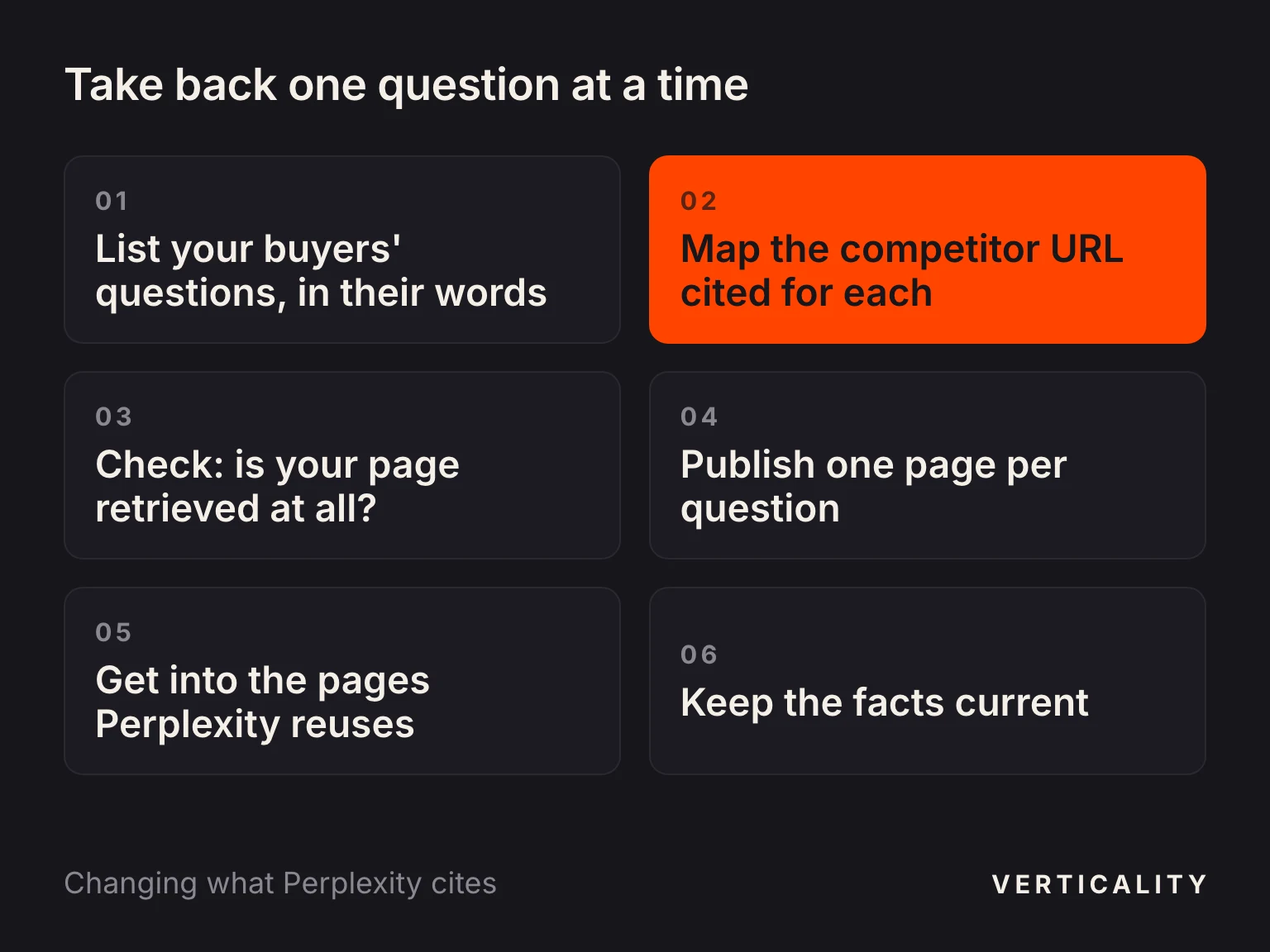
The plan runs per question: one competitor URL, one page of yours, one set of placements.
The same work for ChatGPT runs in a different order, because ChatGPT leans on brands’ own pages more than Perplexity does; see how to get cited by ChatGPT. For why each engine keeps a different kind of source, see how generative engine optimization works.
How long until Perplexity cites you instead?
Expect weeks, and expect the change to come in jumps rather than a slope. Perplexity re-cites most of its sources from one day to the next, so a new page has few openings. When the list does change, it often changes all at once. On our question, the source list turned over almost completely on four days in the month: on 15 and 29 September Perplexity read the question as one about which sources AI engines cite in general, on 17 September it switched back, and on 30 September the API changed. On the other days, about three quarters of the sources carried over from one day to the next.
Our own record shows both sides. Perplexity cited verticality.co in 9 answers in the week of 6–12 September and in 35 in the week to 3 October, out of 910 answers a week, nearly all of them through our Reddit marketing pages. On the 16 “how to get cited by AI” questions, it has cited us in 0 of 464 answers, including the question this guide answers. This guide is our attempt to change that, and we will check the question again 30 days after publishing.
For a full program, our planning numbers are the ones on how it works: first signals in 4–8 weeks, compounding by month 3–6.
How do you track whether Perplexity has switched to your page?
Measure the same questions on a schedule and count three things per question each week:
- The competitor’s share. The share of answers that cite the competitor’s URL for that question. This is the number that should fall.
- Your share, and how you appear. The share of answers that cite your URL, and whether Perplexity references it in the text or only lists it. In our data about half of Perplexity’s listed sources were never referenced in the answer text before 30 September; since then about 6 of the 10 are.
- Dated platform changes. Mark the dates when Perplexity itself changes, such as 30 September 2026, so a platform change is not read as your win or your loss.
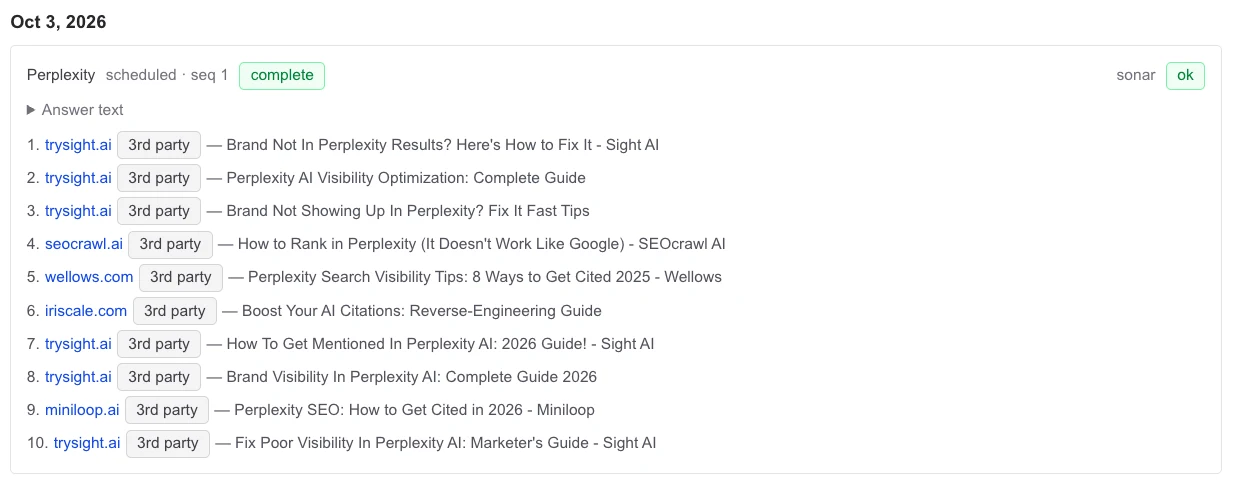
One day’s record in our tracker: Perplexity’s answer of 3 October listed 10 sources, and six were Sight AI pages.
Run each question more than once a week, because Perplexity sometimes answers from a different reading of the question for a day.
Check a sample in the Perplexity app as well, since tracking tools usually query the API and the two lists can differ. On 4 October we asked the same question in the app, signed in to a free account. Six of its first seven sources had titles built on “Perplexity cites competitors”, such as “Why Perplexity Cites Competitors Instead of You”, and Sight AI’s pages came eighth and ninth. The API answer the day before had led with three Sight AI pages. The two lists differ, but they point the same way: the pages Perplexity picks repeat the wording of the question.
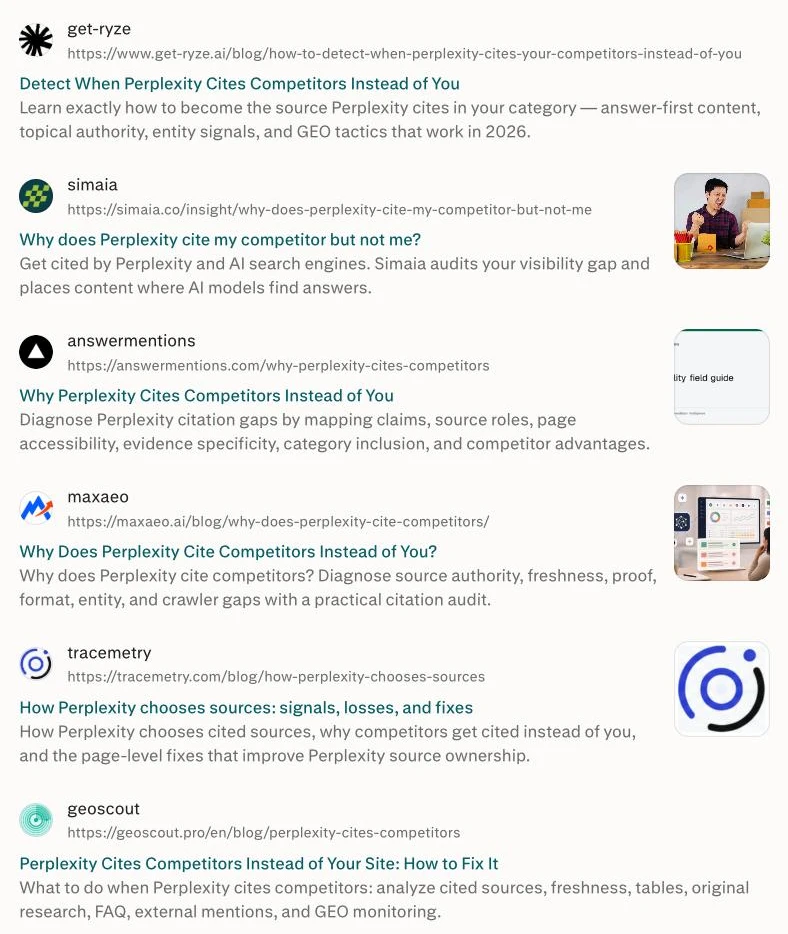
The Perplexity app’s sources for the same question on 4 October 2026: the top pages repeat the question’s wording.
The metrics, and how to roll them into one score, are in how to measure AI visibility.
Get the competitor’s Perplexity sources mapped
If one competitor’s blog is taking every Perplexity answer in your category, the free AI visibility audit in our GEO programme maps it for you: your buyers’ questions, the competitor URL Perplexity cites for each, whether PerplexityBot reaches your pages, and the page or placement that can replace each one. For the same work on ChatGPT, Google’s AI Overviews and Claude, see LLM SEO, model by model.
Frequently asked questions
Can you pay Perplexity to cite your website?
No. Perplexity says its Government, Academic and Trusted source labels are set by a review process alone and that payments and partnerships do not affect them. When it launched ads in November 2024, Perplexity said the content of its answers would not be influenced by advertisers.
Does blocking PerplexityBot remove a site from Perplexity's answers?
Not completely. Perplexity says PerplexityBot follows robots.txt and will not index the text of a site that disallows it, but it may still index the domain, headline and a brief factual summary. Its other agent, Perplexity-User, fetches pages when a user asks and generally ignores robots.txt, according to Perplexity's crawler documentation.
Does Perplexity use Google's or Bing's index?
Perplexity documents its own. Its search team says the index tracks over 200 billion unique URLs, crawled by PerplexityBot, and its help center says it also partners with third-party crawlers. None of Perplexity's documentation names Google or Bing as the source of its results, and the guides we checked that say Perplexity runs on Bing cite nothing for it.
Why do tracking tools show different Perplexity sources than the app?
Most trackers query Perplexity's developer API. Perplexity says the API uses the same search system as the app 'with differences in configuration', and that the model can differ. For one of our questions, the API answer of 3 October 2026 led with three Sight AI pages, while the app on 4 October put Sight AI eighth and ninth. Results also move with Perplexity's own changes: on 30 September 2026 the API answers in our tracker dropped from about 20 listed sources to 10.
Do llms.txt or schema markup help a page get cited by Perplexity?
Perplexity has not said so. Its crawler documentation, help center and search engineering posts mention robots.txt, its IP ranges and passage-level relevance, but not llms.txt or schema markup. Use structured data to keep facts consistent across your site, not as a Perplexity ranking lever.
Want your brand named in AI answers?
Our free AI visibility audit asks ChatGPT, Perplexity and Google AI Overviews the questions your buyers ask, shows who gets named instead of you and which sources they cite, and ends with a ranked work plan.
Get a free AI visibility auditNot ready for a call? Run the free AI visibility checker: 40+ buyer questions in ChatGPT and Google AI Overviews, report by email within 24 hours.