How Does Generative Engine Optimization Work in Practice?
GEO acts on the five steps of every AI answer: fan-out, retrieval, selection, synthesis and citation. Where a brand can act on each, and one real prompt traced.
COO · AI Search & Data Architecture
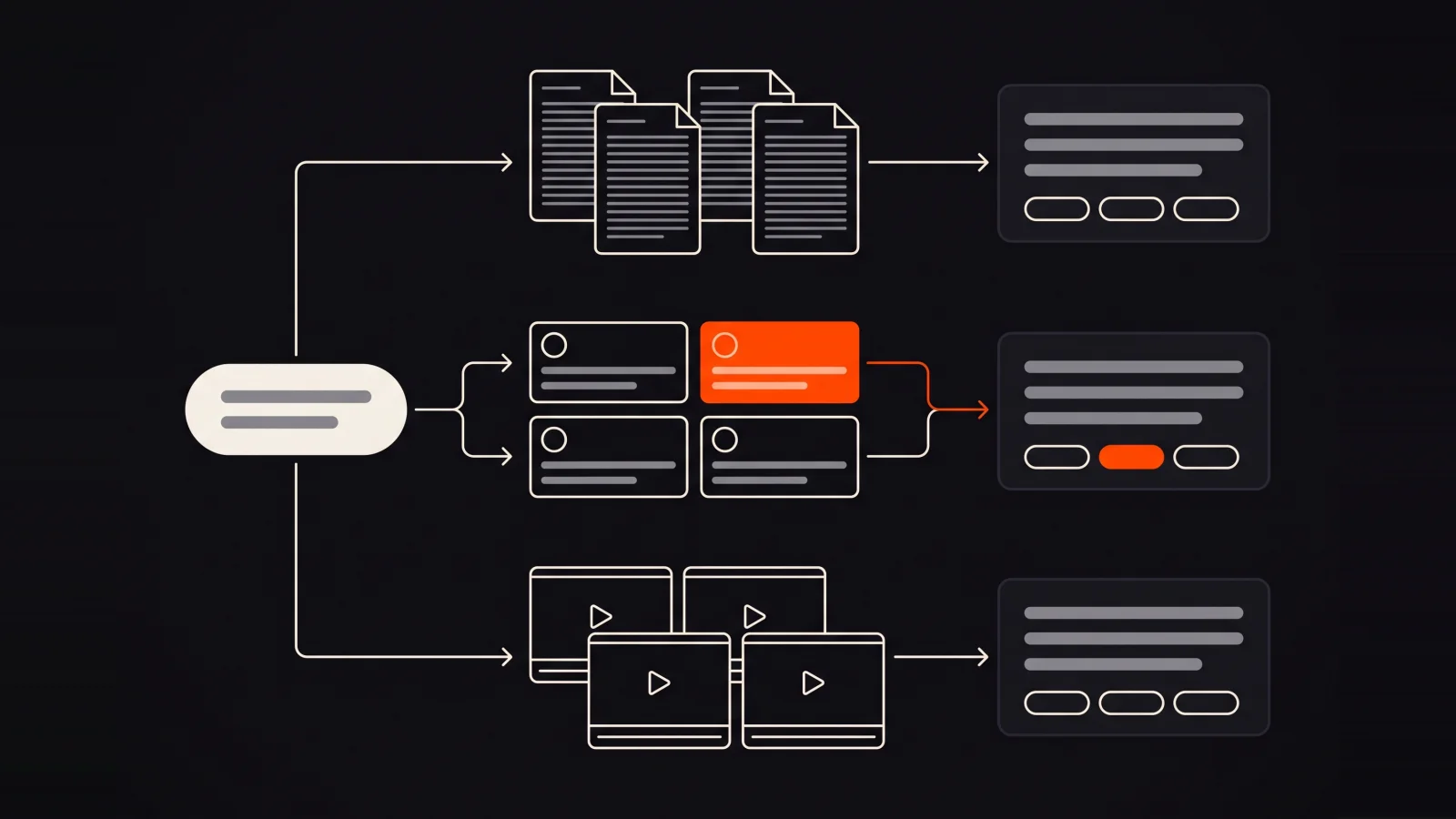
Generative engine optimization (GEO) aims to have a brand named, and its pages linked, when ChatGPT, Perplexity or Google’s AI Overviews answer a buyer’s question. It works by acting on the path every answer takes: the engine turns the question into searches, retrieves pages, keeps a few, writes from them and links some. A brand can influence each of those steps, but not the same way on every engine.
Below are the five steps, with what the engines document and what our tracker recorded, then one buying question traced from zero mentions to the top of ChatGPT’s answer, and the reason Perplexity and Google did not move. The definition and history of the term are in what is generative engine optimization.
What happens between a question and an AI answer?
None of the engines publishes its full recipe, but the documentation they do publish and the answers we collect every day describe the same five steps. A 2026 survey of 45 GEO studies reaches the same view: GEO is “not a single ranking task” but a pipeline that runs from search activation to citation (Martinez, 2026).
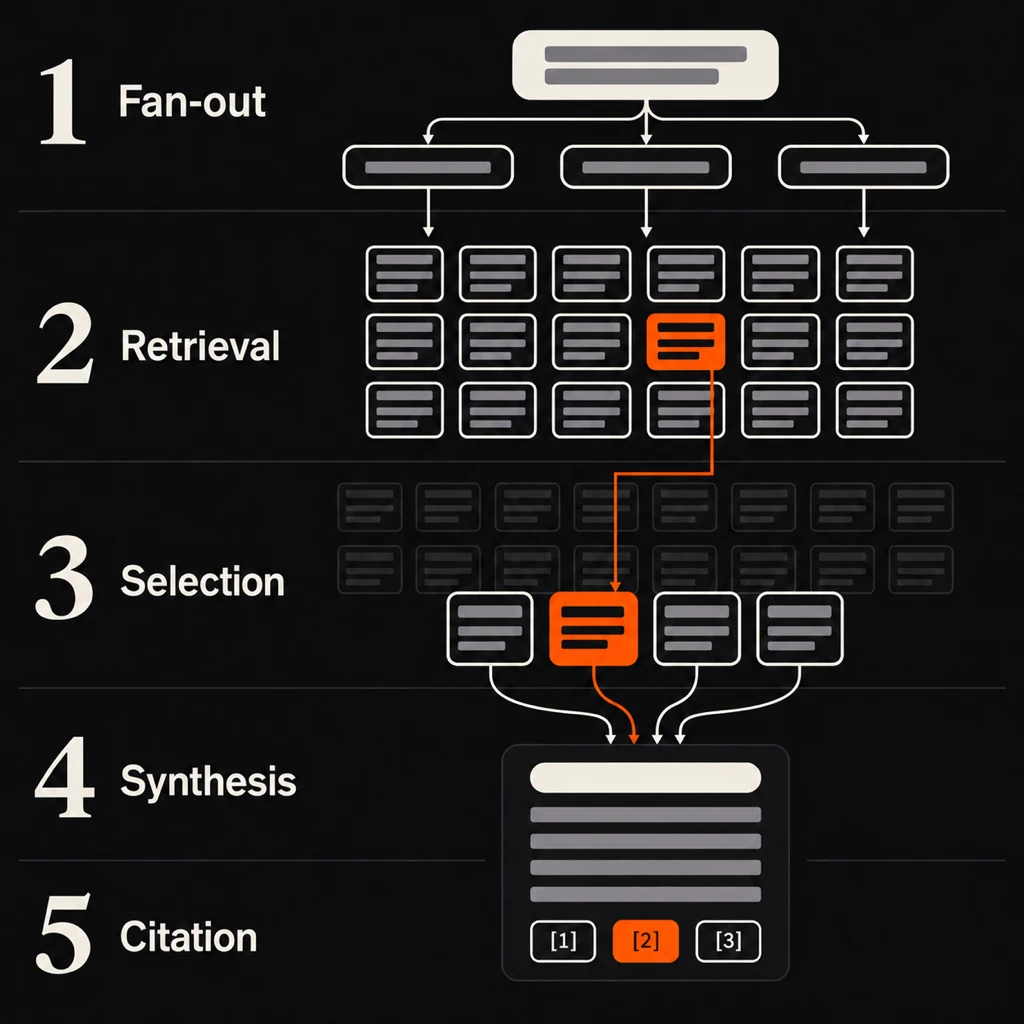
One question, several searches, many pages, a few kept, one answer: a brand can drop out at any of the five steps.
| Step | What the engine does | Where a brand can act |
|---|---|---|
| 1. Fan-out | Rewrites the question into several searches | Pages that answer the sub-questions, in the words the engine searches with |
| 2. Retrieval | Runs those searches against an index it can read | Crawler access, and indexing in Google and Bing |
| 3. Selection | Keeps a handful of the pages it found | Being the kind of source that engine keeps for that kind of question |
| 4. Synthesis | Writes the answer from passages of the kept pages | Facts stated plainly enough to be lifted: price, scope, numbers |
| 5. Citation | Links some of the sources, often different ones the next day | Daily measurement, prompt by prompt and engine by engine |
The numbers in this guide come from our own tracker, ai.verticality.co, which asks 130 buying questions in our own category (marketing services) to ChatGPT, Perplexity and Google every day. They describe how the engines behave on those questions, not a cross-industry census.
1. Fan-out: one question becomes several searches
Google documents this step for AI Overviews and AI Mode as “query fan-out”: “issuing multiple related searches across subtopics and data sources” (Google Search Central). OpenAI describes the same step in ChatGPT, which “typically rewrites your query into one or more targeted queries” and may send “additional, more specific queries” after reading the first results (OpenAI).
Our tracker records the searches ChatGPT writes. In 617 ChatGPT answers collected from 29 September to 3 October 2026, ChatGPT wrote 2.36 searches per question on average, anywhere from 1 to 10. Only 1 of the 1,459 searches repeated the buyer’s question word for word. A typical search kept fewer than half of the question’s words and added new ones: a year in 24% of searches, the word “official” in 269 of them, “pricing” in 58. For the same question, the set of searches was identical from one day to the next in only 107 of 491 cases.
Where a brand acts: the page has to match the engine’s searches, not only the buyer’s sentence. For “How does generative engine optimization work in practice?” ChatGPT searched for Google AI Overviews search content guidance generative AI SEO official and OpenAI search crawler OAI-SearchBot website search official. Its citations follow those searches: of the 22 ChatGPT answers to this question that carry a source, 20 cite Google’s documentation and 18 cite research papers on arXiv. Matching does not mean a page per search: Google’s guide warns that separate pages for every fan-out variation count as scaled content abuse. One page that answers the sub-questions under clear headings is the target. Google’s side of this step is covered in how to optimize for AI Overviews and AI Mode.
2. Retrieval: the searches run against an index the engine can read
Each engine searches a different index. Google grounds AI Overviews and AI Mode in its own: its guide says the systems retrieve “relevant, up-to-date web pages from our Search index” (Google). ChatGPT sends its searches to partner search providers and reads sites through OpenAI’s crawler; to be eligible, OpenAI says, a site must “allow OAI-Searchbot to crawl the site” (OpenAI). Perplexity searches the web in real time and keeps its own index, built by PerplexityBot (Perplexity).
Where a brand acts: a page that is never retrieved cannot be selected, however good it is. The page must load for each engine’s crawler and sit in the index that engine searches. Retrieval can fail without anyone choosing it: until 3 September 2026, a default Cloudflare setting on verticality.co returned 403 errors to Claude’s and Perplexity’s user agents. The ChatGPT side of retrieval, from OAI-SearchBot to firewall rules, is in how to get cited by ChatGPT.
3. Selection: a handful of pages are kept
On our 56 AI-search buying questions (4–23 September 2026), ChatGPT cited 6.0 URLs per answer on average, Google’s AI Overviews 8.6 and Perplexity 20.5. The bigger difference is which kind of source each engine keeps. For “How does generative engine optimization work in practice?” (29 answers per engine, 4 September – 3 October 2026):
- ChatGPT kept Google’s documentation and research papers: an arXiv survey of generative engine optimization in 15 of 29 answers, Google’s “AI features and your website” page in 14, Google’s guide to optimizing for generative AI features in 14.
- Perplexity kept marketing publishers’ explainers: Search Engine Land in 29 of 29 answers, Moz in 28, HubSpot in 27.
- Google’s AI Overview kept videos first: YouTube in 23 of 29 answers, then Semrush’s guide in 18 and Directive’s in 16.
Google’s guide describes selection only in general terms: its AI systems “take a look at a variety of sources”, so a distinct viewpoint helps (Google); the pools above are what that looks like in practice.
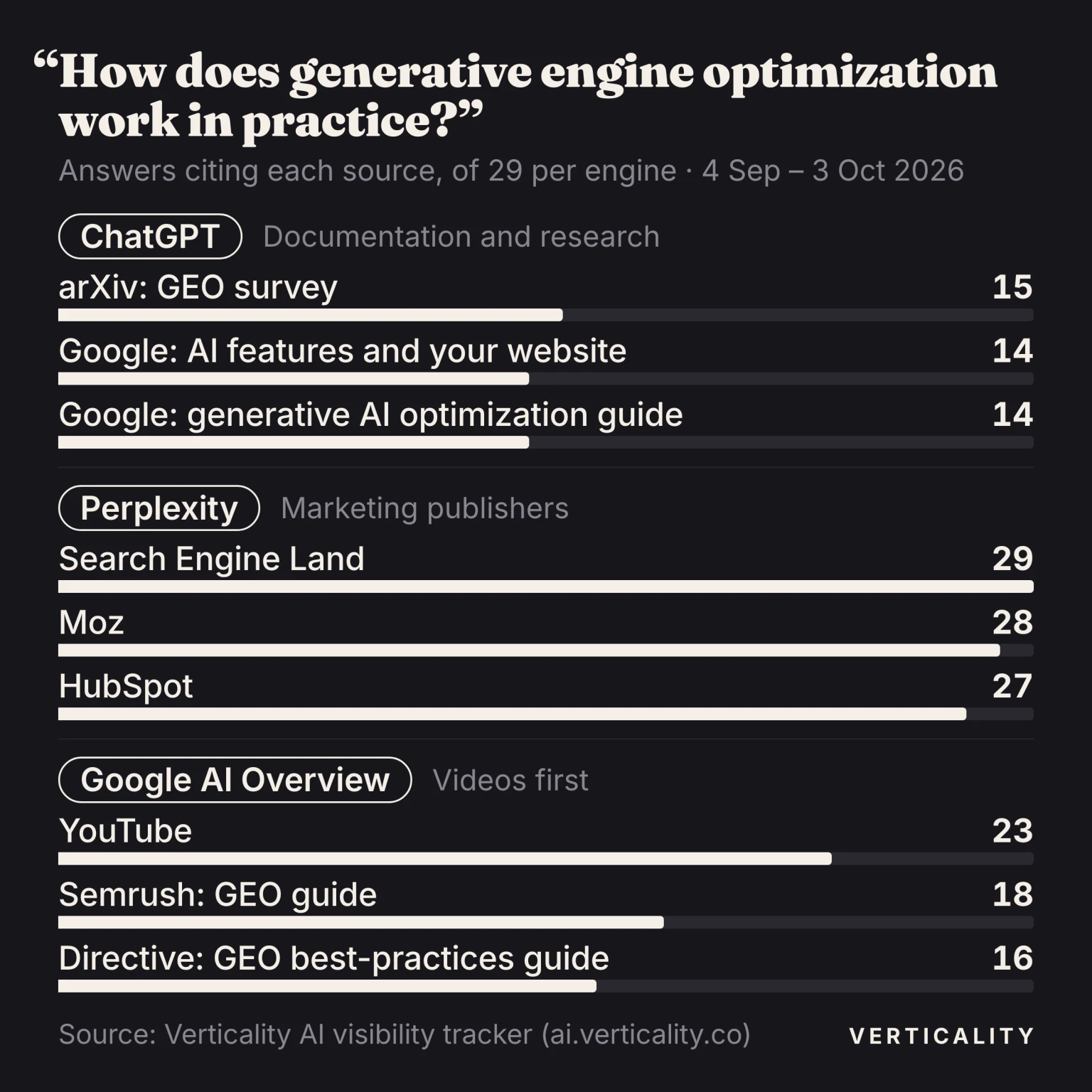
Same question, three engines, three source pools: documentation on ChatGPT, publishers on Perplexity, videos on Google.
Where a brand acts: find out which pool each engine draws from for your buyers’ questions, then get into that pool. It may be your own page, a publisher’s explainer, a video, or a third-party list.
4. Synthesis: the model writes from the passages it kept
The engine does not reproduce a page; it lifts statements from it. The original GEO paper measured this step. Adding citations, quotations from relevant sources and statistics to a page raised its visibility in generated answers by up to 40%, while keyword stuffing gave “little to no improvement” (Aggarwal et al., KDD 2024). Those gains were measured with the page already in the model’s context, as a 2026 survey of 45 studies points out (Martinez, 2026), so they describe how a kept page gets used, not whether it gets found.
We see the same lifting in our own answers. When ChatGPT named Verticality for the GEO-agency question traced below, it repeated our published price in 9 of 10 answers and our list of off-site work (Reddit, roundups, third-party articles) in 9. It lifted competitors’ prices the same way: “$3,500/month” from one agency’s page and “$1,500/month” from another’s.
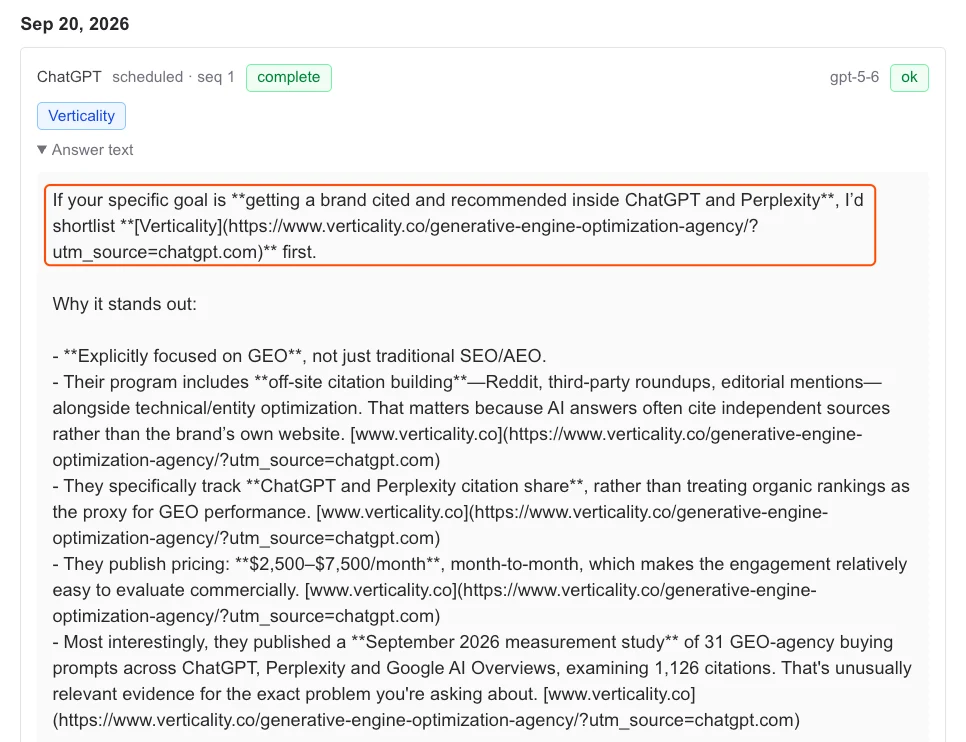
ChatGPT’s answer on 20 September 2026 opened with our name and lifted our published price and our study from the page.
Where a brand acts: state the facts a buyer decides on in sentences that still make sense when lifted alone: who the offer is for, what it includes, what it costs, and numbers with their dates. A vague claim gets replaced in the answer by a competitor’s specific one.
5. Citation: some sources get a link, and the list moves
Engines link only part of what they read, and the list changes from day to day. OpenAI says it plainly: “Placement is not guaranteed” (OpenAI). On the same 56 questions, only 26.4% of the URLs ChatGPT cited were cited again for the same question the next day. Perplexity re-cited 70.1% and Google’s AI Overviews 49.8%. A page can also be linked without the brand being recommended, which happened to us on 3 October in the walk-through below.
Where a brand acts: measure each buying question on each engine every day, and read the answers, not only the counts. The method is in how to measure AI visibility, and the free AI visibility checker shows where you start on ChatGPT and Google AI Overviews.
What did this look like on one real prompt?
The prompt is #56 in our tracker: “Recommend a GEO agency that gets brands cited in ChatGPT and Perplexity.” We traced our own brand because it is the one brand whose every change we can date.
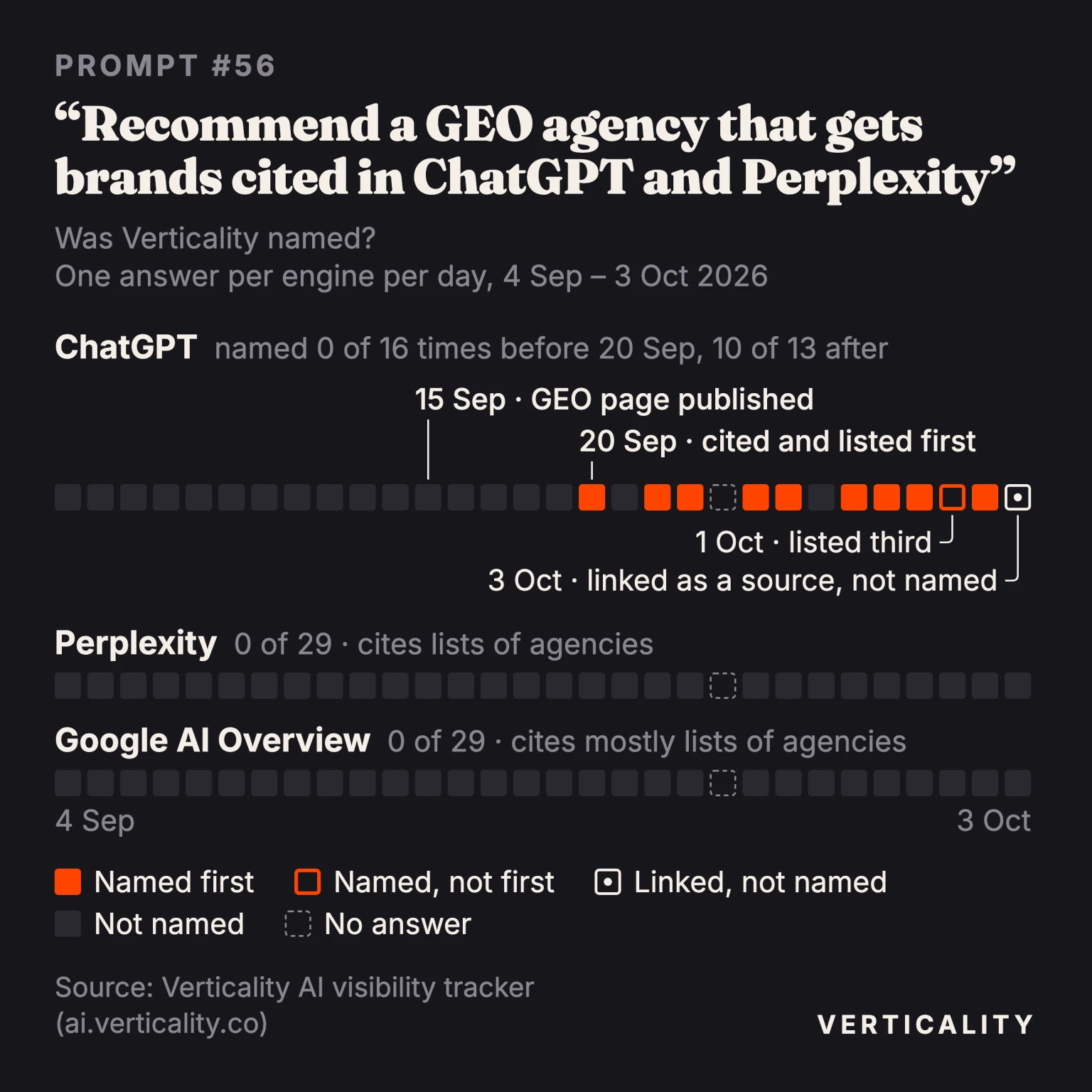
ChatGPT named us five days after the page went live, then dropped us from its shortlist on 3 October; Perplexity and Google named us in none of 58 answers.
The starting point. On 3 September 2026 our first tracker run asked 150 questions on three engines. Verticality was named in 0 of the 450 answers.
What ChatGPT cited before. From 4 to 19 September, ChatGPT answered this question 16 times and never named us. It built its answers mostly from agencies’ own service pages: Fifty One Degrees in 10 of 16 answers, Percepture and Veza Digital in 9, Revlift and Sharply Labs in 8.
What we changed.
- 3 September: switched off the Cloudflare rule that blocked Claude’s and Perplexity’s user agents. OpenAI’s search crawler had never been blocked, so this did not change what ChatGPT could read.
- 15 September: published our GEO agency page, titled “Generative Engine Optimization (GEO) Agency”. It states the price ($2,500–$7,500 a month, month-to-month), the scope (off-site citations on Reddit, roundups and third-party articles, plus tracking) and a study of 1,126 citations collected on 31 GEO buying questions.
Other pages went live on the site in the same weeks, but every ChatGPT answer to this question that linked us linked this one page.
What changed in ChatGPT’s answer.
- 20 September, five days after launch: ChatGPT cited the page and opened its answer with “I’d shortlist Verticality first”, followed by our price and our study.
- 20 September – 3 October: of 13 daily answers, ChatGPT named Verticality in 10, linked the page in 11 and listed us first in 9.
- The searches matched the page. ChatGPT’s recorded searches for this question included
"Generative Engine Optimization" agency ChatGPT Perplexity, which matches the page’s title. - Then the answer moved. On 1 October ChatGPT listed us third, after DoodleWeb and Sharply Labs. On 3 October it left us off the shortlist and linked our page only as the source of the study: “one 2026 analysis of 1,126 citations”.
What did not change. Perplexity and Google’s AI Overview named Verticality in 0 of 29 answers each over the same month. Neither engine builds this answer from agencies’ own pages the way ChatGPT does. Perplexity cited lists of agencies: The Digital Elevator’s in 21 of 29 answers, Thrive’s in 19, Animalz’s and Citeme’s in 18. Google’s AI Overview leaned on lists too, led by an eintelligenceweb.com list of AEO agencies in 21 of 29 answers and a LinkedIn article ranking B2B GEO agencies in 10. It also cited some agencies’ own pages, such as Crackle PR’s GEO page in 12 answers, but lists made up most of its sources. None of these 58 answers named us.
Why did one page win on ChatGPT and not on Perplexity or Google?
Retrieval does not look like the problem. Google has the page in its index, and both engines cite other pages of verticality.co: Perplexity linked our Reddit marketing page in 69 answers between 7 September and 3 October, Google’s AI Overview in 5. The page lost at selection. For “recommend an agency”, ChatGPT keeps vendors’ own pages, so a vendor page can enter the answer quickly; ours did in five days. Perplexity and Google mostly keep lists written about vendors, so the same page has no slot to fill there, and the work that moves those two engines is getting onto the lists they cite.
The pools also change with the question. For “how does GEO work”, ChatGPT keeps documentation and research, Perplexity keeps publishers and Google keeps videos. Before choosing any tactic, map which pool each engine uses for each of your buyers’ questions; the map decides whether the work is your own page, a placement, a video or a correction.
What are the workstreams of a GEO program?
A GEO program runs four workstreams, one for each place an answer can be won or lost.
- Technical access (retrieval). AI crawlers allowed at the CDN and the firewall, and pages indexed in Google and in Bing.
- Own pages (fan-out and synthesis). Pages that answer the sub-questions engines actually search for, in their words, and that state the facts engines lift: price, scope, audience, dated numbers.
- Third-party citations (selection). Roundups and comparison lists, Reddit threads and LinkedIn articles: the pools Perplexity and Google’s AI Overviews draw from. On our 56 AI-search questions, Perplexity cited linkedin.com in 51.0% of answers, and Google’s AI Overviews cited YouTube in 44.5% and reddit.com in 35.0%.
- Measurement (citation). A fixed set of buying questions, asked on each engine every day, read answer by answer.
The tactics inside each workstream are listed in GEO best practices, and the time each one takes in how long GEO takes. How we run the four workstreams for a client, in what order and on what timeline, is on how it works.
Find the step where your brand drops out
The trace above follows one question until the brand falls out at a step: fan-out, retrieval, selection, synthesis or citation. Our free AI visibility audit starts the same trace on your buyers’ questions: it runs them on ChatGPT, Perplexity and Google, and shows who is named instead of you and every source each engine cites. Request the audit on our GEO agency page.
Frequently asked questions
How does generative engine optimization work?
Generative engine optimization (GEO) works on the five steps an AI engine takes to build an answer: it rewrites the question into several searches (query fan-out), runs them against an index (retrieval), keeps a handful of pages (selection), writes from their passages (synthesis) and links some of them (citation). A brand acts on each step: pages that match the engine's searches, crawler access and indexing, a place in the sources each engine prefers, facts stated plainly enough to be lifted, and daily measurement.
What is query fan-out in AI search?
Query fan-out is the step where an AI engine splits one question into several related searches before it writes the answer. Google documents it for AI Overviews and AI Mode. In 617 ChatGPT answers to 130 buying questions tracked by Verticality (29 September – 3 October 2026), ChatGPT wrote 2.36 searches per question on average, and only 1 of 1,459 searches repeated the question word for word.
Why do ChatGPT, Perplexity and Google AI Overviews cite different sources for the same question?
Each engine keeps a different kind of source at the selection step. For 'How does generative engine optimization work in practice?' ChatGPT cited Google's documentation and arXiv papers, Perplexity cited marketing publishers such as Search Engine Land in 29 of 29 answers, and Google's AI Overview cited YouTube in 23 of 29 (Verticality tracker, 4 September – 3 October 2026). A page can win one engine and be invisible on the others.
Is a citation in an AI answer permanent?
No. On 56 AI-search buying questions Verticality tracked from 4 to 23 September 2026, only 26.4% of the URLs ChatGPT cited were cited again for the same question the next day; Perplexity re-cited 70.1% and Google's AI Overviews 49.8%. A page that leads an answer one week can drop off the next, so GEO results are measured daily, prompt by prompt.
What does a GEO program include?
A GEO program runs four workstreams, one for each place an answer can be won or lost: technical access (AI crawlers allowed, pages indexed in Google and Bing), the brand's own pages (written to match the engines' searches and to state liftable facts), third-party citations (roundups, comparison lists, Reddit threads, LinkedIn articles) and measurement (a fixed set of buying questions asked on each engine every day).
Want your brand named in AI answers?
Our free AI visibility audit asks ChatGPT, Perplexity and Google AI Overviews the questions your buyers ask, shows who gets named instead of you and which sources they cite, and ends with a ranked work plan.
Get a free AI visibility auditNot ready for a call? Run the free AI visibility checker: 40+ buyer questions in ChatGPT and Google AI Overviews, report by email within 24 hours.