What Is Generative Engine Optimization (GEO)? Definition & Origin
Generative engine optimization (GEO) is the practice of making a brand's content more likely to be cited or recommended in answers written by AI search engines.

COO · AI Search & Data Architecture
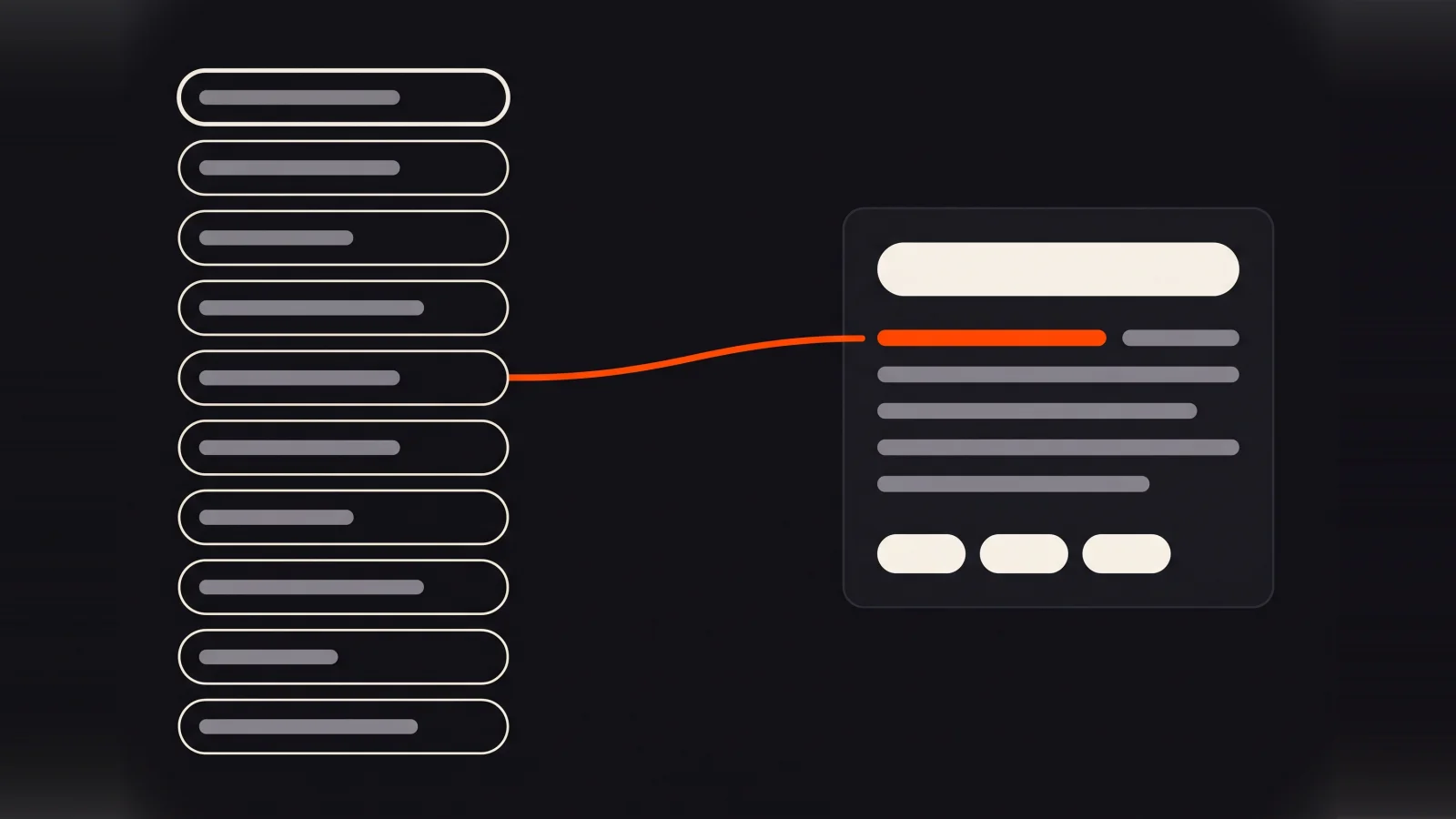
GEO targets six engines: ChatGPT, Perplexity, Google AI Overviews and AI Mode, Gemini and Microsoft Copilot. It counts a win when the answer names your brand or cites your page, not when a page climbs a list of links. The term comes from a research paper first posted to arXiv in November 2023 by researchers at Princeton University, Georgia Tech, the Allen Institute for AI and IIT Delhi, and published at KDD 2024 (arXiv:2311.09735).
This guide covers where the term came from, what GEO optimizes for, the six engines and how each one finds its sources, what those engines themselves say GEO is, how it differs from SEO, and the five levers a GEO programme works on.
Where does the term “generative engine optimization” come from?
The term was coined in “GEO: Generative Engine Optimization”, a paper by Pranjal Aggarwal, Vishvak Murahari, Tanmay Rajpurohit, Ashwin Kalyan, Karthik Narasimhan and Ameet Deshpande. Version one went up on arXiv on 16 November 2023. The paper was accepted to KDD 2024, the ACM data-mining conference held in Barcelona in August 2024 (arXiv:2311.09735). Wikipedia dates it the same way: a 2023 paper, later presented at KDD 2024 (Wikipedia).
The authors first named a new kind of system. They called search products that combine a conventional search engine with a language model generative engines, and gave Bing Chat, Google’s Search Generative Experience and Perplexity as the examples. GEO was their name for helping content creators raise the visibility of their content inside those engines’ responses.
Then they measured what works. They built GEO-bench, a set of 10,000 queries drawn from nine sources, and rewrote source pages in nine different ways to see which changes made a page more visible in the generated answer:
- What won: citing sources, adding quotations from credible sources and adding statistics. These three gave a 30–40% relative improvement on the paper’s main visibility metric.
- What failed: keyword stuffing, the classic SEO move, gave little to no improvement in the simulated engine and did 10% worse than the unedited page when tested on Perplexity.
- Who gained most: pages ranked lower in the search results. Citing sources lifted the visibility of fifth-ranked pages by 115.1%, while the top-ranked page lost 30.3% on average.
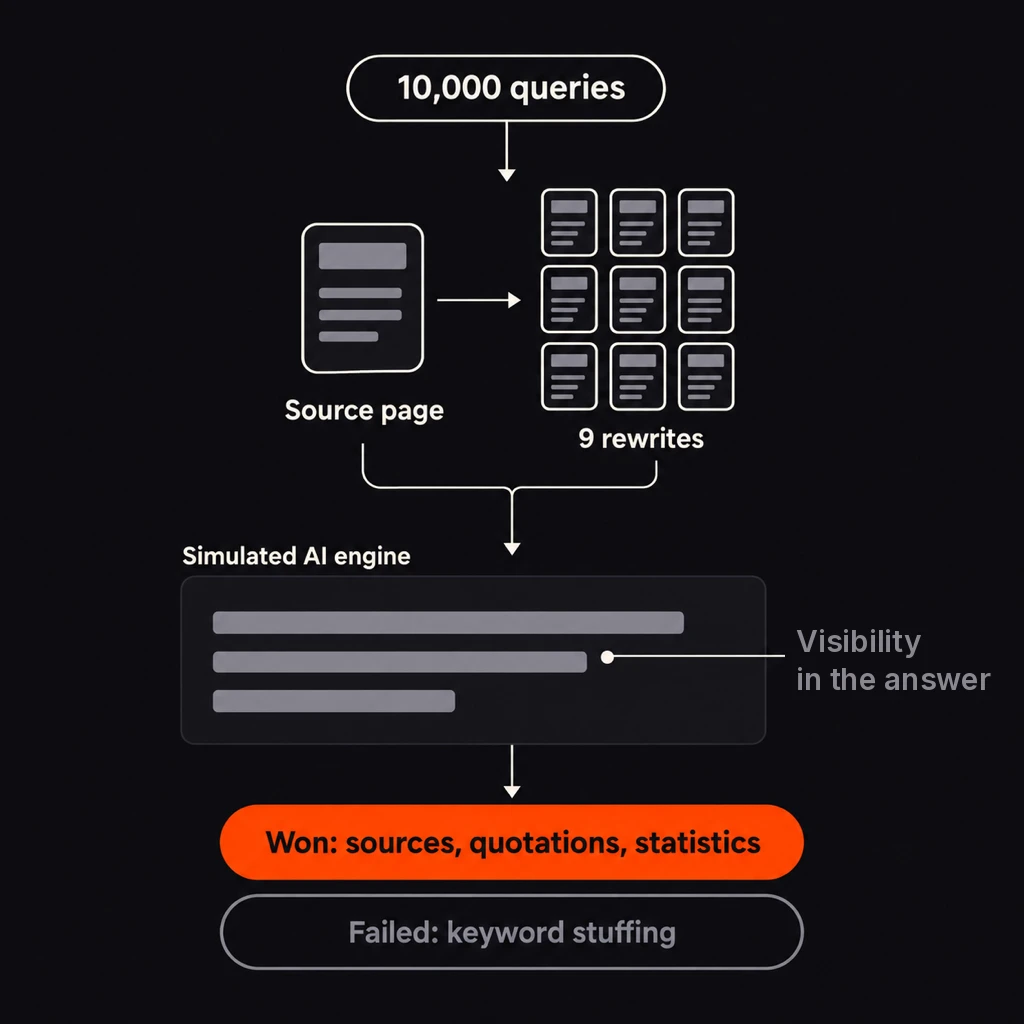
The 2023 paper rewrote source pages nine ways and measured which edits got them quoted more by a simulated engine.
Read the percentages as direction, not a recipe. The experiments ran in 2023 on GPT-3.5 Turbo inside a simulated engine, with one test on Perplexity. Today’s engines are different products. The direction still matches what we see in AI answers: pages that state sourced, specific facts get quoted, and pages that repeat a keyword do not.
One detail AI gets half-right. In the last 25 ChatGPT answers our tracker collected to “What is generative engine optimization?”, ChatGPT named the Princeton paper 7 times, and when it gave a year it said 2024 six times and 2023 twice. Both years are defensible. The precise version is “first posted in November 2023, published at KDD 2024”.
What does GEO optimize for, if not rankings?
GEO optimizes for presence inside the answer. A brand can be present in three ways, and each one is measured separately:
- Cited. Your URL appears in the answer’s list of sources or as an inline link. Perplexity and Google AI Overviews attach sources to almost every answer; ChatGPT shows them when it searches the web.
- Named. The answer mentions your brand in its text, with or without a link. For “best X for Y” questions, this is the outcome that puts you on a buyer’s shortlist.
- Described correctly. The answer states your category, audience and price the way you do. An engine that names you with last year’s pricing is also a GEO problem.
![An AI answer card marking the three ways a brand can be present: named in the answer text, described correctly by category, audience and price, and cited as numbered source [2].](/images/blog/what-is-generative-engine-optimization/answer-presence.webp)
GEO counts three outcomes inside the answer: cited, named and described correctly.
The 2023 paper scored visibility the same way, with no rank in sight. Its main metric, Position-Adjusted Word Count, counts how many words of the answer come from your source and gives more weight to words near the top. A second metric, Subjective Impression, uses a language model to rate each citation on relevance, influence, uniqueness and how likely a reader is to click it. Under that scoring, rank alone settles nothing: a page that ranks first in Google can contribute little to the AI answer above it, while a page from the second results page can supply the opening sentence.
Which AI engines does GEO cover, and how does each one find sources?
GEO work usually targets six engines, and they do not share one index. Each row below comes from the platform’s own documentation.
| Engine | Where its sources come from |
|---|---|
| ChatGPT search | OpenAI’s crawler OAI-SearchBot surfaces websites for ChatGPT’s search features; a site that blocks it is left out of search answers. ChatGPT also rewrites the question into targeted queries for partner search providers, and its help page names Microsoft among them (OpenAI crawlers, ChatGPT search help). |
| Perplexity | Searches the web in real time for every question and attaches numbered citations to every answer. PerplexityBot builds its index, and a second agent, Perplexity-User, visits a page on demand while answering a specific question (Perplexity crawlers, How Perplexity works). |
| Google AI Overviews | Retrieves pages from Google’s own Search index with its core ranking systems, and may fan the question out into several related searches. To be used as a supporting link, a page has to be indexed and eligible to appear in Search with a snippet (AI features and your website). |
| Google AI Mode | Same index and same eligibility rule as AI Overviews, but it can use a different model and technique, so the links it shows differ from AI Overviews for the same question. Google launched it on query fan-out: many related searches across subtopics, run at once (Google, March 2025). |
| Gemini | The Gemini app pulls from external sources such as Google Search to build its answers, a process Google calls retrieval augmentation. When sources are available, it lists the public web pages it drew on; not every answer has them (Gemini overview, Gemini Apps Help). |
| Microsoft Copilot | Grounds answers that need current information in web search results and lists hyperlinked citations below the text. Bing’s webmaster guidelines say Copilot’s search experiences rely on the same crawling, indexing and ranking foundation as Bing search (Copilot transparency note, Bing Webmaster Guidelines). |
The practical reading: being in Google’s index covers AI Overviews, AI Mode and the Google Search side of Gemini. Copilot needs Bing. ChatGPT needs its own crawler let through and draws on partners. Perplexity reads its own crawl. One page can be visible in three of these and absent from the other three.
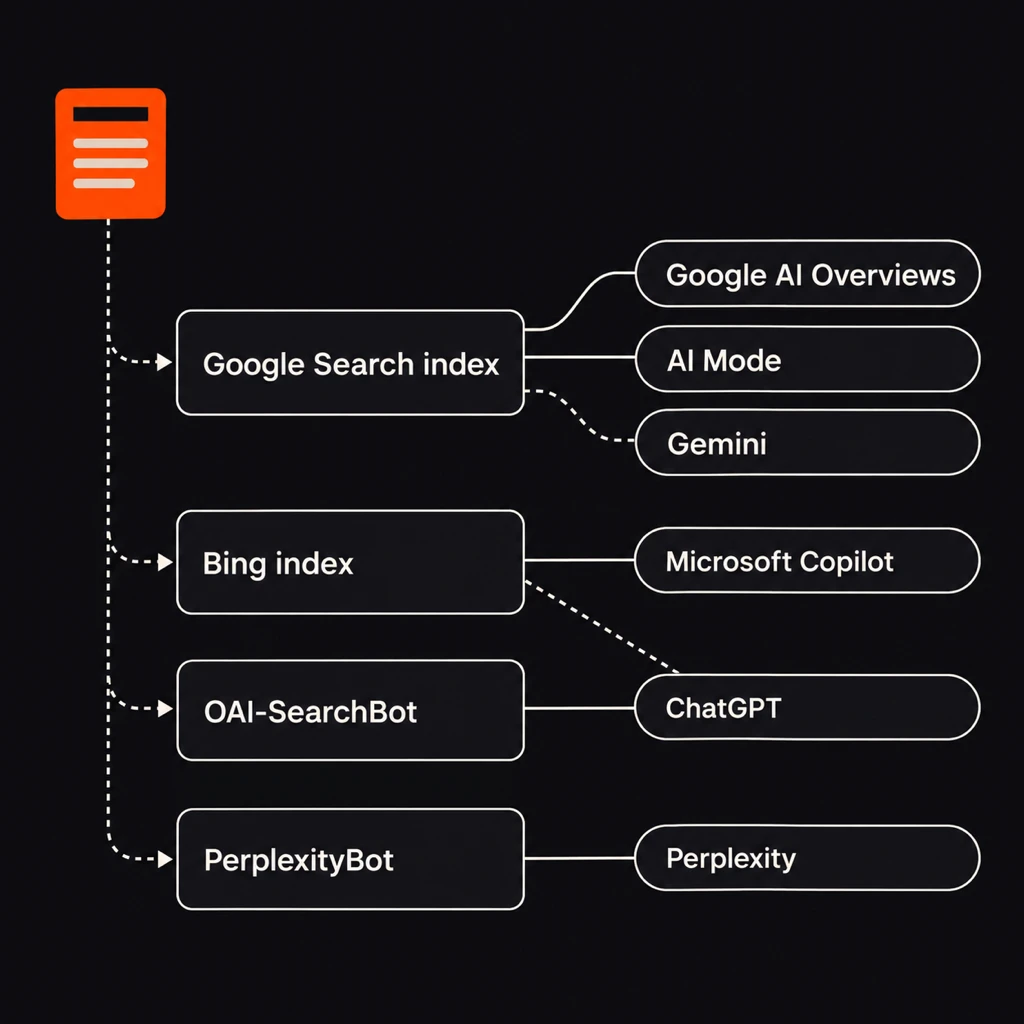
Google’s index covers three engines; Copilot, ChatGPT and Perplexity each need their own way in. Dashed lines are partial routes.
What do AI engines say GEO is? We asked them every day for a month
We track the question “What is generative engine optimization?” every day in ChatGPT, Perplexity and Google AI Overviews with our own tracker, ai.verticality.co. Between 3 September and 3 October 2026 that produced 89 answers: 29 from ChatGPT, 30 from Google AI Overviews and 30 from Perplexity. Three findings stood out.
The definitions converge. Every engine opened with the same skeleton: GEO is the practice of shaping content so that AI search and answer engines can find it, understand it and cite it. The wording changed almost daily, and Google’s AI Overview alone used at least six versions in 25 answers, but the parts never changed: a practice, content, AI engines, citation. Wikipedia’s lead compresses it further, to the practice of improving visibility in responses generated by generative AI systems. The definition at the top of this page uses the same parts on purpose.
Each engine reads from a different short list.
- Perplexity cited 74 different domains, about 20 links per answer. Three sites appeared in all 30 of its answers, each through a GEO explainer: HubSpot, Coursera and Search Engine Land. Wikipedia appeared in 28.
- Google AI Overviews cited 29 domains. YouTube appeared in 29 of 30 answers, through 10 different explainer videos; Coursera appeared in 24, Semrush in 19 and Wikipedia in 16.
- ChatGPT cited only 9 domains and gave no source at all in 12 of its last 25 answers. When it did cite, it went to primary sources: Google’s developer documentation in 10 of 29 answers, most often its guide to generative AI features, and Princeton’s publication page for the paper in 8.
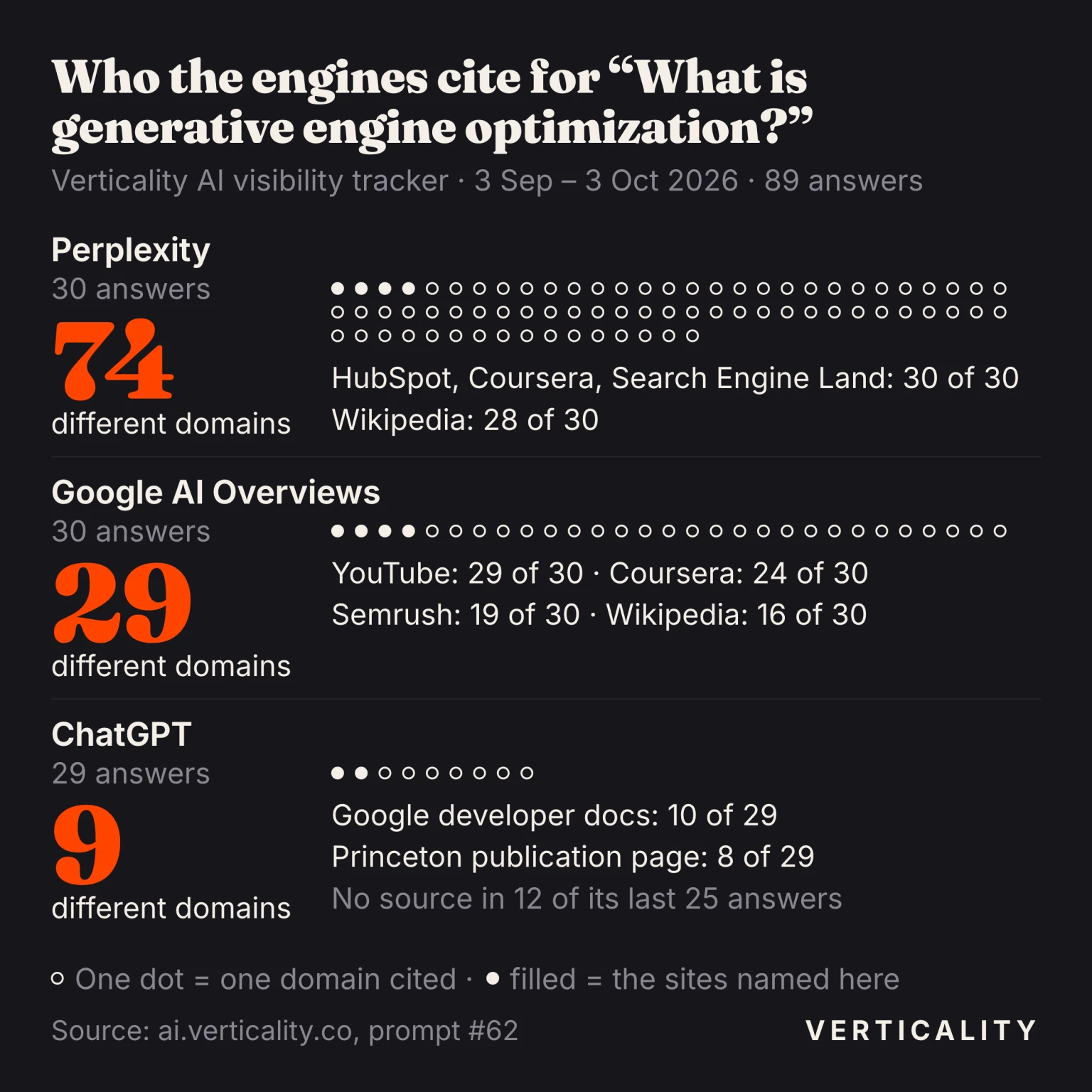
Same question, three reading lists: 74, 29 and 9 domains in one month.
No agency made it into the answer. We read the 75 most recent answers in full, and the word “agency” does not appear in any of them. Apart from the AI platforms, the only companies named were Semrush and HubSpot. No GEO agency was mentioned, ours included.
What follows from it: a definition question is won by pages that state the definition in the shape the engines already use, cite the primary source, and add a fact the other explainers lack. That is the pattern for any “what is X” question in your own category, not only this one.
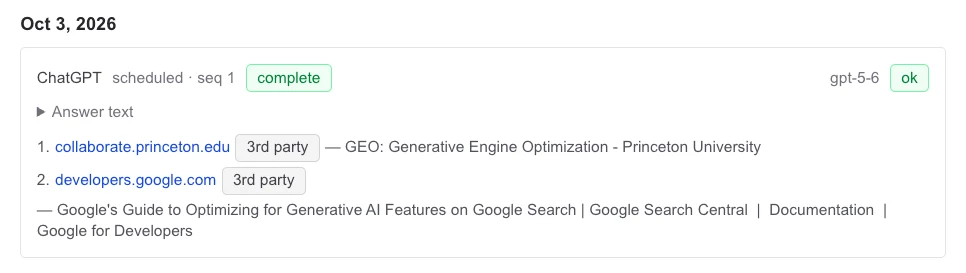
ChatGPT on 3 October 2026 cited two sources, both primary: the paper’s Princeton page and Google’s own guide.
How is GEO different from SEO?
The two search companies answer this differently. Google says optimizing for its generative AI features is “still SEO”, because AI Overviews and AI Mode retrieve from the same index with the same ranking systems (Google’s guide to generative AI features, updated 10 July 2026). Microsoft’s Bing guidelines use the term GEO outright and describe it as work on whether content is eligible to ground and be referenced in AI responses, while stating that SEO fundamentals still apply (Bing Webmaster Guidelines).
Both are right about the foundation: a crawlable, indexed, original page is the entry ticket to every engine in the table above. What changes is the rest, summarised below and compared axis by axis in GEO vs SEO:
| SEO | GEO | |
|---|---|---|
| A win looks like | A ranked position for a query | A citation or a brand mention inside an answer |
| Engines | Google and Bing results pages | ChatGPT, Perplexity, AI Overviews, AI Mode, Gemini, Copilot, each with its own sources |
| Where the work happens | Mostly on your own site | Your site plus third-party pages that AI answers already quote |
| How it is measured | Rankings, impressions, clicks | Mention rate and cited sources across a fixed set of buyer questions, per engine |
Keyword stuffing fails in both. The GEO paper measured it as worse than doing nothing on Perplexity, and Google’s guide warns that many suggested GEO “hacks” do not work. Wikipedia lists answer engine optimization (AEO) and AI optimization (AIO) as other names for the same practice; the line we draw between GEO and AEO gets its own comparison in AEO vs GEO.
What are the five levers of GEO?
GEO work falls into five levers. Each one gets a dedicated guide in this series.
- Understand how the answer gets built. An engine expands the question into sub-queries, retrieves passages, keeps a few and writes the answer around them. Knowing where your page drops out of that chain tells you which of the other four levers to pull.
- Make your pages worth quoting. Open each section with its answer, write facts as explicit sentences, cite primary sources and add numbers you can stand behind. These are the same three moves that won in the 2023 paper.
- Get into ChatGPT’s sources. Allow OAI-SearchBot in robots.txt, make sure your CDN does not block OpenAI’s crawlers, check that Bing can index you, and earn mentions on the pages ChatGPT already cites for your topic.
- Win Google AI Overviews and AI Mode. Be indexed and snippet-eligible, rank for the sub-queries a fan-out produces, and read the Generative AI performance report in Search Console, which Google rolled out to all sites on 31 August 2026.
- Measure mentions, not rankings. Fix a set of buyer questions, run them on every engine on a schedule, and record who gets named and which sources each answer cites.
Levers two to four each have an off-site half. When we classified the sources behind 31 buying questions about GEO agencies, two citations in three came from pages the brands did not own; the method and the numbers are on our generative engine optimization agency page.
Where should a brand start with GEO?
Start with a baseline: the questions your buyers ask, run on each engine, with every cited source recorded. Without it, there is no way to tell whether any change worked. We ran our own on 3 September 2026, and verticality.co appeared in 0 of 450 AI answers. ChatGPT began citing our GEO agency page on 20 September 2026, five days after it was published.
If you want that baseline for your own brand, our generative engine optimization programme opens with a free AI visibility audit. It runs 50 to 200 of your buyers’ questions on ChatGPT, Google AI Overviews and Perplexity and hands back your mention rate per engine, the competitors named instead of you, and the cited sources sorted by how many of those questions each one influences. You keep the audit even if we never work together. For a quicker first read, the free AI visibility checker runs 40+ of your buyers’ questions on ChatGPT and Google AI Overviews and emails the result within 24 hours.
Frequently asked questions
What does GEO stand for in marketing?
In marketing, GEO stands for generative engine optimization: the practice of making a brand's content more likely to be cited or recommended in answers written by AI search engines such as ChatGPT, Perplexity, Google AI Overviews and AI Mode, Gemini and Microsoft Copilot. It is unrelated to geo-targeting, which means showing ads or pages by location.
Who coined the term generative engine optimization?
The term comes from the paper "GEO: Generative Engine Optimization" by Pranjal Aggarwal, Vishvak Murahari, Tanmay Rajpurohit, Ashwin Kalyan, Karthik Narasimhan and Ameet Deshpande. It was first posted to arXiv on 16 November 2023 by researchers from Princeton University, Georgia Tech, the Allen Institute for AI and IIT Delhi, and accepted to the KDD 2024 conference.
Is GEO the same as AEO?
Mostly. Wikipedia lists answer engine optimization (AEO) and AI optimization (AIO) as other names for generative engine optimization, and Google's own guide treats both labels as descriptions of SEO work for AI search. Where a line is drawn, AEO leans toward winning the single direct answer (featured snippets, voice assistants) and GEO toward being one of the cited sources inside a generated answer.
Does GEO replace SEO?
No. Google says its AI Overviews and AI Mode retrieve pages from its regular Search index with its core ranking systems, so SEO remains the entry ticket there, and Microsoft's Bing guidelines say the same for Copilot. GEO adds what SEO does not cover: engines with their own sources such as ChatGPT and Perplexity, third-party pages that AI answers quote, and measuring mentions instead of rankings.
How do you know if GEO is working?
Fix a set of questions your buyers ask, run them on each AI engine on a schedule, and track how often your brand is named and which sources the answers cite. Google Search Console's Generative AI performance report shows impressions in AI Overviews and AI Mode, and Bing Webmaster Tools' AI Performance report shows citations in Copilot and Bing's AI summaries.
Want your brand named in AI answers?
Our free AI visibility audit asks ChatGPT, Perplexity and Google AI Overviews the questions your buyers ask, shows who gets named instead of you and which sources they cite, and ends with a ranked work plan.
Get a free AI visibility auditNot ready for a call? Run the free AI visibility checker: 40+ buyer questions in ChatGPT and Google AI Overviews, report by email within 24 hours.