How Long Does Generative Engine Optimization (GEO) Take?
GEO shows first signals in 4–8 weeks and compounds by month 3–6. Here is the clock for each kind of work and engine, and what to measure at 30, 60 and 90 days.
COO · AI Search & Data Architecture
Generative engine optimization (GEO) shows first signals in 4–8 weeks and compounds by month 3–6. That is the timeline we publish on How it works and report against every month. The range is wide because GEO is five kinds of work on five clocks: a crawler fix takes effect in days, a new page waits for Bing or Google to index it, roundup placements and Reddit threads take weeks to months, and training data waits for the next model.
How long does each kind of GEO work take?
Each kind of work has a gate it must pass before any AI engine can use it. The gate sets the clock, not the effort.
| Work | Gate it has to pass | Typical clock | Evidence |
|---|---|---|---|
| Crawler access (robots.txt, CDN or firewall rules) | The engine’s crawler re-reads your rules | Days | OpenAI: robots.txt changes take “~24 hours” to reach ChatGPT search (OpenAI crawlers); Google: recrawling takes “a few days to a few weeks” (Google Search Central) |
| New or rewritten pages on your site | Indexed by Bing (ChatGPT, Copilot) or Google (AI Overviews, AI Mode) | Days to weeks | Our pages were first cited 4–15 days after launch; two were still missing from Bing’s index 6 and 9 days after launch (table below) |
| Roundup and article placements | The publisher’s schedule, then that site’s indexing | Weeks | Our own Reddit agency roundup was cited by Perplexity 7 days and by ChatGPT 15 days after it went live |
| Reddit threads | The thread earns replies and upvotes, then ranks | Days to months | Google and OpenAI receive Reddit content through Reddit’s real-time Data API (Google, Feb 2024; Reddit, May 2024); Perplexity cited one r/SEO thread in 13 of its 29 answers to this guide’s question |
| Training data (what a model knows without searching) | A new model trained after your content existed | Months, next model | GPT-6 Astra: knowledge cutoff April 30, 2026, released September 3, 2026 (OpenAI models) |
The program-level timeline is the sum of these clocks. First signals in 4–8 weeks come mostly from crawler fixes and new pages, the work that only waits for indexing. Compounding by month 3–6 comes from placements and threads: they need more lead time, and their effect builds up.
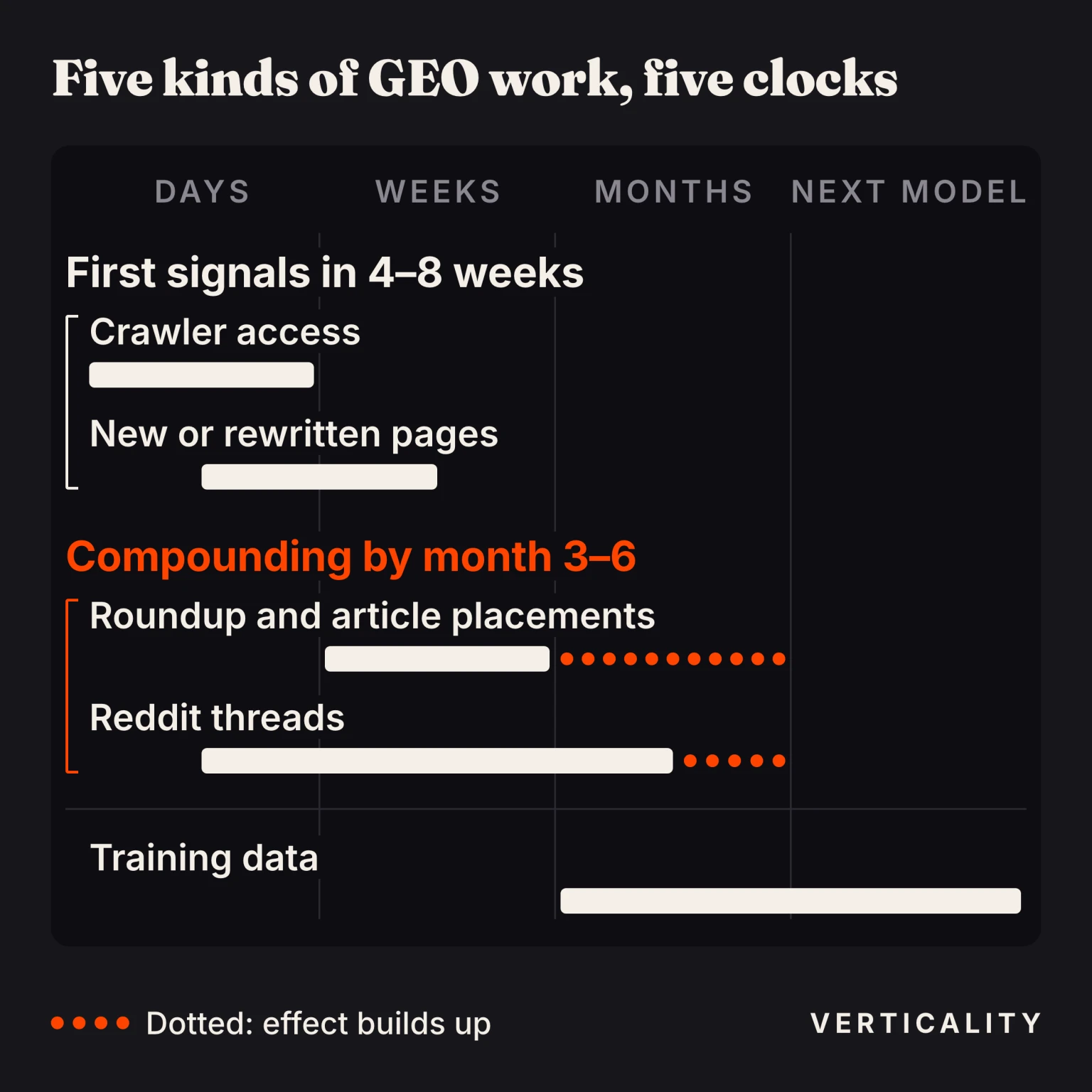
The fast clocks drive most first signals; the slow ones are where compounding comes from.
How long does it take to show up in ChatGPT answers?
ChatGPT can cite a page within days of indexing, because ChatGPT search queries the web at answer time. OpenAI’s crawler OAI-SearchBot must be allowed: sites that block it “will not be shown in ChatGPT search answers” (OpenAI). ChatGPT search rewrites the question into targeted queries and sends them to third-party search providers (OpenAI Help); Microsoft announced Bing as its default search experience in 2023 (Microsoft). That makes Bing’s index the first gate to check: of the pages we published in September, the two Bing had not indexed are the only two no engine has cited.
On verticality.co, ChatGPT cited our Reddit marketing page four days after it went live, the GEO page after five days and How it works after ten.
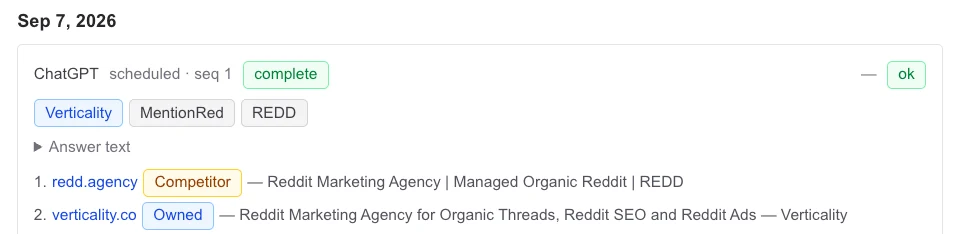
7 September 2026: ChatGPT cites our Reddit marketing page for the first time, four days after it went live.
The slow part is training data. A fact published today enters a model’s weights only when a model trained after it ships. GPT-6 Astra stopped learning on April 30, 2026 and launched four months later. Until the next model, ChatGPT knows your new pricing page only if its search step retrieves it. Even a retrieved page is not a promised citation: OpenAI says ChatGPT ranks results for relevant, reliable information, and “Placement is not guaranteed”.
How long does it take to appear in Google AI Overviews?
Google AI Overviews run on Google’s index and ranking systems, so their clock is the SEO clock. Google says there are “no additional requirements to appear in AI Overviews or AI Mode”: a page must be indexed and eligible to show with a snippet (Google Search Central). Google’s optimization guide puts it plainly: optimizing for generative AI search “is optimizing for the search experience, and thus still SEO” (Google).
Since August 31, 2026 every site also has a Search generative AI control in Search Console. Inclusion is the default; a site switched to exclusion drops out of AI Overviews and AI Mode within 1–2 days, sometimes longer (Search Console Help). Check it before you wait for anything else.
AI Overviews were the slowest engine on our own pages. Our Reddit marketing page was first cited in an Overview 15 days after launch, against four days in ChatGPT and Perplexity. Our GEO page had no Overview citation 18 days after launch, while ChatGPT had been citing it for 13 of those days. Overviews may also fan one question out into several related searches across subtopics (Google), so the cited pages can be the ones ranking for a sub-question rather than for the main query.
How fast did verticality.co get cited after publishing?
We track 130 buying questions daily across ChatGPT, Perplexity and Google AI Overviews on our own tracker, ai.verticality.co. On 3 September 2026, the first run, Verticality was named in 0 of 390 answers (130 questions × 3 engines). Every page below was published after that day.
| Page | Live | ChatGPT first cited | Perplexity first cited | AI Overviews first cited |
|---|---|---|---|---|
| /reddit-marketing-agency/ | 3 Sep 2026 | 7 Sep (4 days) | 7 Sep (4 days) | 18 Sep (15 days) |
| /generative-engine-optimization-agency/ | 15 Sep | 20 Sep (5 days) | not yet | not yet |
| /blog/best-reddit-marketing-agencies-for-saas/ | 15 Sep | 30 Sep (15 days) | 22 Sep (7 days) | not yet |
| /chatgpt-ads-agency/ | 18 Sep | not yet | 22 Sep (4 days) | not yet |
| /how-it-works/ | 18 Sep | 28 Sep (10 days) | not yet | not yet |
| /aeo-agency/ | 15 Sep | not yet | not yet | not yet |
| /llm-seo-agency/ | 18 Sep | not yet | not yet | not yet |
Source: Verticality AI Visibility Tracker, 130 buying questions in our own category (marketing services), daily runs 3 September to 3 October 2026. “Not yet” means no citation by 3 October.
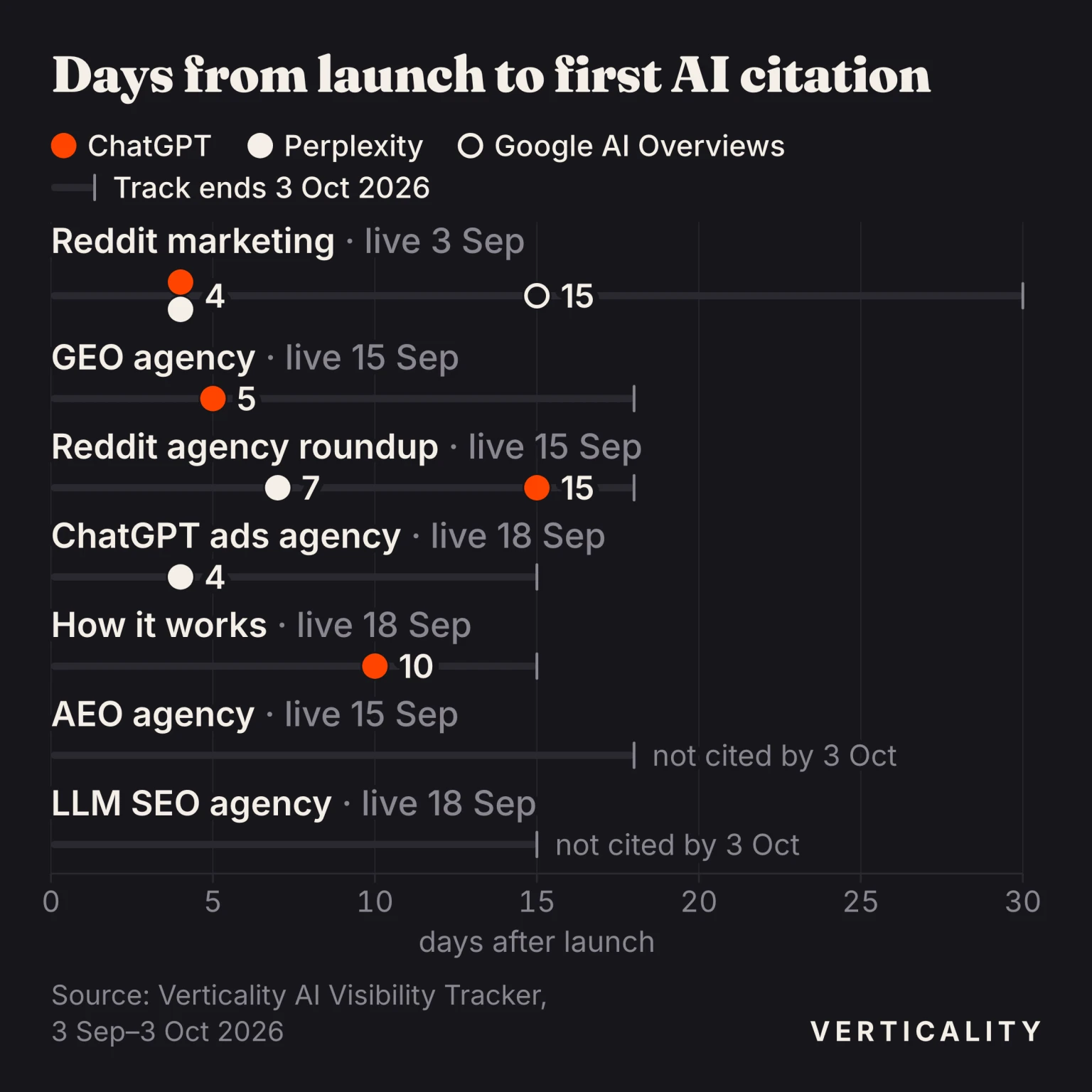
First citations came 4–15 days after launch; AI Overviews cited one page, and two pages were not cited by 3 October.
The two pages at the bottom show where the clock really starts. Nine and six days after launch, on 24 September, AEO and LLM SEO were the only pages of the site missing from Bing’s index, and both repeated large blocks of text from sibling pages. We rewrote both that day and pinged IndexNow. By 30 September, six days after the rewrite, ChatGPT was retrieving both pages in its search results; by 3 October it had cited neither. Retrieved is not cited, and each step takes its own days. The full diagnosis is in how to get cited by ChatGPT.
Across all 130 questions, ChatGPT named Verticality in 19 of 910 answers in the first week (2.1%) and in 55 of 780 answers in the fourth week (7.1%). Perplexity went from 4 of 910 to 19 of 780. Google AI Overviews named us once in the third week and once in the fourth.
Why do AI answers quote different GEO timelines?
Ask ChatGPT, Perplexity or Google how long GEO takes and you get “2–6 weeks”, “4–8 weeks”, “3–6 months” or a 60–90-day checkpoint. We read the answers to that exact question for 30 days (4 September to 3 October 2026, 86 answers across the three engines). “3–6 months” appeared in 71 of the 75 answers we read in full, “2–6 weeks” in 34 and “4–8 weeks” in 26. ChatGPT added its own 30/60/90-day evaluation plan in 17.
The figures trace back to a handful of agency and vendor pages:
- 2–6 weeks to first results and 3–6 months to consistent visibility: Google’s Overviews attach both to Boston Web Marketing (cited in 22 of 29 Overviews) and to a LinkedIn article (cited in 26). Boston Web Marketing states no method.
- 60–90 days to initial improvements: the same Boston Web Marketing page, for “full-stack” programs.
- 4–8 weeks to early signals: WebFX, cited by Perplexity in 20 of 29 answers, with no stated method. AmICited, which Perplexity began citing on 23 September, gives ChatGPT 6–12 weeks on one FAQ page and “hours to days” on another.
- 47 days median to a first citation: a Xale AI study of 127 brands tracked April 2024 to April 2025, the only source in the set that publishes a sample. It counts a brand mention in at least 3 queries within 7 days, starts the clock at program launch and reports Perplexity at 31 days, ChatGPT at 44 and AI Overviews at 67. Xale is a GEO vendor, and the study is self-published.
- 24 hours: ChatGPT sometimes credits this to OpenAI’s publishers FAQ. The figure is on OpenAI’s crawler page, and it covers a robots.txt change reaching ChatGPT search, not a new page appearing.
The numbers differ for four reasons:
- Different finish lines. A first mention, a linked citation, consistent visibility, traffic and pipeline are five events. Xale’s own medians run 47, 78 and 112 days for citation, traffic and pipeline.
- Different starting guns. Some sources count from program launch, others from the day a page is published. A page cited four days after publishing can sit two months into a program.
- Different engines. Perplexity and ChatGPT search the web live; AI Overviews follow Google’s rankings. Xale’s own platform medians span 31 to 67 days.
- One snapshot versus repeated runs. On the 56 AI-search buying questions we track in our own category, ChatGPT still cited only 26.4% of its sources for the same question the next day (4–23 September 2026). A single check can catch you on a good day or miss you on one.
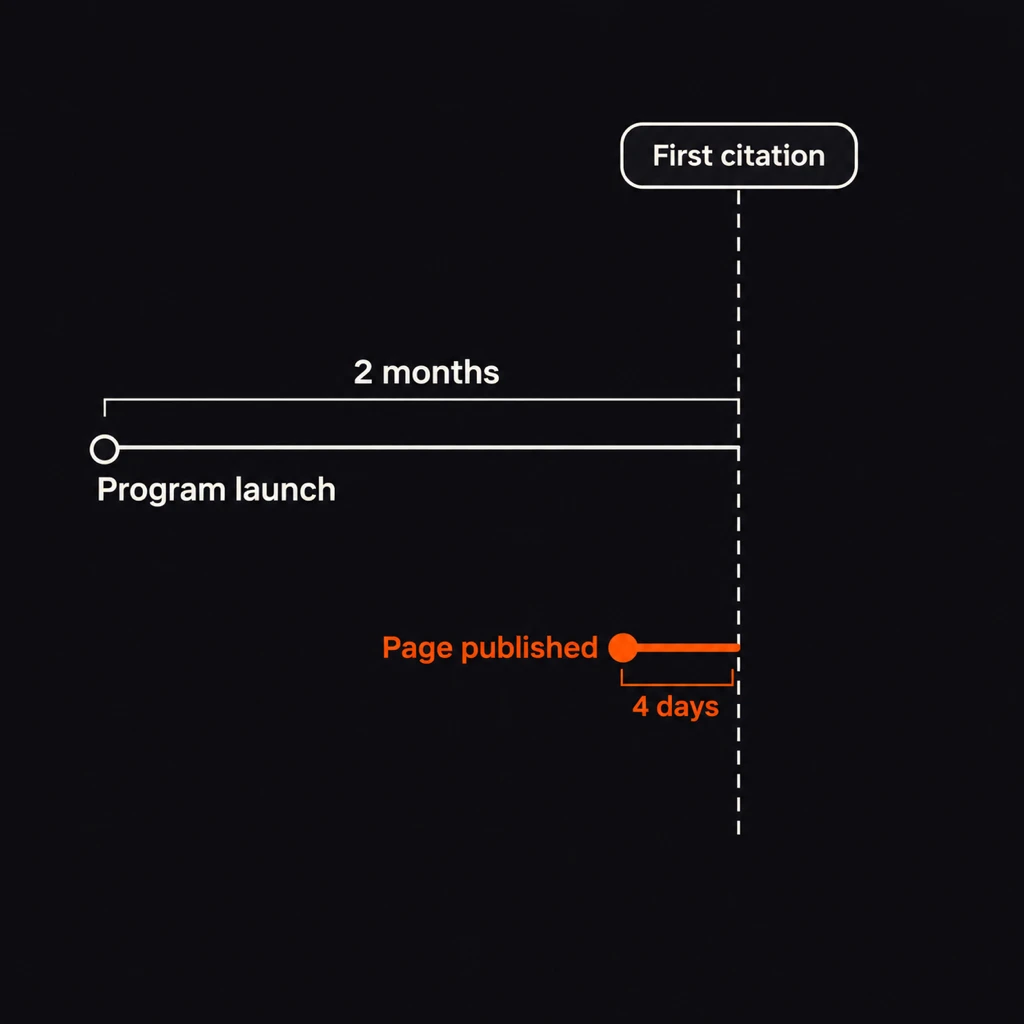
Same citation, two clocks: four days after the page went live, two months into the program.
What should you measure at 30, 60 and 90 days?
Measure a fixed set of buying questions run daily on each engine, read weekly, against a baseline taken before any change. Engines rotate their sources from day to day, so a one-off check proves nothing.
| Checkpoint | What should be true | How to check |
|---|---|---|
| Week 2 | Baseline: the questions your buyers ask AI, and where you stand on each engine | First tracker runs before any change ships |
| Day 30 | The gates are open: AI crawlers allowed, new and rewritten pages indexed by Google and Bing | Server or CDN logs for OAI-SearchBot and PerplexityBot; URL Inspection in Search Console and Bing Webmaster Tools |
| Day 60 | The end of the 4–8 week first-signal window: first mentions and first citations of your own pages, usually in ChatGPT and Perplexity first | Mention rate per engine against the baseline; which of your URLs are cited |
| Day 90 | Into month 3, where compounding starts: placements and threads cited, mention rate rising week over week | Share of voice against named competitors; the third-party sources cited instead of you; AI referral sessions in analytics |
Google’s Search Console added a Generative AI performance report on June 3, 2026, available to all sites since August 31. It shows impressions in AI Overviews and AI Mode by page, country and device; the announcement lists no click metric (Google). Use it for the Google half; ChatGPT and Perplexity need a prompt tracker. Definitions of each metric are in how to measure AI visibility.
If nothing moves by day 60, go back to the gates before adding content. In our case the missing step was Bing’s index, and the cause was text repeated across sibling pages.
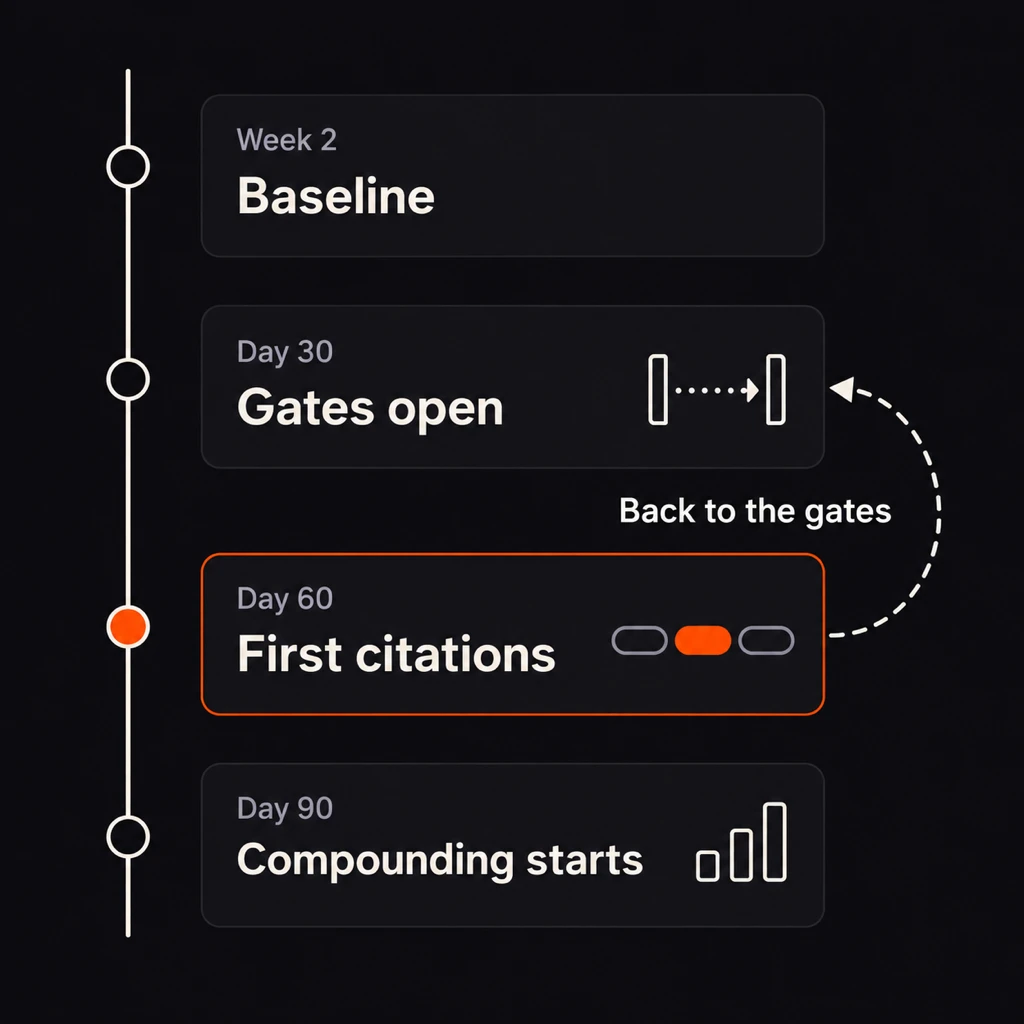
If day 60 shows nothing, the fix is upstream: go back to the gates before adding content.
Where do you stand on day one?
A timeline only means something against a baseline. Every GEO program we run opens with a free AI visibility audit: the buying questions in your category, how often ChatGPT, Google AI Overviews and Perplexity name you today, which competitors they name in your place, and the sources behind each answer. You keep the audit whether or not we work together, and every later week of the program is read against it. For a quick reading before that, the free AI visibility checker shows how often ChatGPT and Google AI Overviews name you across 40+ buyer questions.
Frequently asked questions
How long does generative engine optimization take to show results?
Verticality's published timeline for a generative engine optimization program is first signals in 4–8 weeks and compounding by month 3–6. Single pieces of work run faster or slower: a robots.txt change reaches ChatGPT search in about 24 hours, a well-built new page can be cited within days of being indexed, and anything that depends on a model's training data waits months for the next model.
Is GEO faster than SEO?
For Google AI Overviews, no: Google says optimizing for its generative AI features is still SEO, and a page must be indexed and eligible for a snippet before an Overview can cite it. ChatGPT and Perplexity can be faster, because they search the web live; on verticality.co both engines cited a new page four days after it went live.
Why is my site still not cited by ChatGPT after a month?
Check the gates in order: OAI-SearchBot allowed in robots.txt and in your CDN or firewall, the page indexed by Bing, and the page saying something other sources do not. On verticality.co two pages that shared large blocks of text were missing from Bing's index 6 and 9 days after launch, and ChatGPT cited neither.
How long does it take for new information to reach ChatGPT's training data?
Months. OpenAI's GPT-6 Astra has a knowledge cutoff of April 30, 2026 and was released on September 3, 2026, about four months later. Anything published after the cutoff reaches that model only through ChatGPT search, which needs OAI-SearchBot access and a page the search provider has indexed.
Do GEO results last once you stop?
Citations are not permanent. In Verticality's tracking of 56 AI-search buying questions (4–23 September 2026), ChatGPT still cited only 26.4% of its sources for the same question the next day, Perplexity 70.1% and Google AI Overviews 49.8%. Visibility has to be measured daily and re-earned, not banked.
Want your brand named in AI answers?
Our free AI visibility audit asks ChatGPT, Perplexity and Google AI Overviews the questions your buyers ask, shows who gets named instead of you and which sources they cite, and ends with a ranked work plan.
Get a free AI visibility auditNot ready for a call? Run the free AI visibility checker: 40+ buyer questions in ChatGPT and Google AI Overviews, report by email within 24 hours.