What an AI Visibility Audit Includes (and What to Expect)
An AI visibility audit should hand you the prompt list, results per AI engine, share of voice, every cited source and a ranked plan. Checklist and red flags.

COO · AI Search & Data Architecture
An AI visibility audit records how ChatGPT, Google AI Overviews, Perplexity and similar assistants answer the questions your buyers ask: how often they name you, who they name instead, and which pages they cite to build the answer. A complete audit hands you eight things: the prompt set, the engines and number of runs, your mention rate and share of voice against named competitors, every cited source, the Reddit threads among them, a crawler access check, your on-site gaps and a ranked action plan. If the report cannot show you the questions it asked and the sources it found, you bought a screenshot, not an audit.
What does an AI visibility audit include?
Eight items. Each one replaces something you would otherwise have to take on trust.
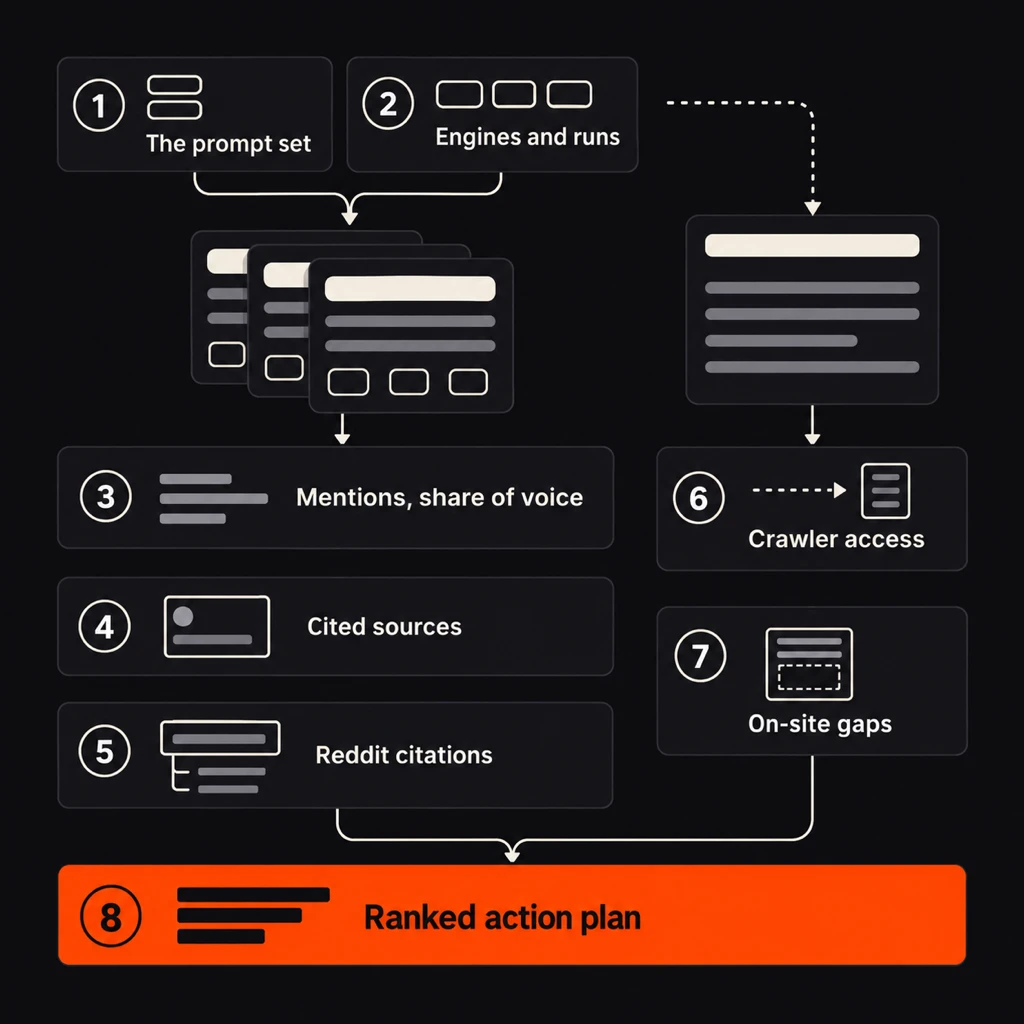
Two inputs, five findings, one ranked plan.
| # | Item | What the report should show |
|---|---|---|
| 1 | The prompt set | Every question asked, worded the way buyers ask an assistant, grouped by type: best-of, comparison, problem, price, with questions that name your brand kept apart. Published audits range from 5 to 8 questions on starter tiers to 50 or more; ours uses 50 to 200. |
| 2 | Engines and runs | Which assistants and which mode were queried (ChatGPT with search on or off, AI Overviews or AI Mode), on which dates, how many times per question, from which country. |
| 3 | Mention rate and share of voice | Per engine: the share of answers that name you, and your share of all brand mentions against a competitor set you agreed on. |
| 4 | Cited sources | Every URL the engines cited, ranked by how many of your questions it appears in, and which brands it names. |
| 5 | Reddit citations | The specific threads and subreddits cited, per engine, and whether you or a competitor show up in them. |
| 6 | Crawler access | Whether OAI-SearchBot, PerplexityBot, Googlebot and Bingbot can fetch your pages through robots.txt and your CDN, and whether the pages are indexed in Google and Bing. |
| 7 | On-site gaps | Buying questions no page of yours answers, and pages that exist but are not indexed, not quotable, or missing the facts engines repeat: who it is for, what it costs, what you get. |
| 8 | Ranked action plan | Fixes and placements ordered by how many questions each one moves, each with an owner and a date. |
Why one run is not an audit
AI answers change daily, and each engine changes at its own speed. We tracked 56 AI-search buying questions once a day for 20 days in September 2026: ChatGPT kept about a quarter of its cited URLs from one day to the next (26.4%), Google AI Overviews half (49.8%) and Perplexity seven in ten (70.1%). These are questions from our own category, not a census of every industry. An audit built on one afternoon of prompting measures that afternoon, so ask how many runs sit behind every number and over how many days. Our guide on how to measure AI visibility covers how many runs are enough.
Why the source list matters more than the score
Engines assemble answers from pages, and most of those pages belong to someone else: of 1,126 citations behind answers to 31 GEO-agency buying questions we measured, third-party articles and roundups made up 63.6% and vendor sites 21.0%. Ranked by how many of your questions each source touches, that list becomes the work plan: one placement in a page that feeds 40 of your questions does more than a new page of your own that feeds one.
Why Reddit gets its own line
Reddit is cited unevenly: across 56 AI-search buying questions in September, reddit.com appeared in 35.0% of Google AI Overviews and 30.9% of Perplexity answers, against 7.9% of ChatGPT answers. The audit should name the threads, not only the domain, because a thread is something a person can answer. How we work those threads is on our Reddit marketing agency page.
What the crawler and index check covers
OpenAI says sites that block OAI-SearchBot “will not be shown in ChatGPT search answers”. Google says a page needs to be indexed and eligible for a snippet to appear as a link in AI Overviews or AI Mode, and that no special file or markup is required. So the audit checks robots.txt, CDN and firewall rules, and index status in both Google and Bing. A request sent with a crawler’s user agent proves little on its own, because CDNs such as Cloudflare check real crawlers against published IP lists, reverse DNS or signed requests; firewall or server logs settle it. The index check earned its place on our own site: two of our service pages were missing from Bing’s index on 24 September 2026, and neither had been cited by ChatGPT by then. The ChatGPT side of this check is set out step by step in how to get cited by ChatGPT.
What do you get from an AI visibility audit? The workbook, tab by tab
Ours arrives as one Google Sheet. The one we built for our own brand on 3 September 2026, from the first collection run of 150 questions and 450 answers, has eleven tabs. Below are the nine views they add up to: what each contains, what it showed for us, and the decision it lets you make.
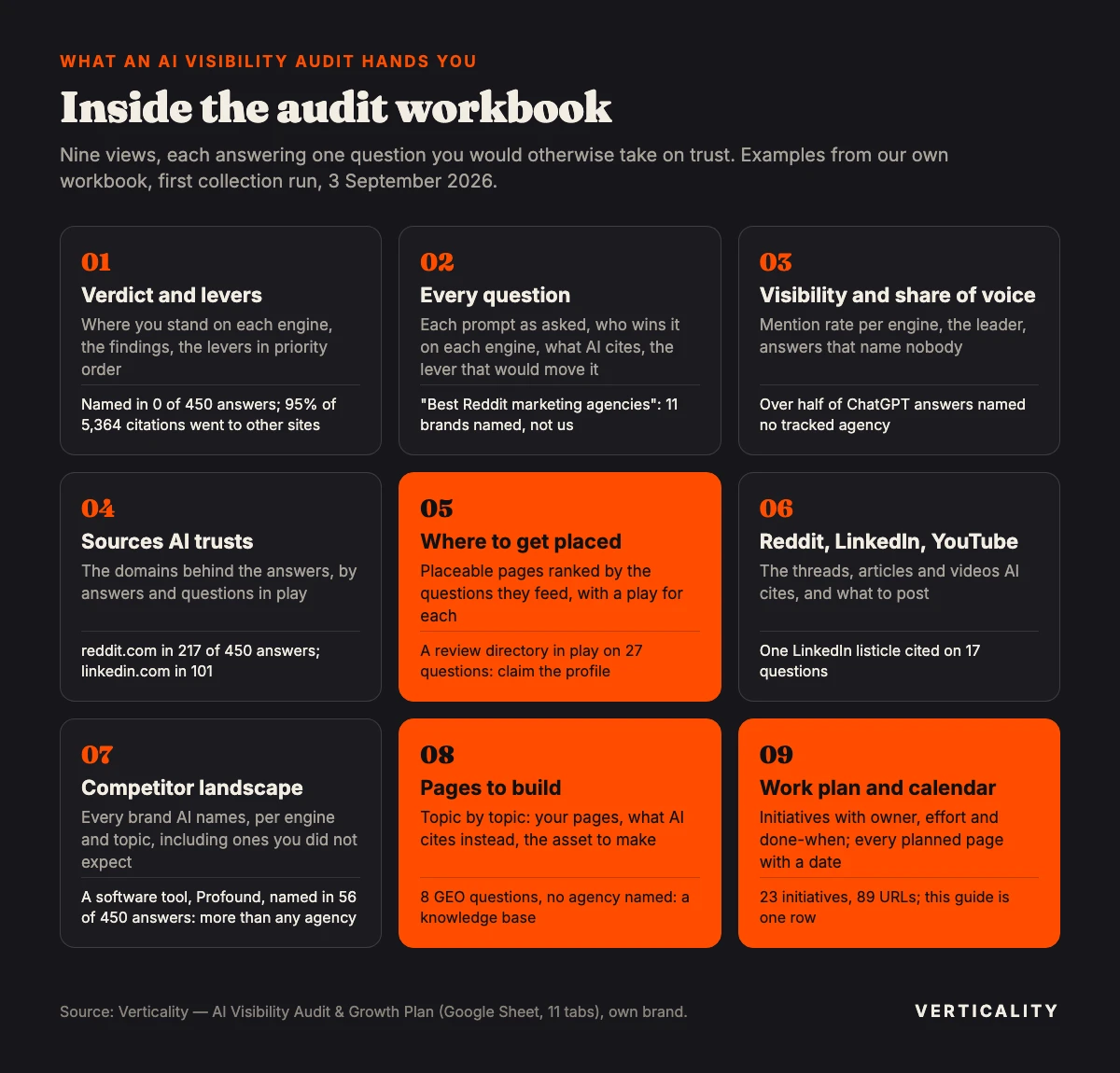
Each view answers one question a buyer would otherwise take on trust. The three in orange are where the work plan comes from.
| View | What it contains | What it showed for us | What you decide with it |
|---|---|---|---|
| Verdict and levers | Mention rate per engine against the category leader, seven findings, growth levers in priority order, a 90-day outline | Named in 0 of 450 answers; 95% of 5,364 citations went to third-party sites | Whether to invest, and which lever comes first |
| Every question | Each prompt exactly as asked, its type and intent, who wins it on each engine, what AI cites for it, the lever that would move it | ”Best Reddit marketing agencies”: 11 brands named across three engines, none of them us | Which questions matter, and what each one needs |
| Visibility and share of voice | Mention rate per engine, the leader, how many answers name no tracked brand at all, share of voice | 79 of 128 ChatGPT answers named no tracked agency, so the category was still open | How hard the fight is, engine by engine |
| Sources AI trusts | The 40 most-cited domains, how many answers and questions each feeds, which competitors appear next to them | reddit.com in 217 of 450 answers across 114 questions; linkedin.com in 101 across 76 | Which channels matter in your category |
| Where to get placed | Placeable third-party pages ranked by the questions they feed, each with a suggested play | A review directory in play on 27 questions (claim the profile); an agency roundup on 23 (pitch inclusion) | The outreach list, in order |
| Reddit, LinkedIn and YouTube | The subreddits and threads AI cites, with thread age; the LinkedIn articles and YouTube videos it cites; what to publish | r/DigitalMarketing: 37 threads cited in 55 answers; one LinkedIn listicle cited on 17 questions | Where your people show up, and what they post |
| Competitor landscape | Every brand AI names, per engine and topic, including brands outside your shortlist | A software tool, Profound, was named in 56 answers, more than any agency | Who you are really compared with |
| Pages to build | 25 topics: your existing pages, what AI cites instead, the recommended asset, its priority | GEO education: 8 questions, no agency named, AI citing Coursera, Yotpo, Moz and Google’s documentation | Which pages to create or rewrite first |
| Work plan and calendar | 23 initiatives with owner, effort, dependency and definition of done; every planned page with its URL, date and author | 89 URLs in the calendar; this guide is one row of it | What happens next week, and who does it |
Under the views sits the raw layer: the prompt file with the conditions each question ran under, the answer log with engine, mode, date and country for every answer, and the citation table. That layer is what lets anyone, us included, run the same audit again and compare. If an agency will not hand over the prompt file, no later audit can be measured against this one.
One caveat we hold ourselves to: that first workbook came from a single day’s run, so we treat its numbers as a map rather than a measurement. Decisions are then read against daily runs, which is what the next section shows.
What gets added for a site that already has content
Our site had 12 pages when we audited it, so most of our plan was about building. A site with an existing library gets four more views:
- The question-by-question matrix: for every question, your page, whether it answers the question directly, the page that wins instead and the diagnosis. For a matchmaking service we work with, 67 of 93 questions landed in “page exists, does not answer directly”, so the plan was rewrites rather than new pages.
- A content inventory: every existing page marked keep, rewrite, merge or remove, so new pages do not compete with the ones you already have.
- An external profile scan: the directories and review sites AI cites where your competitors have a profile and you do not.
- Competitor page types: the kinds of page that get your competitors cited. For a wealth manager we work with, rivals were cited through pages written for single professions (doctors, dentists, attorneys), and the firm had none.
How does the audit turn into a work plan? Our own, 30 days on
The workbook is the map; the matrix is the measurement. For every buying question it records whether you are named, which of your pages is cited, which page wins instead and what kind of page that is, then gives the question a diagnosis and an action. Here is that layer for our own brand a month after the first run: 11,180 answers to 130 buying questions from ChatGPT, Google AI Overviews and Perplexity, 4 September to 3 October 2026.
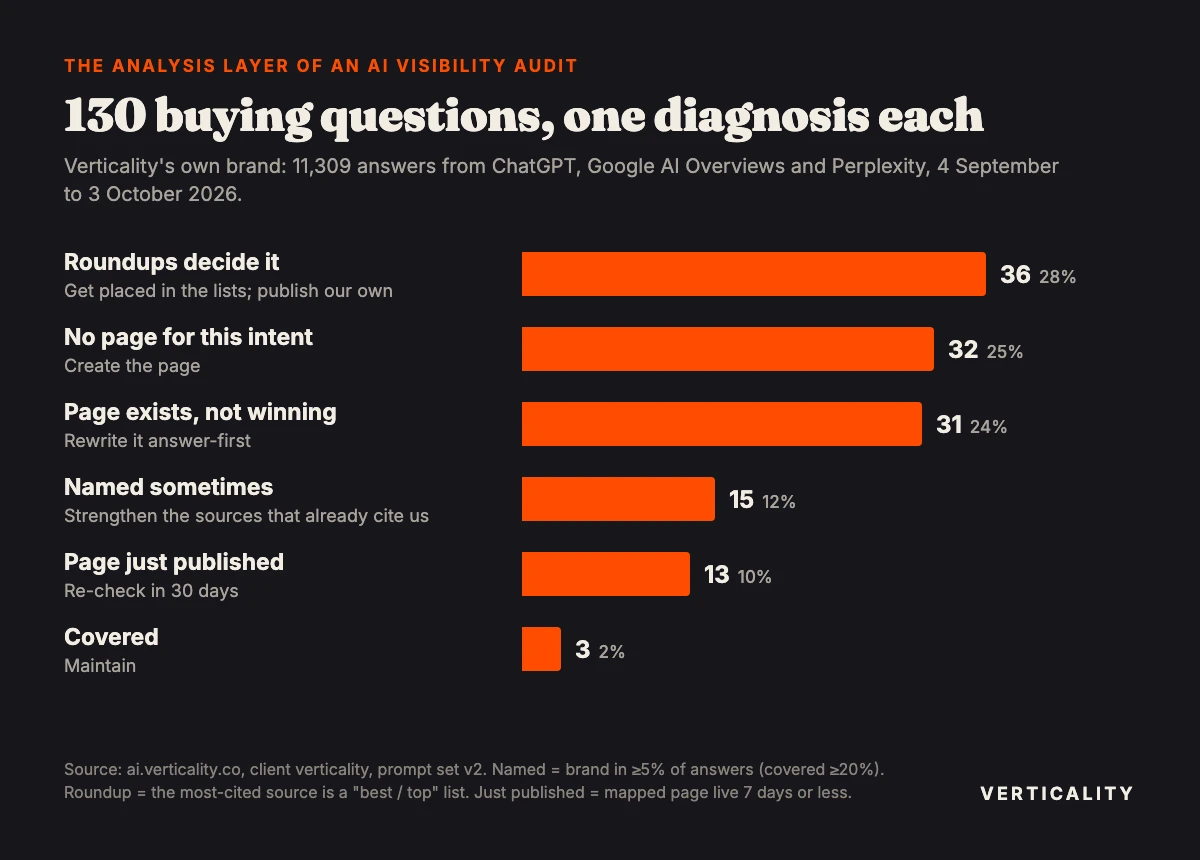
Each question gets one label. Two thirds of ours fall into three buckets: a roundup decides the answer, we have no page for the question, or our page exists and does not win yet.
Every question gets a diagnosis and an action
| Diagnosis | Questions | What it means | Action |
|---|---|---|---|
| Roundups decide it | 36 | We are named in under 5% of answers, and the most-cited source is a “best” or “top” list | Get into those lists; publish our own |
| No page for this intent | 32 | Under 5%, and no page of ours targets the question | Create the page |
| Page exists, not winning | 31 | Under 5%, although a page of ours covers the topic | Rewrite it answer-first, with the facts engines repeat |
| Named sometimes | 15 | Named in 5% to 19% of answers | Strengthen our place in the sources that already cite us |
| Page just published | 13 | The page went live in the last seven days | Re-check in 30 days |
| Covered | 3 | Named in 20% of answers or more | Maintain |
Six rows from the matrix show how the labels are earned:
| Tracked question | Named (30 days) | Our page cited | Most-cited page instead | Diagnosis |
|---|---|---|---|---|
| #5 A Reddit marketing agency focused on organic brand mentions | 25 of 86 | /reddit-marketing-agency/, 21 answers | Vettted, “Top 7 Reddit Marketing Agencies”, 37 | Covered |
| #56 A GEO agency that gets brands cited in ChatGPT and Perplexity | 9 of 86 | /generative-engine-optimization-agency/, 10 | Digital Elevator, “12 Best GEO Agencies”, 23 | Named sometimes |
| #1 Best Reddit marketing agencies | 0 of 86 | none | Digital Elevator, “9 Best Reddit Marketing Agencies”, 65 | Roundups decide it |
| #2 Agencies offering done-for-you Reddit marketing | 3 of 86 | /reddit-marketing-agency/, 3 | OutreachBloom’s service page, 57 | Page exists, not winning |
| #28 How to market on Reddit without getting banned | 0 of 86 | none | Reddit’s own rules page, 37 | No page for this intent |
| #68 What an AI visibility audit includes | 0 of 86 | none | mywebaudit’s audit walkthrough, 47 | Page just published: this guide |
Whose pages win: ours against competitors’
Over the same 30 days, a page of ours was cited for 34 of the 130 questions. The competitor pages AI cites most widely reach 37 to 47 questions each, and most of them are “best agencies” lists:
| Page | Whose | Questions citing it | Answers citing it |
|---|---|---|---|
| InterTeam Marketing: “Best Reddit Marketing Agencies in 2026 (Ranked & Reviewed)“ | Competitor | 47 | 919 |
| Quimby Digital: “Top Reddit Marketing Agencies (2026)“ | Competitor | 44 | 828 |
| Soar: “Best Reddit marketing agencies in 2026” | Competitor | 44 | 469 |
| Growthner: “15 Best Reddit Marketing Agencies for SaaS in 2026” | Competitor | 39 | 618 |
| Growth Marketing Pro: Reddit agency service page | Competitor | 37 | 501 |
| verticality.co/reddit-marketing-agency/ | Ours | 20 | 181 |
| verticality.co/generative-engine-optimization-agency/ | Ours | 9 | 50 |
| verticality.co/blog/best-reddit-marketing-agencies-for-saas/ | Ours | 7 | 21 |
Four of those five competitor pages are roundups published by agencies that sit in our own competitor set. That one finding put two lines into the plan: get placed in their lists, and publish a roundup of our own. Ours went live on 15 September and has been cited for 7 questions so far.
What AI cited instead, topic by topic, and what we built
The audit groups the questions into topics and records what AI cited for each one before we had a page. That column is the brief for the page.
| Topic | Questions | What AI cited instead on 3 September | What we built | Named, last 30 days |
|---|---|---|---|---|
| Reddit agency shortlists | 8 | Reddit threads and competitors’ own roundups | /reddit-marketing-agency/ (3 Sep) and our SaaS roundup (15 Sep) | 65 of 688 answers (9%) |
| GEO agency shortlists | 9 | Reddit, LinkedIn articles and GEO agency lists; our only page said “AI SEO” and never “GEO” | GEO, AEO and LLM SEO pages (15 to 18 Sep) | 37 of 774 (5%) |
| GEO education | 8 | Coursera, Yotpo, Moz and Google’s documentation; no agency named | Six guides, this one included (3 Oct) | Too early to read |
| Reddit playbooks | 10 | Reddit threads and Reddit for Business pages | Not built yet | 0 of 860 |
| Alternatives to named competitors | 16 | Reddit threads and competitors’ own pages | Not built yet | 21 of 1,376 (2%) |
The rows still at zero are the next pages in the plan, and the matrix shows which source each one has to beat.
The work plan that came out of it
The workbook turns the matrix into 23 initiatives in four phases, each with an owner, an effort estimate and a definition of done:
| Phase | Initiatives | Done when |
|---|---|---|
| Weeks 1–2 | Unblock AI crawlers, schema and entity basics, a content system, tracker hygiene, a positioning and pricing brief | Every AI crawler gets a 200 response; the first guide is published from the new system |
| Month 1 | Pillar pages for Reddit marketing, Reddit Ads, GEO and the audit itself; pricing; case studies; the first playbook guides | Each pillar page is cited on two or three questions or more by day 60 |
| Month 2 | Our own roundups, the first “alternatives” pages, outreach to the 25 highest-reach pages, Reddit threads, LinkedIn articles | We are present in sources that feed 40 or more questions |
| Month 3 | The GEO knowledge base, getting-cited guides, pain-point guides, vertical pages, original research, a re-measure | verticality.co is cited on ten or more education questions |
Placements are planned the same way, from a list of third-party sources ranked by how many questions each one reaches:
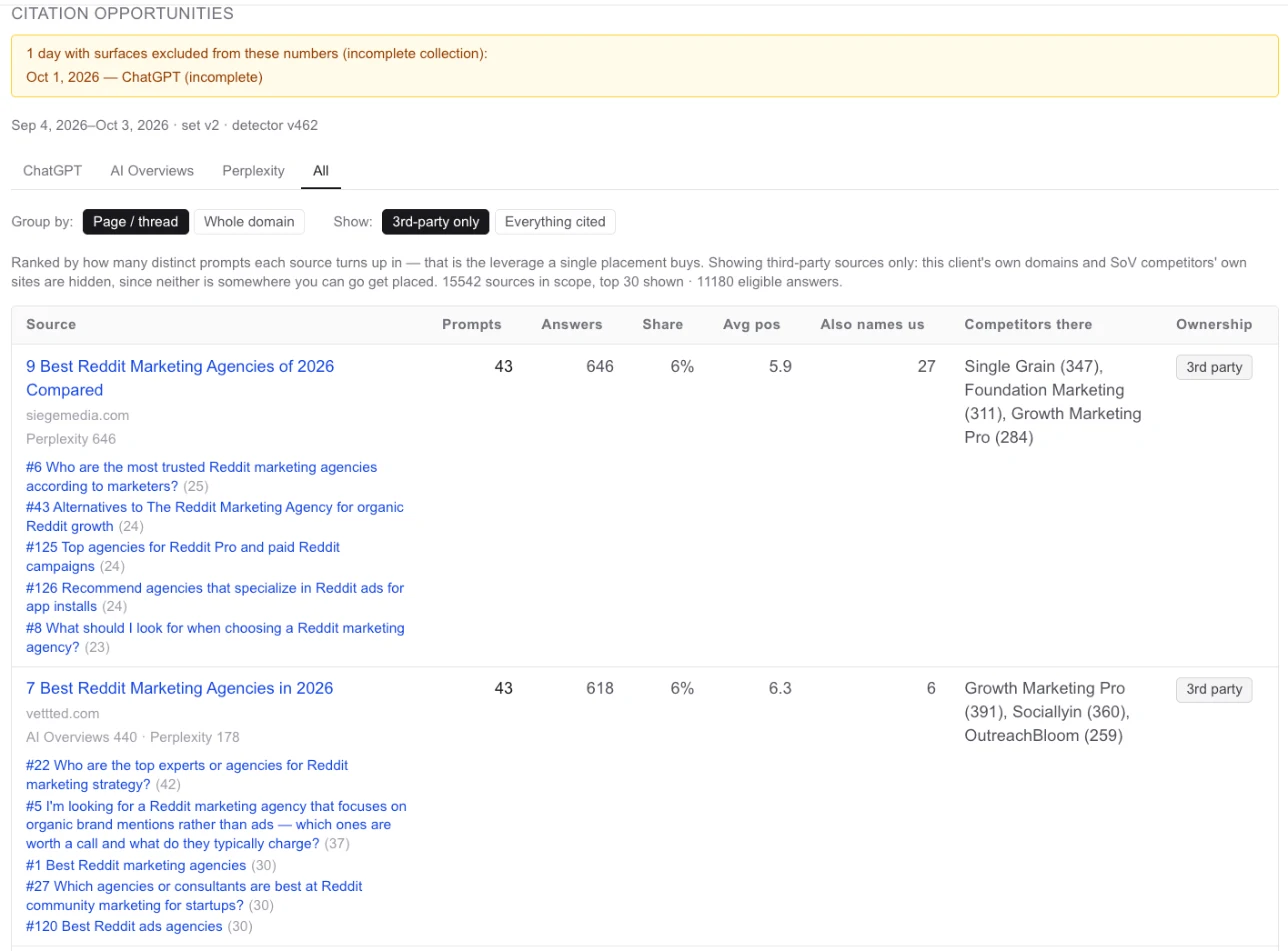
The two highest-reach sources each feed answers to 43 of our questions. The first already names us in 27 of the answers that cite it, the second in 6, so the second is the bigger gap to close.
What moved in 30 days
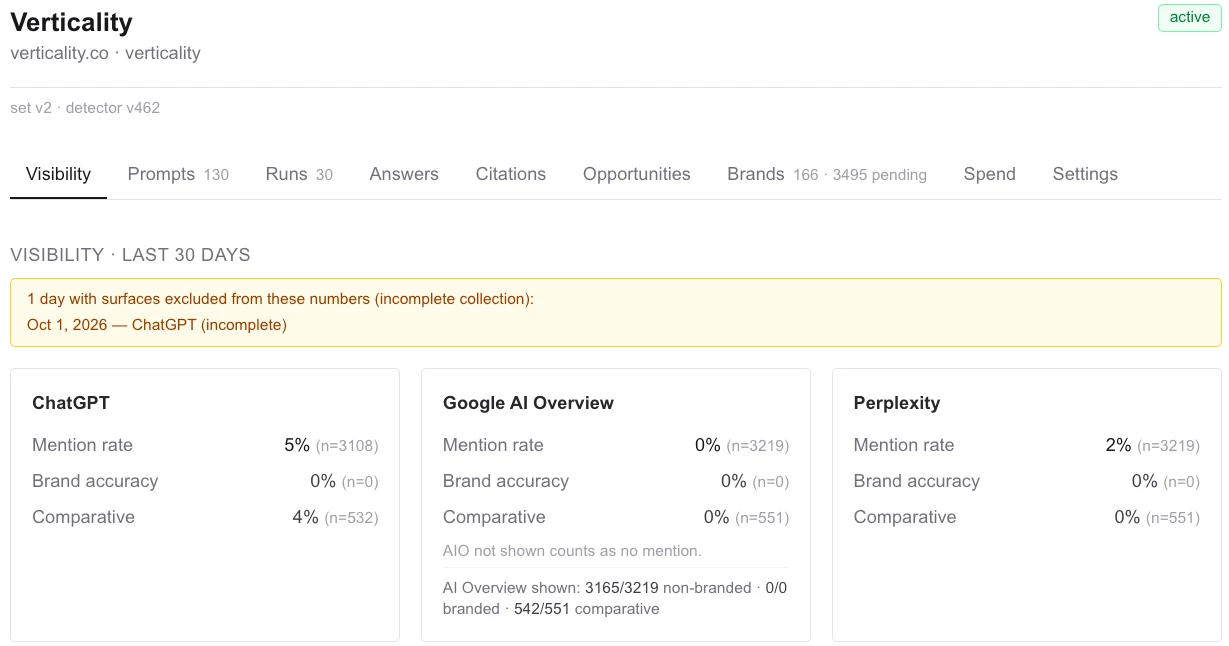
From none of 450 answers on 3 September to 156 of 3,108 non-branded ChatGPT answers over the next 30 days, 57 of 3,219 on Perplexity and 3 of 3,219 on Google AI Overviews. The yellow note lists a day left out because collection was incomplete.
The pages built from the plan carry the movement: /reddit-marketing-agency/ is cited in 181 answers across 20 questions, and ChatGPT first cited the GEO page five days after it went live. Google AI Overviews has barely moved, which is why the next phase leans on roundups and placements rather than more pages of our own. Mention rate, share of voice and citation are defined, with the formulas our tracker uses, in how to measure AI visibility.
How does an audit run, and how long does it take?
The sequence is the same at most agencies; the depth differs.
- Intake. You agree the prompt set and the competitor set before any run, and hand over what the auditor needs: Search Console and analytics access, your markets and languages. Questions you did not see are numbers you cannot check.
- Collection. Repeated runs on each engine over several days, so one odd answer does not set the baseline.
- The report and the raw data. The answers, the sources and the counts, exportable, not only charts.
- A walkthrough call, where the person who ran the audit explains the findings and takes your questions.
- The ranked plan, with the first fixes named page by page and the first placements named source by source.
Of 20 agencies and consultants that publish an audit price, 13 also state a turnaround. Most fall between 5 and 14 business days; the fastest promises 3 business days for a light report, and the slowest takes about six weeks because it tracks answers for 30 days first. Several argue that two to three weeks is what repeated runs require.
Ours runs on the same schedule as the first two weeks of our GEO programme: the prompt set of 50 to 200 questions agreed in the first days, a baseline report by day 10, a ranked work plan by day 15. It starts with a 30-minute call, it is free, and the questions, data and plan stay yours whether or not you hire us. For a quick read before that call, the free AI visibility checker runs 40+ buyer questions through ChatGPT and Google AI Overviews and emails the result within 24 hours.
How much does an AI visibility audit cost?
Published prices we found on 20 agency and consultant websites, checked on 3 October 2026, started at $200 and reached $10,000 for a one-off audit. The median US price was $1,500, the largest group sat between $1,000 and $2,500, and four of the five UK prices fell between £800 and £2,500. Most agencies do not publish a price at all, so treat this as a sample of the sellers who do.
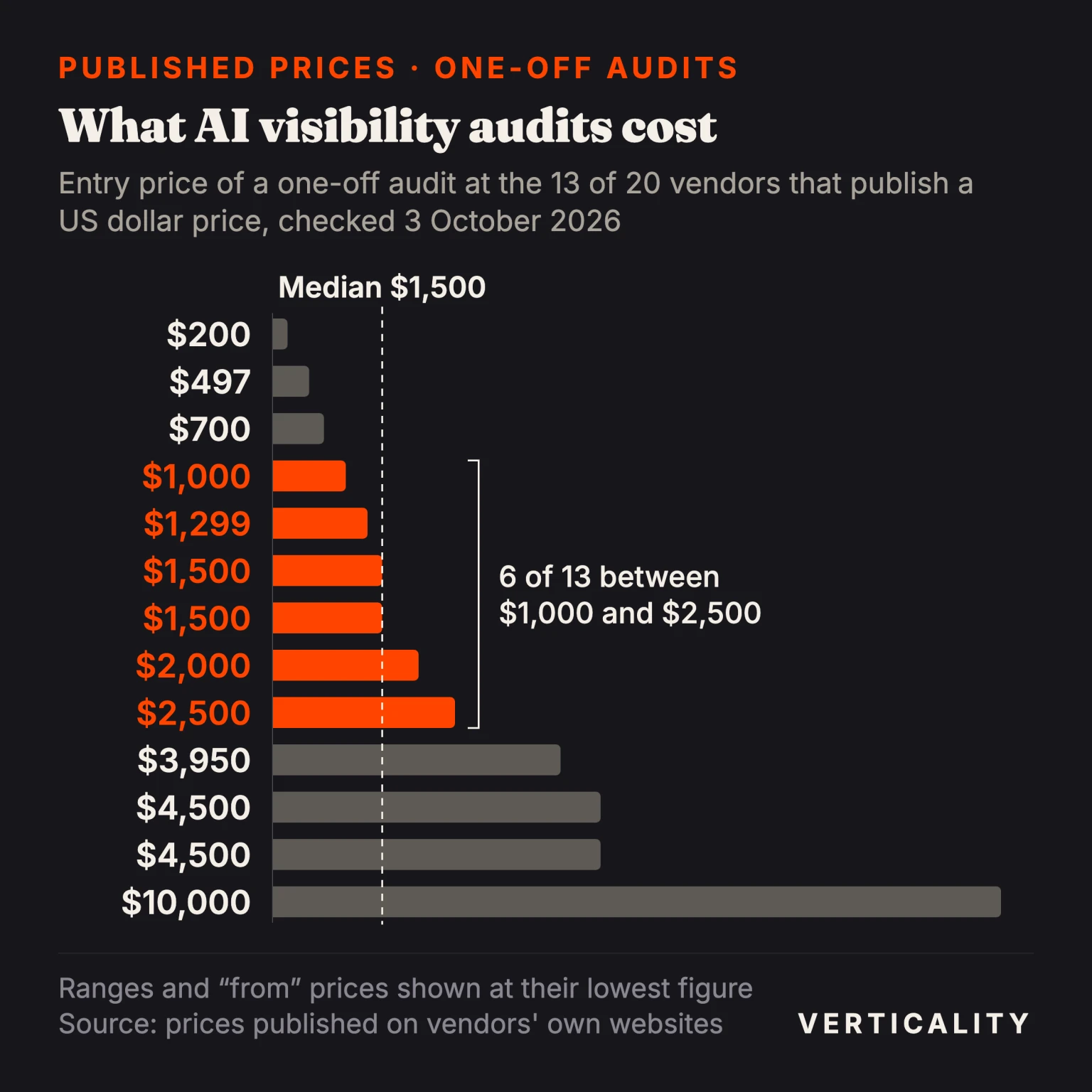
Six of 13 published US prices sit between $1,000 and $2,500; the median is $1,500.
| Tier | Published prices | Typical scope |
|---|---|---|
| Light check | $200 to $700; £300 to £600 in the UK | Up to five engines, a handful of questions or a spot check, a short report, 3 to 10 business days |
| Standard audit | $1,000 to $2,500; £800 to £2,500 | 3 to 5 engines, 15 to 50 questions, competitor comparison, prioritised plan, walkthrough call |
| Deep audit | $3,500 to $5,000 | 4 to 6 engines, repeated runs or 30 days of tracking, 3 to 5 competitors, page-level review, 90-day plan |
| Enterprise | $10,000 in the US; £7,500 and up in the UK; from €9,000 in the EU | Several markets or brands, content deliverables, long strategy sessions |
What moves the price, by the vendors’ own account: the number of questions, the number of engines, how many competitors are benchmarked, how long answers are tracked, site size, the number of markets, and extras such as a 90-day plan or a recheck 30 days later. Many credit the fee against a retainer if you sign within 14 to 60 days. Free audits are common too; most are a sample of 10 to 45 questions or the first step towards a paid engagement. Monitoring software is a separate purchase, published at about $29 to $495 a month for a fixed number of prompts, and it tracks numbers without telling you what to fix.
How do you tell a good AI visibility audit from a weak one?
Three red flags settle most cases: no prompt list, screenshots instead of data, and no source list. The rest of the table follows from those.
| A good audit | A weak audit |
|---|---|
| Lists every question it asked | Says “we tested your brand” and shows no list |
| Names the engines, the dates and the runs per question | One session, engines unnamed or claimed but not queried |
| Delivers the raw answers and sources as data | Shows screenshots of a few answers |
| Ranks every cited URL by how many questions it affects | Advises you to “build authority on high-citation sites” without naming one |
| Keeps mentions, citations and branded questions apart | Reports one “AI visibility score” with no formula |
| Uses a competitor set you agreed before the run | Compares you with whoever happens to appear, including software tools |
| Checks crawler access and index status in Google and Bing | Runs a user-agent test, or skips the technical check |
| Ranks actions by questions moved, with owners and dates | Gives advice that would fit any brand |
| Sticks to what the engines document | Calls llms.txt or a special “AI schema” a requirement, which Google says it is not |
| Promises measurement | Promises a “#1 position in ChatGPT” |
One more check: confirm that the audit queries AI assistants at all. Some products sold under this name are technical SEO crawls, which tell you about your site and nothing about the answers.
Unsolicited audits are a separate case. An email claiming that similarly named competitors outrank you in AI, with a vague score, a small fee and a payment link, is a sales pitch at best and a scam at worst. A real audit starts with your questions and your competitors, not with a verdict someone reached before talking to you.
Is an AI visibility audit the same as an SEO audit?
No, though they overlap. An SEO audit grades your own pages against what Google needs to crawl, index and rank them. An AI visibility audit starts from the answers: it records what the engines say about your category and works back to the pages they relied on, most of which you do not own. The shared ground is technical: crawler access, indexing, rendering and structured data. A site can pass the first audit and still be missing from the answers, because the pages that decide those answers are mostly on other domains.
What happens after the audit?
The plan becomes the work: the on-site fixes first, because they are in your control, then placements in the sources that reach the most questions. In our programmes the first signals show in 4 to 8 weeks and compound by month 3 to 6, as described on how it works; the engine-by-engine view is in how long GEO takes. Re-run the same prompt set on the same engines at least monthly, or the next report will not be comparable with the first.
If you want this report for your brand, our AI visibility audit is free: see what it includes and request one.
Frequently asked questions
What is an AI visibility audit?
An AI visibility audit is a one-off measurement of how AI assistants answer your buyers' questions: how often ChatGPT, Google AI Overviews, Perplexity and similar engines name your brand, which competitors they name instead, which pages they cite as sources, and what to fix first. The output is a report with the questions asked, the answers, the sources and a ranked plan.
How long does an AI visibility audit take?
Most agencies that publish a turnaround deliver in 5 to 14 business days. The range we found on 3 October 2026 ran from 3 business days for a light report to about six weeks for an audit that includes 30 days of tracking. Verticality delivers a baseline report by day 10 and a ranked work plan by day 15.
How much does an AI visibility audit cost?
Published prices on 20 agency and consultant websites, checked on 3 October 2026, ran from $200 to $10,000 for a one-off audit. The median US price was $1,500, the largest group of US prices sat between $1,000 and $2,500, and most UK prices sat between £800 and £2,500. Monitoring software is a separate product at about $29 to $495 a month. Verticality's audit is free.
What do you get at the end of an AI visibility audit?
A workbook and the raw data behind it. Verticality's arrives as one Google Sheet: the verdict per engine, every question with who wins it and what AI cites, the sources ranked by how many questions they feed, Reddit and LinkedIn opportunities, the competitor landscape, the pages to build and a work plan with owners and dates, plus the prompt file and answer log so the audit can be re-run.
Can I run an AI visibility audit myself?
You can run a rough one. Write 20 to 30 questions your buyers ask, put each into ChatGPT, Perplexity and Google on at least three different days, and log who is named and which pages are cited. A manual pass shows where you stand; it cannot show trends or rank sources across hundreds of answers, which is what an audit tool adds.
How often should you repeat an AI visibility audit?
Monthly while you are actively working on AI visibility, which is how often Verticality reports to clients, and at least quarterly after that. Reuse the same prompt file and the same engines each time: a re-audit with different questions measures the new questions, not your progress.
Want your brand named in AI answers?
Our free AI visibility audit asks ChatGPT, Perplexity and Google AI Overviews the questions your buyers ask, shows who gets named instead of you and which sources they cite, and ends with a ranked work plan.
Get a free AI visibility auditNot ready for a call? Run the free AI visibility checker: 40+ buyer questions in ChatGPT and Google AI Overviews, report by email within 24 hours.