Is Generative Engine Optimization Worth It for a Small Brand?
GEO pays for a small brand when buyers ask AI for a shortlist and one customer covers a quarter of work. When it doesn't, what's free, and our own numbers.

COO · AI Search & Data Architecture

Generative engine optimization (GEO) is worth it for a small brand when buyers ask ChatGPT, Perplexity or Google for a shortlist before they buy, when the answers in your category already name companies, and when one new customer is worth more than a quarter of work. If you sell impulse purchases, serve walk-in local customers or cannot change your own pages, do not pay for GEO yet: do the free basics below and stop there.
We ran the same test on our own site. verticality.co is a small agency site. On 3 September 2026 ChatGPT, Perplexity and Google AI Overviews named it in 0 of 333 answers to the buying questions we track. A month later ChatGPT names it in 9 or 10 of 111 answers a day, and Google AI Overviews still almost never does. The numbers are further down.
When does GEO pay off for a small brand?
Three questions decide it. Each takes an afternoon to answer.
- Do AI answers in your category name companies? Ask ChatGPT, Perplexity and Google ten to twenty questions your buyers ask before they buy: “best X for Y”, “X vs Y”, “who does X for a company like mine”. Our free AI visibility checker runs 40+ such questions through ChatGPT and Google AI Overviews for you. If the answers list vendors, there is a shortlist to get onto. In our own category, marketing services, ChatGPT named at least one tracked vendor in 54.9% of its answers to 56 buying questions about AI search (20 daily runs, 4–23 September 2026). If the answers are general advice with no names, being cited buys you less.
- Is the purchase considered? B2B services, software, high-ticket products and regulated services are researched over days or weeks, with follow-up questions. Those conversations now happen inside AI assistants, and the brand named in the answer gets the first call.
- Does one customer pay for a quarter? GEO is slow money: our published timeline is first signals in 4–8 weeks and compounding by month 3–6 (how it works). If a customer is worth $20,000 a year, one or two new ones in a quarter pay for a programme. If a customer is worth $50, you would need hundreds of AI-sourced buyers before the work breaks even.
Three yeses: GEO is worth paying for. Two: do the free work below and measure for a quarter before spending. One or none: do the free basics and put the budget into other channels.
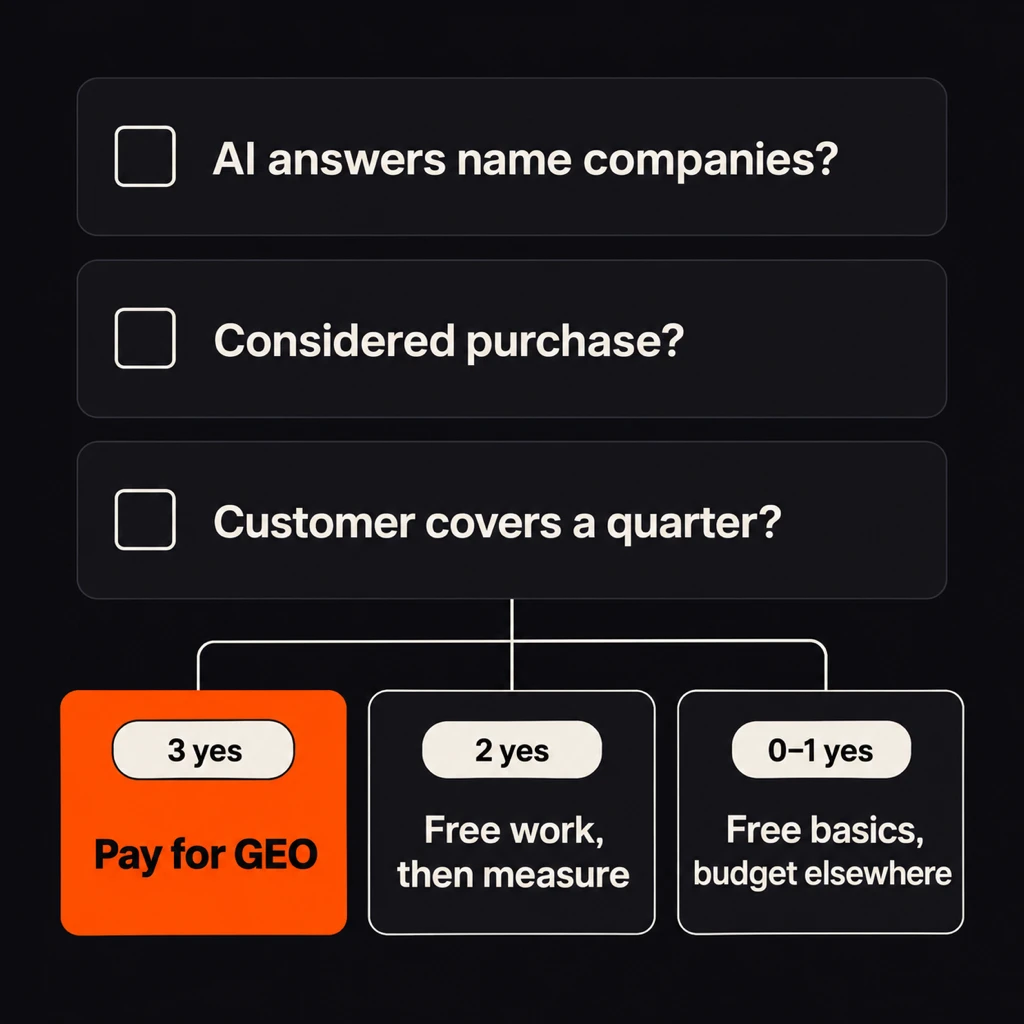
Three yeses: pay for GEO. Two: do the free work and measure. One or none: spend elsewhere.
Is GEO worth it for your kind of small business?
| Small business | How its buyers decide | Our call |
|---|---|---|
| B2B service or software | Compare vendors over weeks, ask “who does X for a company like mine” | Worth a quarter of paid work once the free basics are done |
| High-ticket consumer product | Research “best X for Y” and “X vs Y” before buying | Run the three questions; product facts and reviews first |
| Low-price or impulse e-commerce | Decide in the moment, on a marketplace or from an ad | Free basics only; ads and marketplaces do more per dollar |
| Walk-in local business | Pick from the map, by distance and reviews | Business Profile and reviews (local SEO), not a GEO programme |
When is GEO not worth it?
- Impulse and low-price purchases. A decision made in seconds rarely starts with a question to an AI assistant. The shelf, the marketplace and the ad win those sales.
- Walk-in local businesses. A café, a salon or a dental practice is chosen on Google Maps. Google says local results are “mainly based on relevance, distance, and popularity” and that more reviews and positive ratings can help (Google Business Profile Help). The lever there is the Business Profile and its reviews, which is local SEO, not a GEO programme.
- No one can change the site. GEO is mostly page work and earned mentions. Paying someone to measure answers you cannot act on changes nothing.
- Pages that Google does not index. To appear in Google’s AI features, a page must be indexed and eligible to be shown with a snippet, and Google adds that optimizing for its generative AI search is “thus still SEO” (Google Search Central). Until your pages are indexed, the problem is SEO; GEO vs SEO sets out where one ends and the other starts.
- You need Google AI Overviews in the next quarter and rank nowhere. Google says its generative AI features are rooted in its core ranking and quality systems, so Overviews lean on pages that already rank. Our own data below: in the month when ChatGPT named us in 156 answers, Google AI Overviews named us in 3.
What can a small brand do for free?
Five things need no agency and no paid tool, only a day or two of someone’s time.
- Let the AI crawlers in. Check
robots.txtand your CDN or firewall settings for OpenAI’s OAI-SearchBot and the other AI search crawlers. OpenAI says sites that opt out of OAI-SearchBot will not be shown in ChatGPT search answers (OpenAI crawlers). We found the same block on verticality.co: a CDN setting answered 403 to Claude’s and Perplexity’s fetchers until the afternoon of 3 September 2026. - Put the facts on the page as sentences an engine can lift. What you sell, for whom, where, from what price, how long it takes. AI answers repeat those lines almost word for word. On 23 September 2026 ChatGPT described us as an agency “with pricing published from $2,500/month”, taken from our GEO page.
- Get into Bing. Submit your sitemap in Bing Webmaster Tools and send new URLs through IndexNow; both are free, and Bing says it powers AI tools including ChatGPT (Bing Webmaster blog). Two of our pages that Bing had discovered but not crawled, /aeo-agency/ and /llm-seo-agency/, had not been cited by ChatGPT a week after launch; the GEO page, which Bing had indexed, was cited five days after it went live.
- Collect reviews and fill in third-party profiles. Review sites, directories and your Google Business Profile are where engines check what others say about you. OpenAI says ChatGPT may weigh price and reviews when it picks products, and that its review summaries come from public websites (OpenAI Help).
- Measure with free tools before you buy any. Once a month, ask twenty buyer questions on three engines and log who is named and which pages are cited. Then open three free reports: the Generative AI performance report in Google Search Console, which shows impressions in AI Overviews and AI Mode but no clicks (Search Console Help); AI Performance in Bing Webmaster Tools, which counts citations in Copilot; and visits tagged
utm_source=chatgpt.comin Google Analytics, a parameter ChatGPT adds to its links. The full method is in how to measure AI visibility.
What needs a budget, and what does it cost?
Three parts of GEO cost money.
- Tracking that shows a trend. A single check is noise. ChatGPT re-cited only 26.4% of the same URLs for the same question the next day in our September data, so one screenshot says little. Daily runs over 50–200 questions show whether you are moving.
- Rewriting the pages that decide the answer. The pages that answer “who should I hire” and “how much does it cost” need extractable facts, prices and scope, page by page.
- Earning mentions where the engines read. Roundups, directories, review sites and community threads. This is the slowest part and the one a small team rarely has time for. It is also where most citations go: a June 2026 preprint from Ranqo, a tracking vendor, found that only 2.9% of citations in its customers’ AI answers pointed at the brand’s own domain (arXiv 2606.20065). The answers to one question we track, “Is AI visibility optimization worth investing in for a small brand?”, cited 262 different sources in 30 days.
Our GEO programme costs $2,500–$7,500 a month, month-to-month, with no minimum term (what is included).
Nobody can promise a return in advance. A July 2026 review of 45 GEO studies concluded that claims about GEO return on investment “clearly outstrip the academic evidence” (arXiv 2607.14035), and OpenAI says placement in ChatGPT search is not guaranteed (OpenAI Help). So work from your own numbers.
A simple break-even rule: multiply the monthly fee by three, then divide by the gross profit of one new customer. The result is how many AI-sourced customers you need in the first quarter. At $2,500 a month and $10,000 of first-year gross profit per customer, that is fewer than one. At $500 per customer it is fifteen, which a channel that is still producing its first signals is unlikely to deliver.
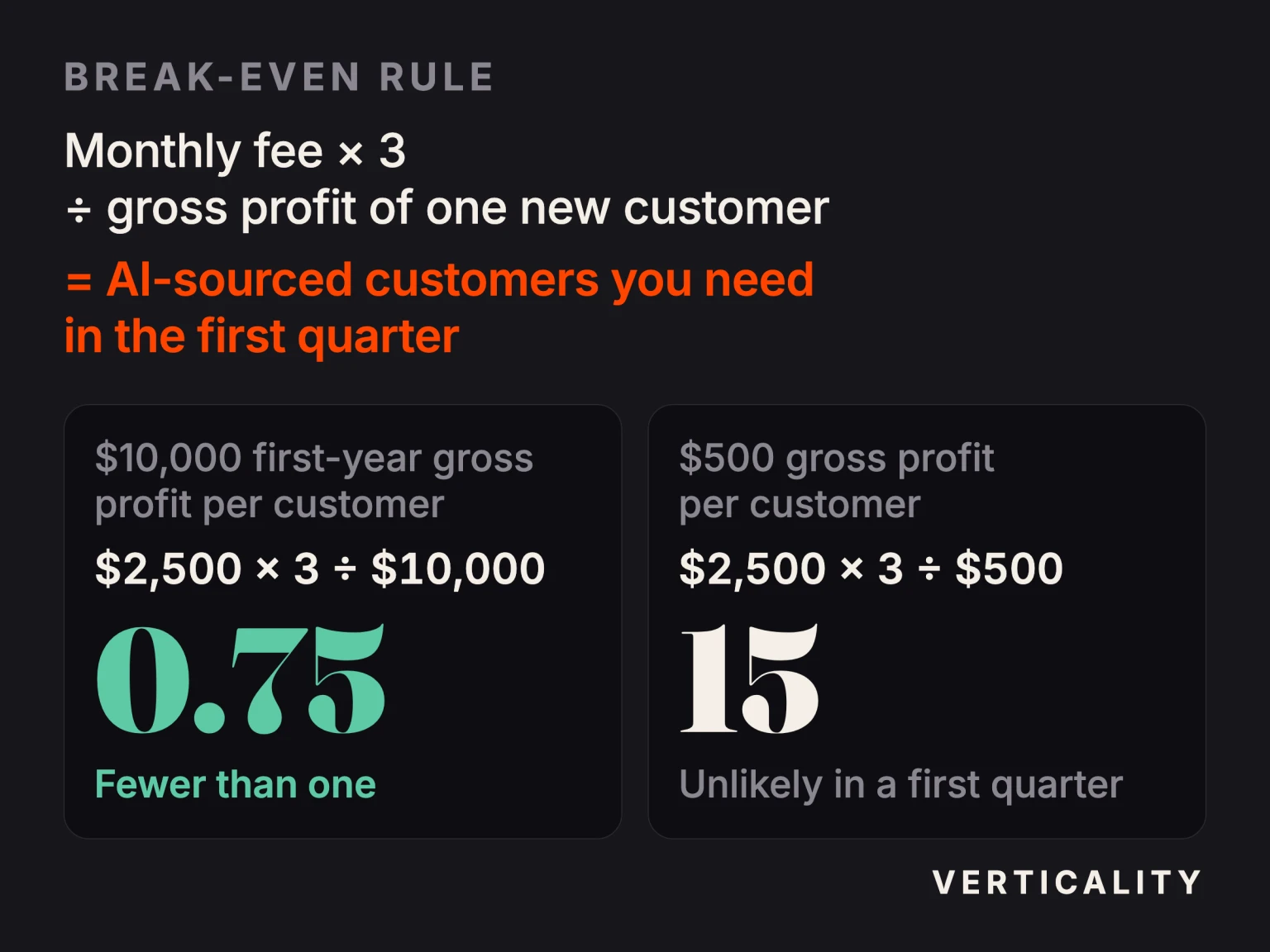
At $2,500 a month, one customer with $10,000 of gross profit covers the quarter; at $500 each you would need fifteen.
What happened when we tried it on our own small site?
verticality.co is a small agency site with almost no Google footprint. We track 111 non-branded buying questions a day on ChatGPT, Perplexity and Google AI Overviews with our own tracker, ai.verticality.co.
| Date (2026) | What changed | ChatGPT | Perplexity | Google AI Overviews |
|---|---|---|---|---|
| 3 Sep | AI crawler block removed; Reddit marketing page goes live with a fact list and a price | 0 / 111 | 0 / 111 | 0 / 111 |
| 7 Sep | First mention | 4 / 111 | 1 / 111 | 0 / 111 |
| 15 Sep | GEO service page goes live | 6 / 111 | 2 / 111 | 0 / 111 |
| 20 Sep | ChatGPT starts citing the GEO page | 7 / 111 | 2 / 111 | 0 / 111 |
| 2 Oct | — | 10 / 111 | 2 / 111 | 0 / 111 |
| 3 Oct | — | 9 / 111 | 2 / 111 | 1 / 111 |
Over the 30 days to 3 October, ChatGPT named us in 156 of 3,108 answers (5.0%), Perplexity in 57 of 3,219 (1.8%) and Google AI Overviews in 3 of 3,219. That is a normal starting point for a small brand: Ranqo’s preprint measured niche and small brands in 11% of relevant answers on their first run, against 73% for global household names, and 9.9% on ChatGPT (arXiv 2606.20065).
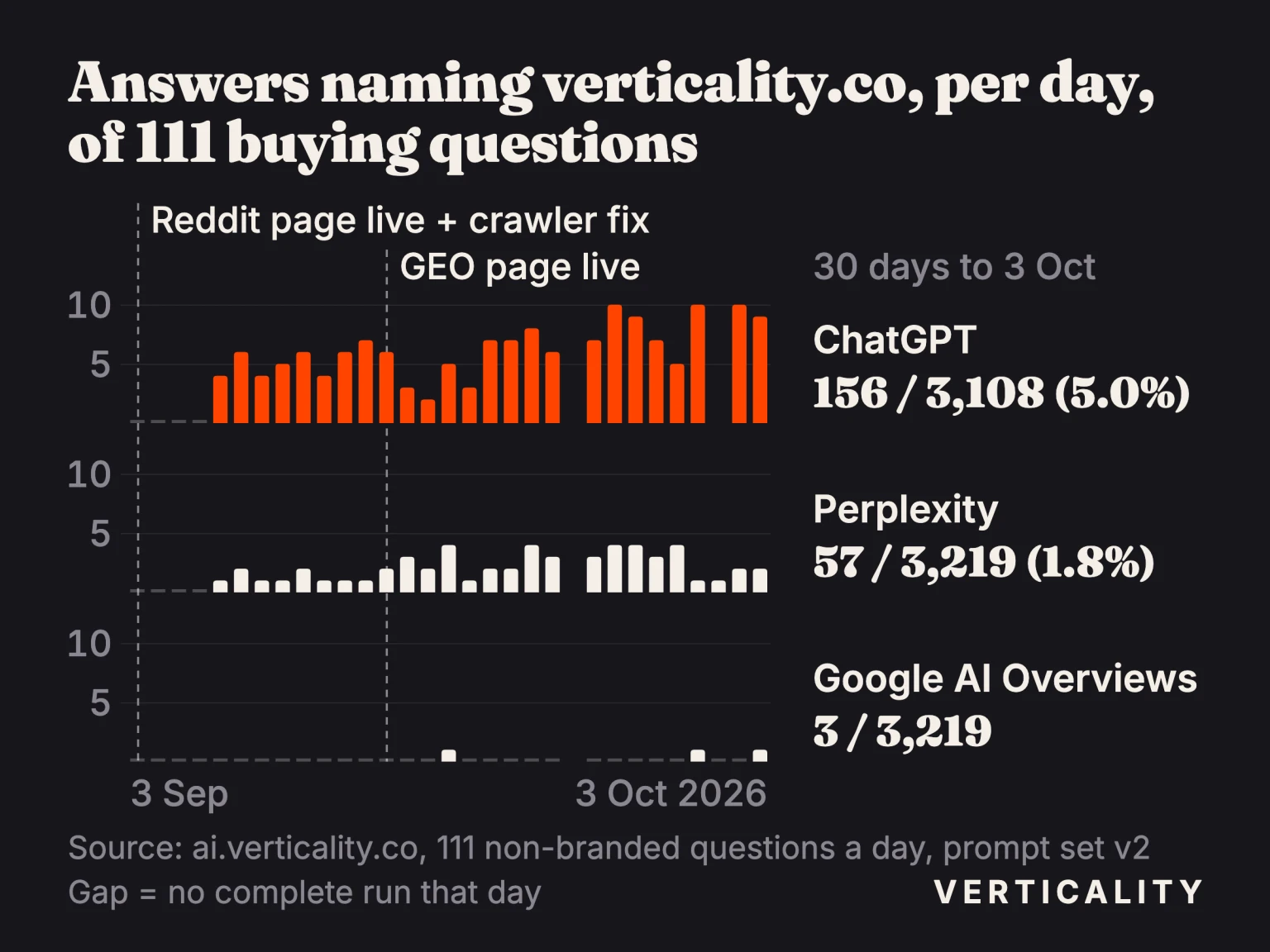
Same site, same month: ChatGPT moved within days, Google AI Overviews barely moved.
Three things stood out.
- ChatGPT moved first, and fast. The first mention came four days after the crawler fix. The pages it cites are the ones that state a scope and a price: the Reddit marketing page in about 190 answers, the GEO page in 50.
- Google AI Overviews barely moved. From 3 to 29 September, Google Search Console shows 24 clicks and an average position of 33 for the whole site. With so little organic presence, Overviews had almost nothing of ours to draw on, and they were the last engine to change.
- ChatGPT sent more visits than Google. From 3 September to 2 October, Google Analytics recorded 58 visits from chatgpt.com and 38 from Google organic search, after we removed our own office traffic and a burst of 49 bot-like sessions.
What it did not change: the answers to general questions. The question this guide answers is in our tracked set, and in 86 answers over 30 days no engine named us. The answers talk about platforms and tracking tools rather than recommend someone to hire; ChatGPT builds them from OpenAI and Google documentation and research papers, Perplexity from vendor blogs.
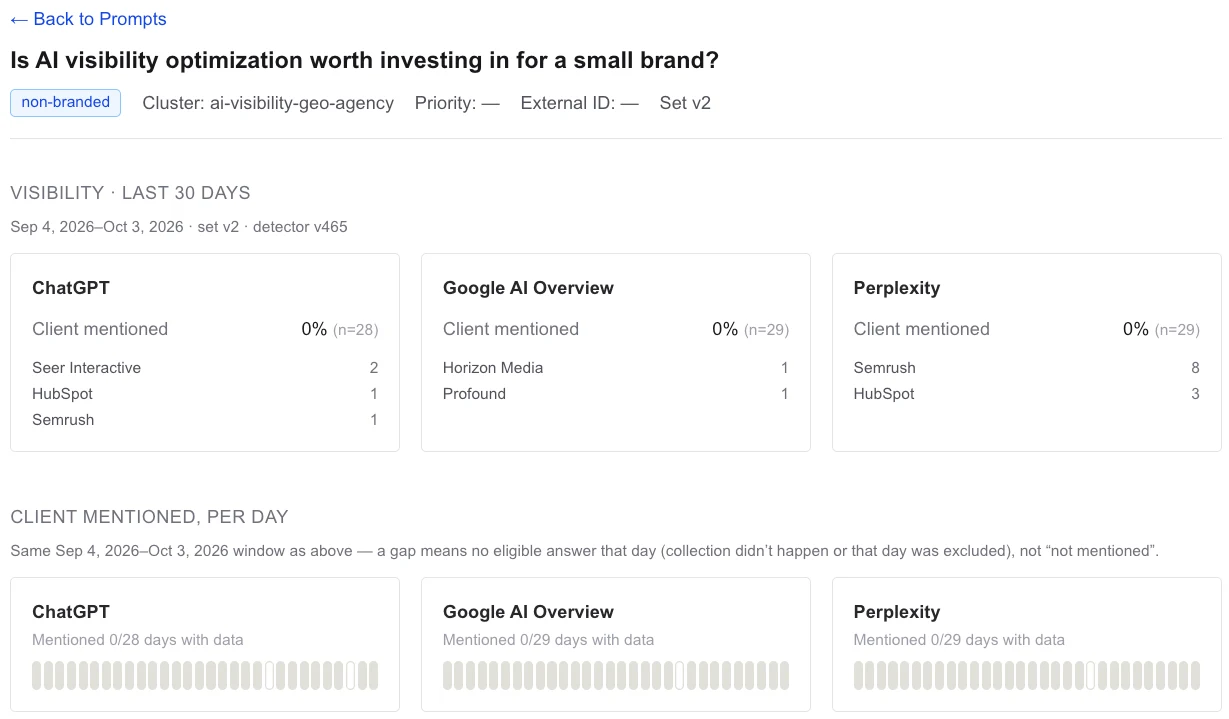
The question this guide answers: 86 AI answers in 30 days, and none named us.
How do you decide after one quarter?
Write the rule down before you start, so the review is not a matter of mood.
- Keep going if your mention rate rose on at least one engine, AI referrals show up in analytics with engaged sessions, and the cited pages are your own or roundups you are in.
- Change the plan if mentions rose but visits did not. The engine names you without a reason to click: check which page it cites and whether the next step is on that page.
- Stop if after 90 days every engine still names no one in your category, or names the same large brands on every question you care about.
Month-to-month terms matter here. A small brand should be able to stop at the review without paying out a contract.
Not sure which side of the line you are on?
The audit answers it with your own data: your mention rate on each engine across your buyers’ questions, the companies named instead of you, and the pages and threads that decide those answers. It takes the first two weeks of our GEO programme and costs nothing. If it shows GEO is not worth it for you yet, it says so.
Frequently asked questions
Is GEO worth it for a small business?
Generative engine optimization is worth paying for when a small business sells a considered purchase, its buyers ask ChatGPT, Perplexity or Google for a shortlist, and one new customer is worth more than a quarter of the work. For impulse purchases and walk-in local businesses it rarely pays; those businesses should do the free basics, such as crawler access, clear facts on their pages and reviews, and spend the rest elsewhere.
How much does GEO cost for a small brand?
The basics cost nothing but time: allowing AI crawlers, stating prices and facts on your own pages, submitting the site to Bing and collecting reviews. Paid work covers daily tracking, page rewrites and earned mentions in roundups, directories and threads. Verticality's GEO programme costs $2,500–$7,500 a month, month-to-month.
Can a small brand get named by ChatGPT before it ranks on Google?
Yes. verticality.co was named in 0 of 111 tracked ChatGPT answers on 3 September 2026 and in 9–10 of 111 a day by early October, while its Google pages averaged position 33 and earned 24 clicks from 3 to 29 September. Google AI Overviews moved far less over the same period: 3 of 3,219 answers named the site.
How long does a small brand wait to see if GEO works?
Verticality publishes a timeline of first signals in 4–8 weeks and compounding by month 3–6. Review the decision after one quarter: keep going if your mention rate rose on at least one engine and AI referrals show up in analytics, stop if every engine still names no one in your category.
Should a small brand do SEO or GEO first?
Google says optimizing for its generative AI search is still SEO, and a page must be indexed and eligible for a snippet to appear in AI Overviews or AI Mode. If your pages are not indexed, SEO comes first. If they are indexed but you are absent from AI answers, the first GEO steps are free and overlap with SEO: crawler access, extractable facts, Bing and reviews.
Want your brand named in AI answers?
Our free AI visibility audit asks ChatGPT, Perplexity and Google AI Overviews the questions your buyers ask, shows who gets named instead of you and which sources they cite, and ends with a ranked work plan.
Get a free AI visibility auditNot ready for a call? Run the free AI visibility checker: 40+ buyer questions in ChatGPT and Google AI Overviews, report by email within 24 hours.