
To get ChatGPT to recommend your business, make sure it can read your site, then get your business named in the sources it uses for your buyers’ questions. You can’t pay for a place in the answer and there is no form to submit. Work in this order: test ten buyer questions, open the door to OpenAI’s crawler, publish a page per service, put your proof in plain text, fix the listings that matter for your type of business, get named on the lists ChatGPT reads, then retest. The fifth step is where most advice goes wrong, because a clinic, an online store and a software company need different listings.
The data in this guide comes from our tracker, which asks AI engines the same buying questions every day. We read 9,493 ChatGPT answers that named at least one vendor, across six businesses, from 5 October to 3 November 2026: two local firms, one online store, one B2B software company, one B2B service and one wealth manager. OpenAI’s and Google’s documentation was checked on 4 November 2026.
How does ChatGPT recommend businesses?
ChatGPT searches, reads what comes back, and names the businesses those pages support. OpenAI doesn’t publish a ranking formula. It says only that ChatGPT ranks results “using multiple factors intended to help users find relevant, reliable information” and that “Placement is not guaranteed” (OpenAI).
Three details in that page shape your plan:
- Your buyer’s words get rewritten. Asked for “good restaurants near me” by someone in San Francisco, ChatGPT “may rewrite your prompt into the search query ‘top restaurants San Francisco.’” Pages that say what you do and where will match those searches. A clever tagline won’t.
- Location comes from the person asking. ChatGPT estimates it from the IP address, or uses device location if the person shares it. You can’t set a service area inside ChatGPT, so your pages have to state it.
- Local answers can use outside listings. ChatGPT “may share your location with trusted third-party providers that help provide more local information, such as nearby business listings.” OpenAI doesn’t name the providers for business listings.
Why one business gets picked over another is its own question, and we cover it in why AI recommends competitors instead of your brand. This page is the plan.
Can you pay or apply to get on ChatGPT?
No to both, for an ordinary business. OpenAI says: “Ads do not influence ChatGPT’s answers. Ads run on separate systems from our chat model, and advertisers have no ability to shape, rank, or alter ChatGPT’s responses” (OpenAI). An ad can sit below an answer, labelled as an ad. It won’t put you in the answer. There is no business directory to join either.
The one real application is for online stores. OpenAI invites merchants to “share your product feed” (OpenAI), and step 5 below shows how visible that is in the answers we track.
What are the seven steps, in order?
Each step depends on the one before it. Steps 1 and 2 take days, steps 3 to 5 take weeks, and step 6 runs for months.
| Step | What you do | You’ve finished when |
|---|---|---|
| 1. Baseline | Ask 10 buyer questions on 3 different days | You have a log of who gets named and which pages get cited |
| 2. Access | Allow OAI-SearchBot through robots.txt and your CDN | Your server or CDN log shows the crawler getting a 200 |
| 3. Service pages | One page per service, in your buyers’ words | Each page says what, who for and where in the first lines |
| 4. Proof | Price, results and credentials as plain text | You can find them with JavaScript turned off |
| 5. Listings | The ones that matter for your business type | Name, category, hours and URL match your site |
| 6. Mentions | Get named on the lists and pages cited for your questions | You appear on the most-cited ones, described correctly |
| 7. Retest | Same questions, same log, four weeks later | You can see which questions moved |
1. Get a baseline before you change anything
Write ten questions the way a buyer would ask them, including your city or niche if it matters, and ask each one in a new chat on three different days. Log who is named and every link under the answer.
Three days is the minimum, because a single answer says very little. Across the six businesses, 30.5% of brand-and-question pairs that ChatGPT named at all were named on just one day of the 30. Only 20.4% were named on more than half of the days. If a competitor shows up once, it may be gone tomorrow. The full measurement method is in a separate guide.
2. Let OpenAI’s crawler in
OpenAI’s condition is short: allow OAI-SearchBot and confirm that your host or CDN lets its published IP addresses through. A site that blocks it “will not be shown in ChatGPT search answers” (OpenAI). GPTBot is a different crawler, used for training, so check the right name. The CDN settings that trip people up, and how to prove the real crawler gets through, are in how to get cited by ChatGPT.
3. Give each service its own page
Do this before you write a single blog post. Among 19,704 ChatGPT citations of named vendors’ own sites, about 54% went to service or product pages, 28% to home pages and 18% to articles. When one of the five businesses we track was named in the text of a ChatGPT answer, its own page was cited in the same answer 82% of the time (1,717 of 2,098). That is a correlation, but it tells you which page has to exist.
Each page should open by saying what you do, who it’s for and where you do it, in the words buyers use. Then add what a shortlist needs: price or how pricing works, typical clients, and how to start. If you serve five cities or sell four services, a page for each is fine as long as each one says something true and specific. Google warns that producing a page for every query variation, mainly to influence its AI answers, “violates Google’s scaled content abuse spam policy” (Google).
4. Put your proof in plain text
ChatGPT can only repeat what it can read. Star ratings inside a widget, prices in a PDF and results in a slider don’t help you. Write them out: “4.8 stars from 212 reviews on Google, October 2026”, “from $900 a month”, “licensed in Ontario since 2014”. Use your own numbers, in sentences that still make sense when lifted alone. Which traits make a passage quotable is covered in our ChatGPT citation guide.
5. Fix the listings for your type of business
This is the step that changes most by business type. The next section covers each one.
6. Get named on the pages ChatGPT reads
Take the links from your step 1 log and count how many of your questions each one appears under. Start with the page that appears most. Send its publisher what an editor needs: one line on what you do, who it’s for, your price and one result with a source. Ask for corrections where you’re described wrongly.
Your own fair comparison page can work too, particularly in small categories. For the local service we track, 43% of the “best X” citations ChatGPT gave went to lists published by companies in that category, and for the B2B service it was 64%. For the online store it was under 2%, because publishers such as Bob Vila and HGTV hold those lists. Check who owns the lists in your category before you choose. How to approach a list is in the roundups section of the diagnosis guide.
7. Retest the same questions
Run the same ten questions four weeks later, on three days, and compare the logs. Note what you changed and when, so you can tell a result from noise. Our GEO programme plans for first signals in 2–6 weeks and citations compounding by month 3–6. Crawler fixes register faster: OpenAI says a robots.txt change takes about 24 hours.
What changes for your type of business?
The sources under ChatGPT’s answers differ a lot by business. Each row below is the share of ChatGPT answers naming a vendor that cited at least one source of that type, for one business we track, from 5 October to 3 November 2026.
| Business | Named vendors’ sites | ”Best X” lists | Google Maps page | Yelp |
|---|---|---|---|---|
| Local service, one city | 49.9% | 36.8% | 13.7% | 6.9% |
| Clinic, one region | 68.2% | 0.0% | 22.4% | 3.8% |
| Online store | 80.4% | 48.8% | 0.2% | 0.1% |
| B2B software | 38.4% | 32.8% | 0.0% | 0.0% |
| B2B service | 84.0% | 42.3% | 8.4% | 1.2% |
| Wealth manager | 36.5% | 32.5% | 2.4% | 0.7% |
Each row rests on 575 to 2,494 answers. Six businesses are examples, not a census, and “named vendors” covers only the brands in each tracker’s dictionary, so the real share of vendor sites is higher. Use the table to decide what to check first, then confirm it against your own step 1 log.
Local businesses: Google Maps and Yelp, then your own pages
ChatGPT does link Google Maps place pages on local questions, far more than other engines do. For the clinic, 22.4% of its answers naming a vendor cited one; for the local service, 13.7%. The clinic’s category has almost no “best X” lists, so its own pages and Maps carry most of the weight. Perplexity almost never did, and Google’s AI Overviews did in 11.1% and 1.3%. The rate moves around: for the clinic it ran from 9% to 33% week to week, so don’t plan around any single figure.
A link doesn’t prove your rating decides the answer. OpenAI doesn’t name Google as a listing source, and several ranking guides calling Google Business Profile “heavily weighted” offer no measurement. What we can say is narrower: the place page is one of the things ChatGPT shows as a source, so an empty or wrong one is a cost you can remove in an afternoon. Google separately says Business Profiles “can help your products and services to be visible” in its own AI responses (Google).
Yelp is the new one to watch. Yelp told investors in August 2026 that its “ratings and reviews recently began powering ChatGPT’s local experience in relevant categories” (Yelp, SEC filing). In our tracker ChatGPT linked no Yelp pages from 4 September to 2 October. In the window for this guide they appear from 8 October, and all 376 Yelp links we logged carry feed parameters naming OpenAI (adjust_creative=openai, utm_campaign=yelp_feed), which points to a licensed feed rather than a crawl. Yelp limits this to “relevant categories” and doesn’t list them, so claim your page even if your customers don’t use Yelp much.
So for a local business: correct the Google and Yelp listings (name, category, hours, phone, website), make sure the website they point to has a page per service, and name your city on it.
Online stores: product feed and retailers
ChatGPT showed product cards in 68.2% of the store’s answers naming a vendor, and 46.4% of them included a link tagged openai_catalog, which appears to mark products from a feed. OpenAI says product results are “selected independently by ChatGPT and are not ads” and draw on “structured metadata from first-party and third-party providers” (OpenAI). So share your feed and keep price and availability correct.
Big retailers and marketplaces appeared in 80.7% of those answers; Home Depot, Walmart, Wayfair and Lowe’s were the most cited for this garden retailer’s category. If your products are also sold through retailers, those listings speak for you, so keep their titles and descriptions as accurate as your own. Feeds, schema and reviews for stores are covered in how to get an e-commerce brand cited by AI.
B2B software: public docs and comparison pages
For the software company, 74.0% of ChatGPT answers naming a vendor cited a docs or help page, and app marketplaces such as Salesforce AppExchange also appeared. Buyers ask how a tool works with their setup, and documentation answers that better than a marketing page. Keep docs public and crawlable, and write up integrations and limits in plain language. Maps and Yelp didn’t appear at all for this business, so skip them. More on page structure is in how SaaS pages get cited by AI.
Professional and B2B services: records, then lists
For the wealth manager, ChatGPT cited regulator records in 39.3% of answers naming a vendor, mostly the SEC’s adviser database. If your profession has a public register, that entry is part of your AI profile, so check it reads correctly. Lists came from publishers such as WSJ and NerdWallet, which are hard to get onto, so start with smaller ones cited for your questions.
The B2B service shows the opposite picture: named vendors’ sites appeared in 84.0% of answers and most of the lists were written by vendors. In a category like that, a well-built service page and an honest comparison page go a long way.
Does the same plan get you recommended by other AI assistants?
Mostly, yes, but steps 5 and 6 point somewhere else. Perplexity leans on lists: 61.4% of its answers naming a vendor cited one, against 34.6% for ChatGPT. Google’s AI Overviews pull in formats ChatGPT almost ignores: video in 26.0% of answers, Reddit and forums in 16.5%, and social posts in 16.2%.
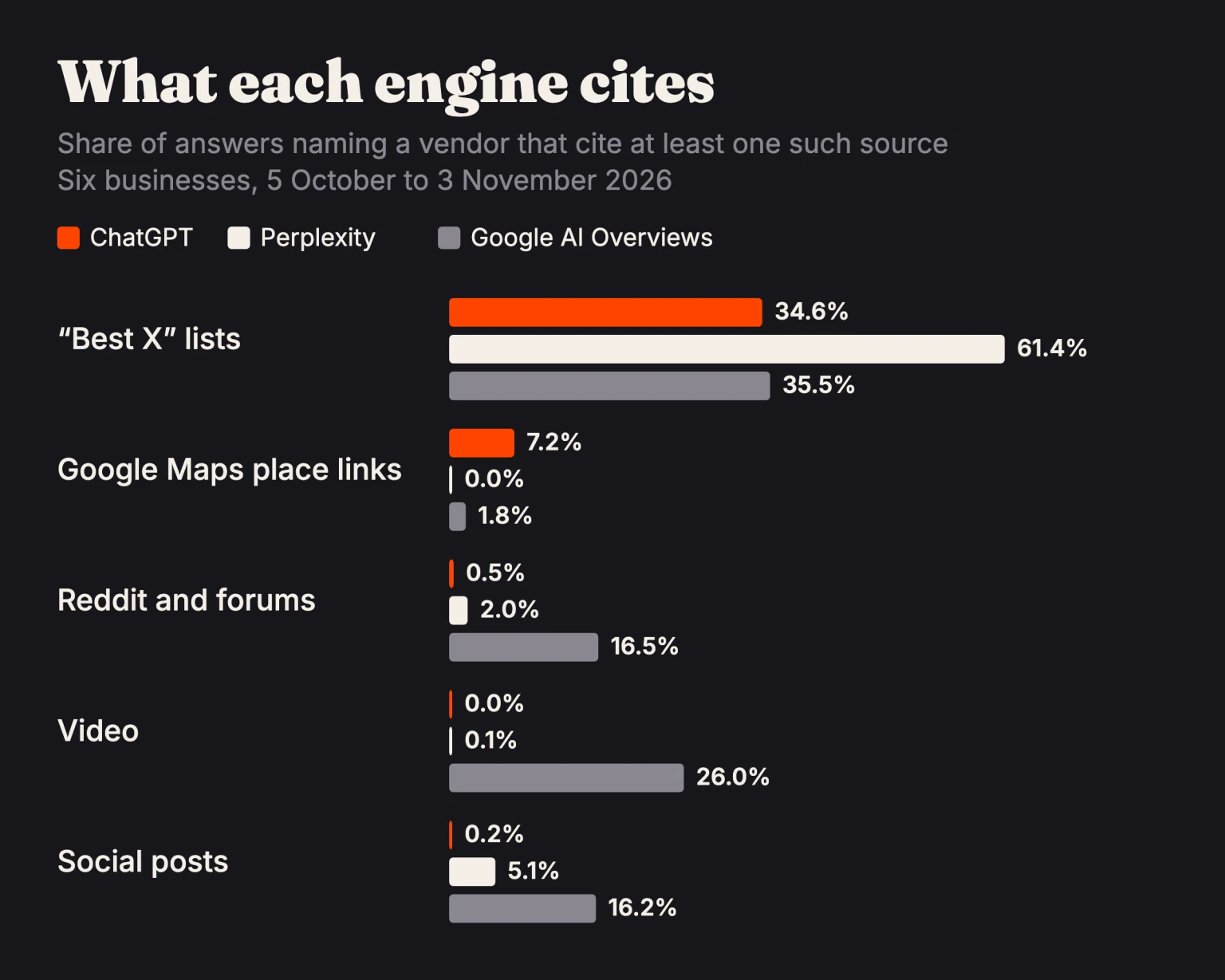
The same six businesses, three different source mixes. Pooled figures, with the online store’s Perplexity answers collected weekly rather than daily.
So to get recommended by AI generally, do steps 1 to 4 once, because they apply everywhere. Then split step 6 by engine: lists for Perplexity, and video and communities for Google. If Reddit threads show up in your Google and Perplexity sources, Reddit marketing is the channel to look at. The engine-by-engine detail is in the GEO checklist, how to change what Perplexity cites and the Google AI Overviews guide.
What doesn’t work?
These come up in most advice on this topic, and none of them will carry you:
- Asking ChatGPT about yourself, or asking customers to. OpenAI describes memory as something it may use when rewriting that same person’s search, for example a saved city. Nothing in its documentation says your chats change what other people are told.
- An llms.txt file. Google says plainly that Google Search “ignores” these files. OpenAI’s stated conditions for appearing in ChatGPT search don’t include one either. It’s harmless, but it isn’t a step.
- Review or AggregateRating schema on your own site. Markup doesn’t carry your Google or G2 reviews into ChatGPT, and Google’s own rules bar star snippets for reviews a business controls about itself. The details are in our reviews guide.
- Buying mentions. Google says “seeking inauthentic ‘mentions’ across the web isn’t as helpful as it might seem”, and its systems block spam.
- Publishing lots of thin blog posts. Articles were the smallest group of vendor-site citations, about 18%. A clear service page comes first.
If ChatGPT is saying something wrong about you, that’s a separate job, covered in how to correct what ChatGPT says about your brand.
Want this plan run for your business?
The free AI visibility audit that opens our GEO programme does steps 1 and 2 for you and turns the rest into a ranked work plan: your buyers’ questions, who gets named, the pages cited instead of yours, and which listings matter for your type of business. For a quicker first read, the free AI visibility checker asks 40+ buyer questions in ChatGPT and Google AI Overviews and emails your mention rate per engine within 24 hours.